Edexcel IGCSE Biology 復習筆記 2.8.2 Transport Systems in Flowering Plants

Edexcel IGCSE Biology 復習筆記 2.8.2 Transport Systems in Flowering Plants
Xylem
- The?roots,?stem?and?leaves?form a plant organ system for the transport of substances around the plant
- Plants also possess two specialist?transport vessels?called the?xylem?and?phloem
- The xylem and phloem are arranged throughout the root, stem and leaves in groups called?vascular bundles
Structure and function of the xylem
- Xylem vessels transport?water and minerals?(pronounced: zi-lem)?from the roots to the stem and leaves
- The xylem has some key?structural features
- It is composed of?dead cells?which form?hollow tubes
- Xylem cells are?strengthened by lignin?and so are adapted for the transport of water in the transpiration stream
Phloem
Structure and function of the phloem
- Phloem vessels?transport food materials (mainly?sucrose and amino acids) made by the plant from photosynthesising leaves to non-photosynthesising regions in the roots and stem (pronounced: flow-em)
- This means that movement can be in any direction around the plant
- The phloem has?structural features?different to the xylem
- The cells are?living cells?and are not hollow
- Substances move from cell to cell through?pores?in the end walls of each cell
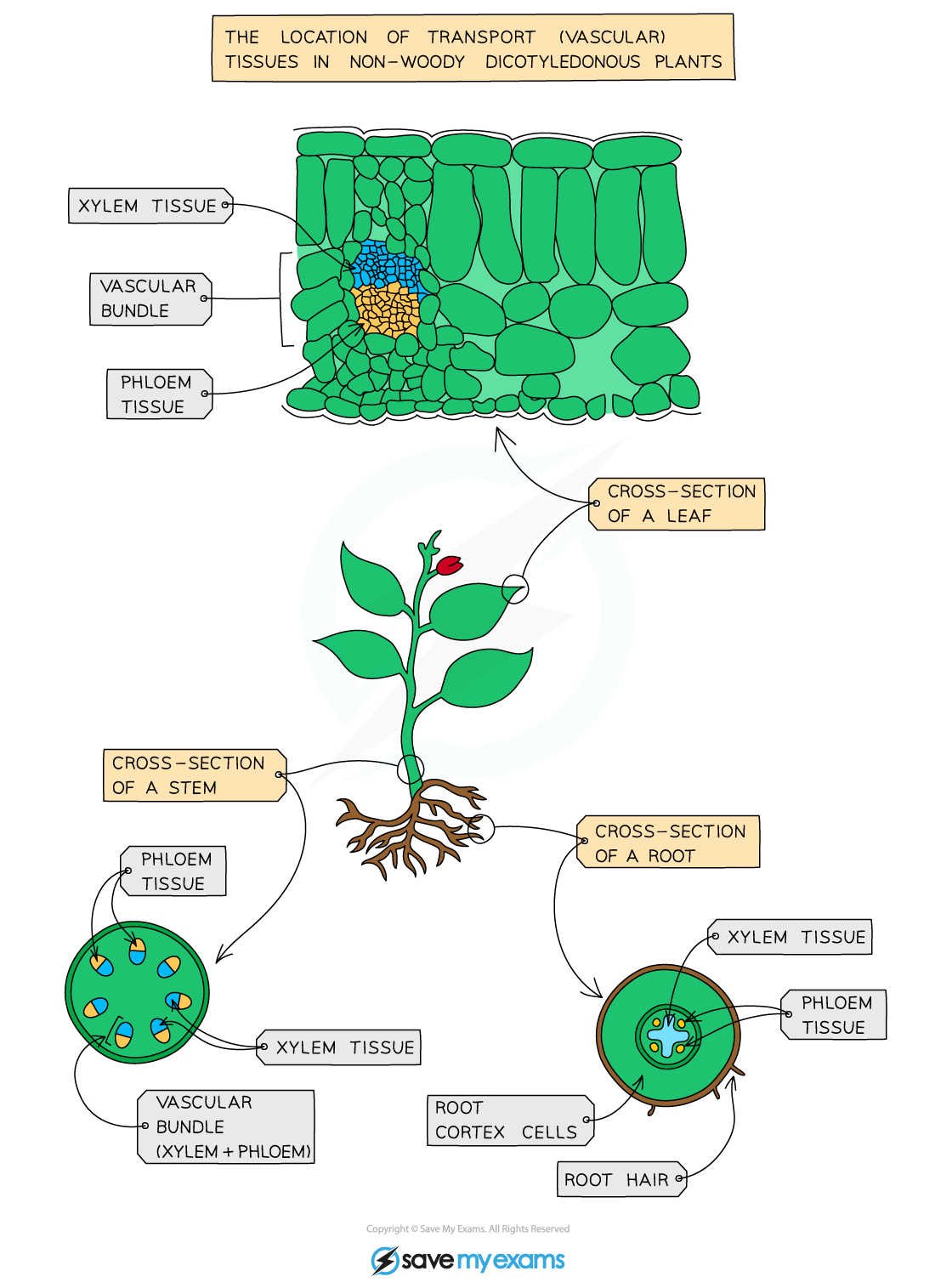
The position of the xylem and phloem in the stem compared to the root
Exam Tip
If you are asked to identify the xylem or phloem in a diagram showing a cross-section of a root, stem or leaf just remember that?xylem is always on the inside and phloem is always on the outside.
轉載自savemyexam
以上就是關于【Edexcel IGCSE Biology 復習筆記 2.8.2 Transport Systems in Flowering Plants】的解答,如需了解學校/賽事/課程動態,可至翰林教育官網獲取更多信息。
往期文章閱讀推薦:
IGCSE全A*,A-Level階段卻崩了?別忽視IGCSE選課的重要性!
2026 CAIE IGCSE 夏季大考放榜!A* 線全面揭曉,今年真的卷到新高度?


翰林AMC8視頻課重磅上線!

國際競賽真題資源免費領取






