【每日一題】AP 生物 20180126

AP Biology精編
During the industrial revolution, a major change was observed in many insect species due to the mass production and deposition of ash and soot around cities and factories. One of the most famous instances was within the spotted moth populations.
An ecological survey was performed where the number of spotted moths and longtail moths were counted in 8 different urban settings over a square kilometer in 1802. A repeat experiment was performed 100 years later in 1902. The results of the experiment are shown below.
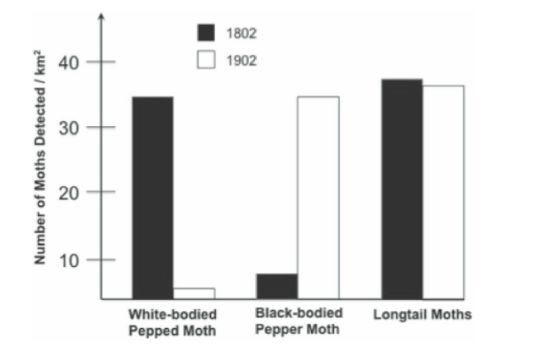
How would the results of this study have been different, if factories produced white or light gray ash and soot rather than black?
(A) There would be no change to the results of the experiment.
(B) There would been added selection pressure for more white-bodied spotted moths and against black-bodied spotted moths.
(C) There would been added selection pressure for more black-bodied spotted moths and against white-bodied spotted moths.
(D) There would have been an increase in the frequency of both black-bodied and white-bodied spotted moths.
題目解析
題目問如果工廠的煙塵是白色的、淺色的,而非黑色的,那么對實驗結果會有何影響。
如果煙塵是白色的,那么白色的蛾子會更容易生存,自然選擇會使得蛾子種群中白色的品種更容易生存和繁衍后代,
因此選(B) There would been added selection pressure for more white-bodied spotted moths and against black-bodied spotted moths。
題目選自Cracking the AP Biology 2015 Edition
以上就是關于【【每日一題】AP 生物 20180126】的解答,如需了解學校/賽事/課程動態,可至翰林教育官網獲取更多信息。
往期文章閱讀推薦:
AP生物太難?翰林教你一招破局:全方位備考指南+限時體驗課,助你拿下5分!
2027年韓國AP報名8月10日開啟!Fulbright最新細則+報名流程來了!


翰林AMC8視頻課重磅上線!

國際競賽真題資源免費領取






