Edexcel A Level Maths: Mechanics:復(fù)習(xí)筆記1.2.1 Working with Vectors

Working with Vectors
Vectors?are used throughout mechanics to describe forces and motion
?How are Vectors used in Mechanics?
- Vector?questions are often embedded in a Mechanics context
- Vectors will most commonly represent?forces,?accelerations?or?velocities, they can also represent displacement
- Newton’s Second Law?F?=?ma?is essential
- Remember that?F?and?a?(force and acceleration) are?vectors, while m (mass) is a?scalar
- When a particle is in?equilibrium, the vector sum of the forces on it is equal to zero
What is vector notation?
- There are?two?vector?notations?used in A level mathematics:
- Column?vectors: This is one number written above the other enclosed in brackets,
e.g. The (column) vector meaning?3 units?in the?positive?horizontal?(x) direction (i.e.,?right) and?2 units?in the?negative?vertical?(y?) direction (i.e.,?down) can be written as:

-
- i?and?j?notation:?i?and?j?are?unit?vectors?(they have?magnitude 1) in the positive horizontal and positive vertical directions respectively
e.g. The vector (-4i?+ 3j) would mean?4 units?in the?negative?horizontal?(x) direction (i.e.?left) and?3 units?in the?positive?vertical?(y) direction (i.e.?up)
- As they are vectors,?i?and?j?are displayed in?bold?in textbooks and online but in handwriting they would be?underlined?(i?and?j)
Calculating Resultant Vectors:
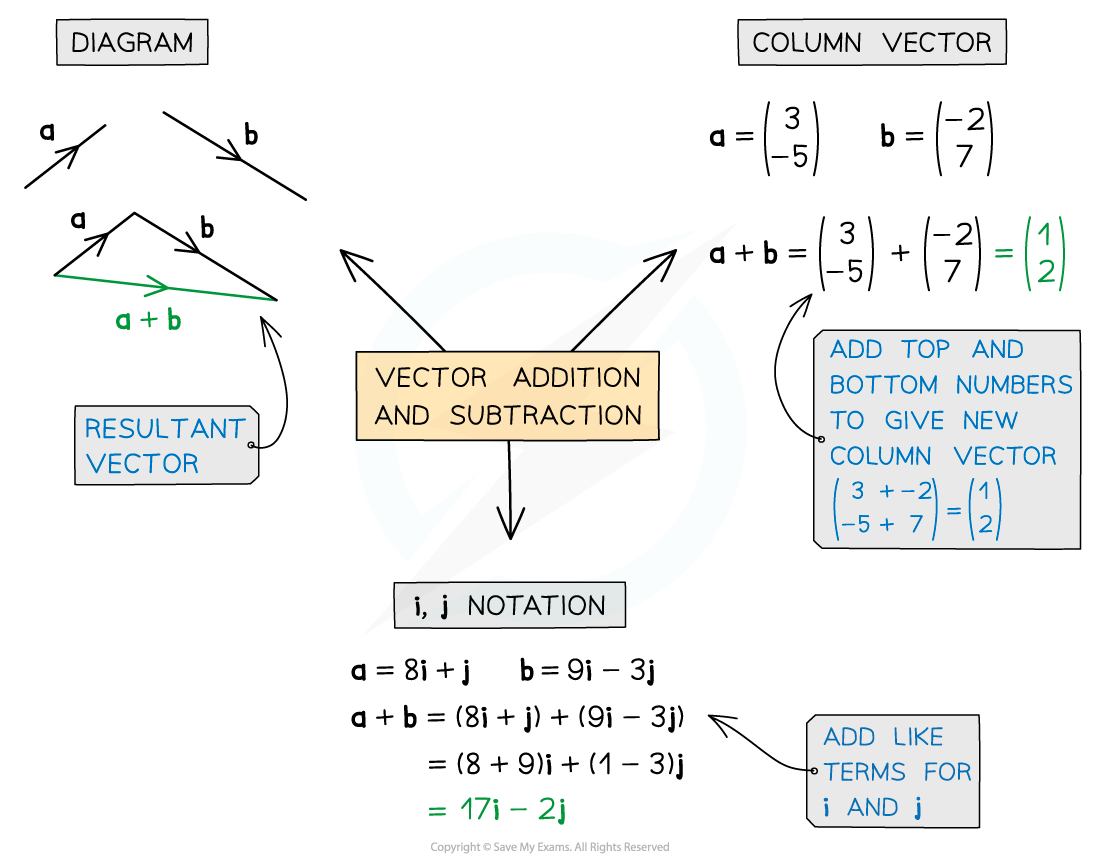
- Both?column vectors?and?i, j notation?can be used for calculating?resultant vectors
- Adding vectors together gives the?resultant vector
- This is the same when adding force vectors; the?resultant force?is simply the force vectors added together
- Forces in?equilibrium?have a resultant force equal to?zero
Calculating Magnitude and Direction:
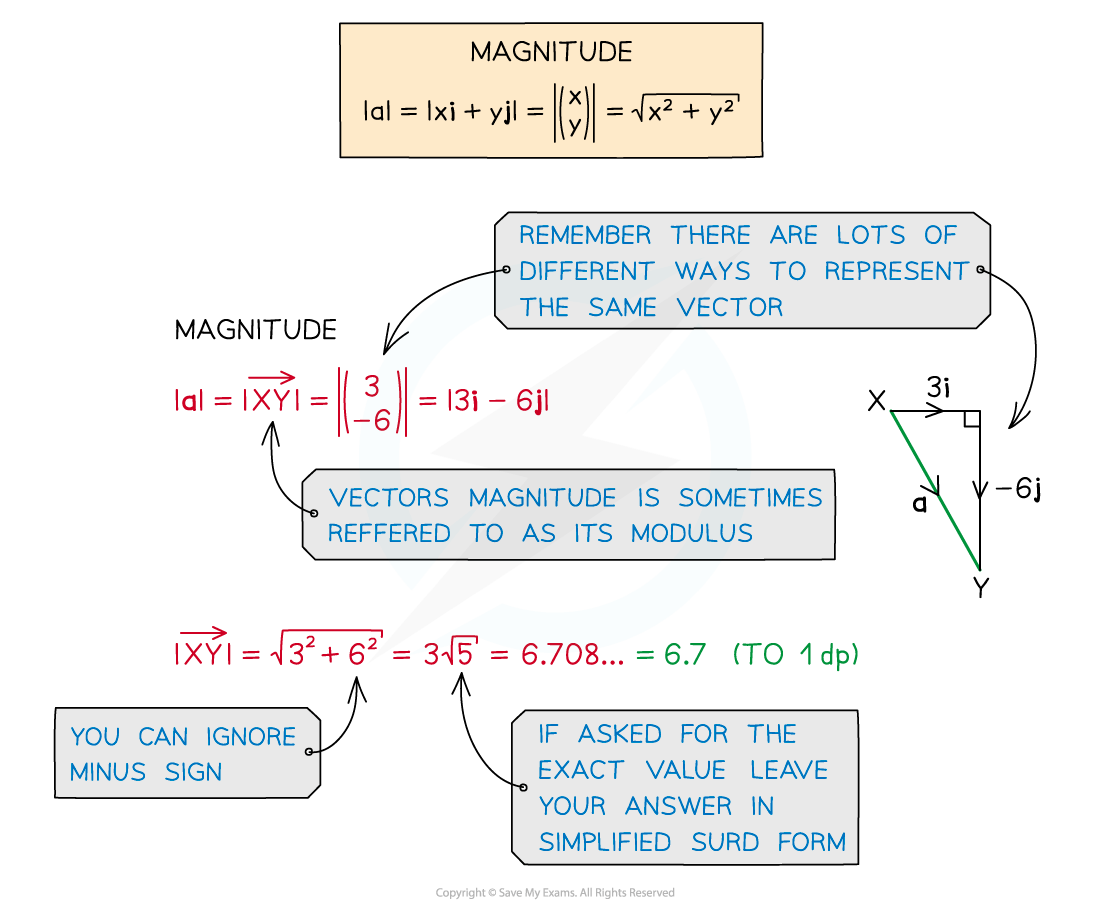
- Pythagoras is used to find the?magnitude?of a vector.
- Trigonometry is used to find the?direction?of a vector
- You may be asked for the direction as a?bearing.?The?unit vector?j?can be used to represent north and the unit vector?i?can?be used to represent east.
- In the case where?k?> 0
- If a particle is moving north then its velocity will have a vector of?kj
- if a particle?A?is due south of another particle?B?then the displacement vector from?B?to?A?will have the form -kj
- If a particle is moving east then its velocity will have a vector of?ki
- if a particle?A?is due west of another particle?B?then the displacement vector from?B?to?A?will have the form -ki
- If the position vectors of two particles have the same?j?component, then the particle with the greater?i?component will be positioned due east of the other
- If the position vector of a particle has equal?i?and?j?components then it is positioned due north - east of the origin
- if a particle?A?is north – east of another particle?B?then the displacement vector from?B?to?A?will have equal?i?and?j?components
- In the case where?k?> 0
Resolving Vectors:
- Resolving?a vector means writing it in?component?form (as?i?and?j?components)
- Given the?magnitude?and?direction?of a vector you can work out its components and vice versa
Worked Example
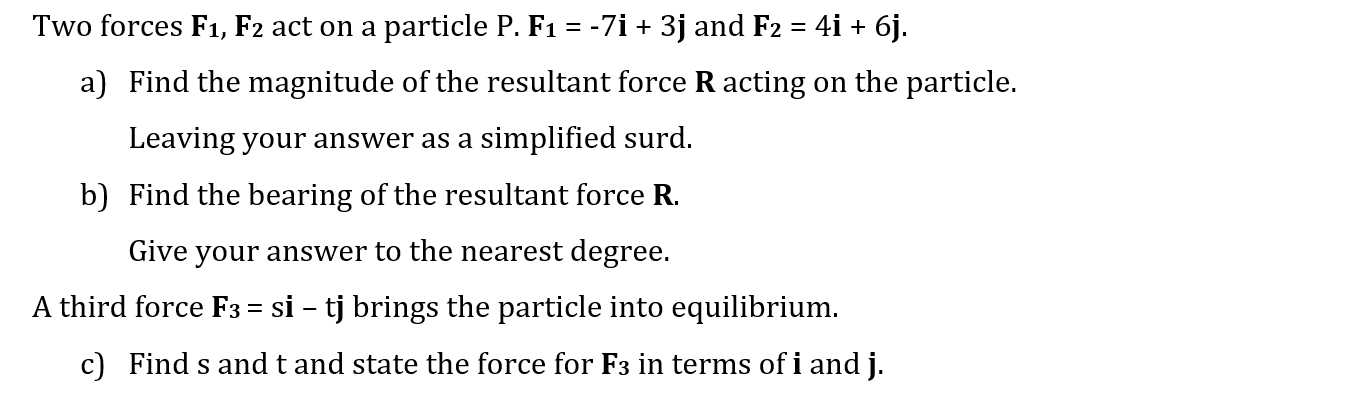
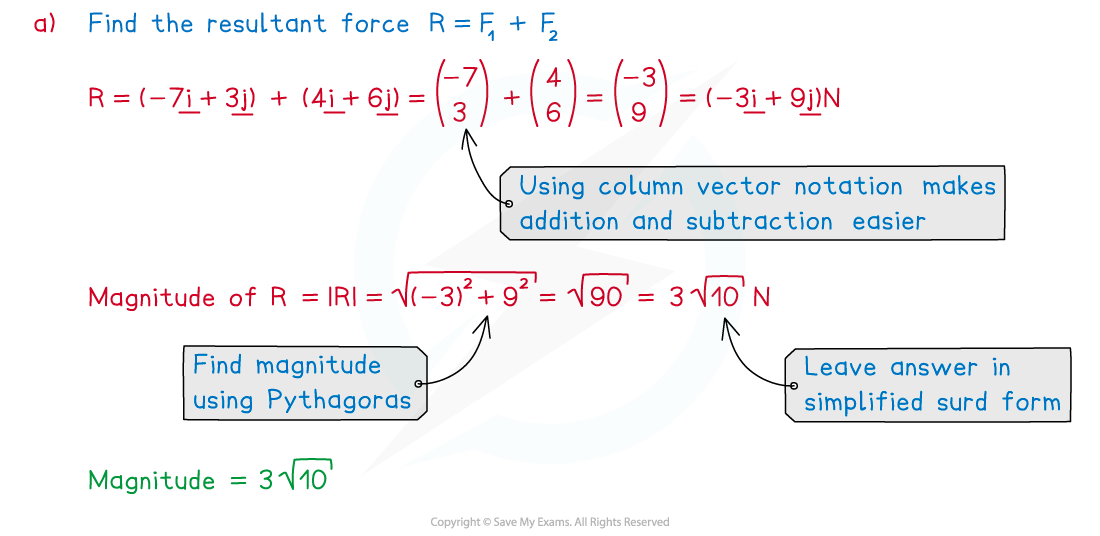
a)? Find the magnitude of the resultant force?R?acting on the particle.
Leaving your answer as a simplified surd.
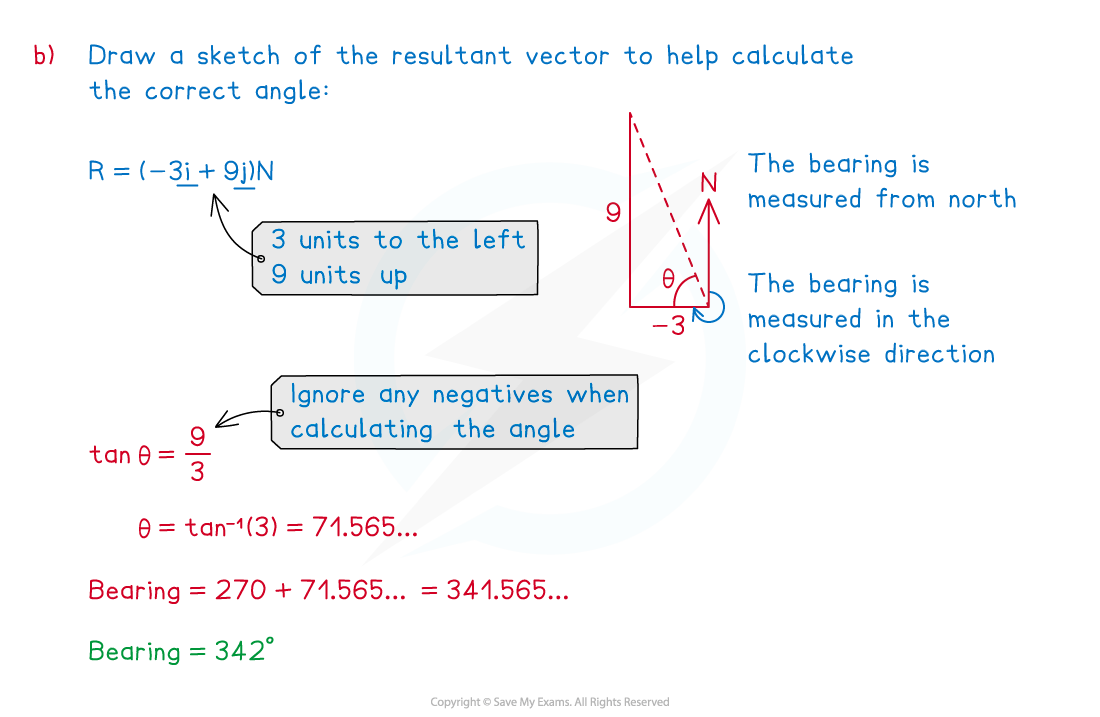
b)? Find the bearing of the resultant force?R.
Give your answer to the nearest degree.
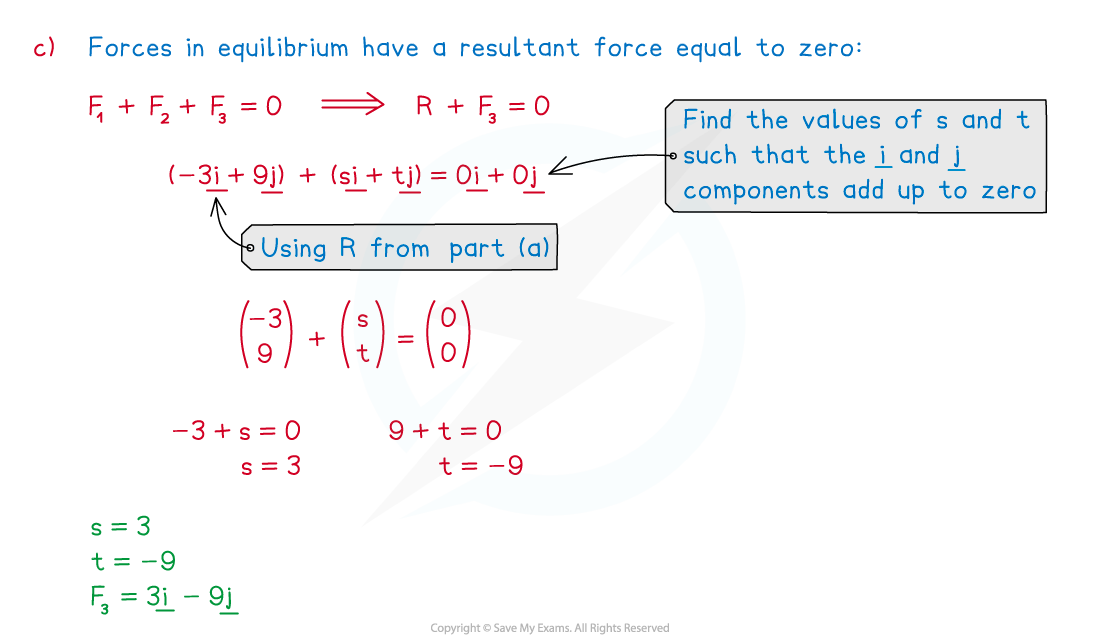
A third force?F3?= si?– tj?brings the particle into equilibrium.
c)? ?Find s and t and state the force for?F3?in terms of?i?and?j.
Exam Tip
- When working with vectors pay attention to accuracy, leaving magnitude in surd form or correct to 3.s.f.
- In your exam you can’t write in?bold?so should?underline?your vector notation
轉(zhuǎn)載自savemyexams
以上就是關(guān)于【Edexcel A Level Maths: Mechanics:復(fù)習(xí)筆記1.2.1 Working with Vectors】的解答,如需了解學(xué)校/賽事/課程動態(tài),可至翰林教育官網(wǎng)獲取更多信息。
往期文章閱讀推薦:
2026 AMC10/12美國數(shù)學(xué)競賽新賽季!【翰林教育 × 清華大學(xué)出版社】獨家教材全面發(fā)售!
CAIE A-Level分?jǐn)?shù)線新鮮出爐!三大考試局查分攻略+出分急救指南速覽!


翰林AMC8視頻課重磅上線!

國際競賽真題資源免費領(lǐng)取






