Edexcel IGCSE Physics: Double Science 復習筆記:1.1.1 Distance-Time Graphs

Edexcel IGCSE Physics: Double Science 復習筆記:1.1.1 Distance-Time Graphs
Distance-Time Graphs
- A distance-time graph shows how the?distance?of an object moving in a straight line (from a starting position) varies over time:
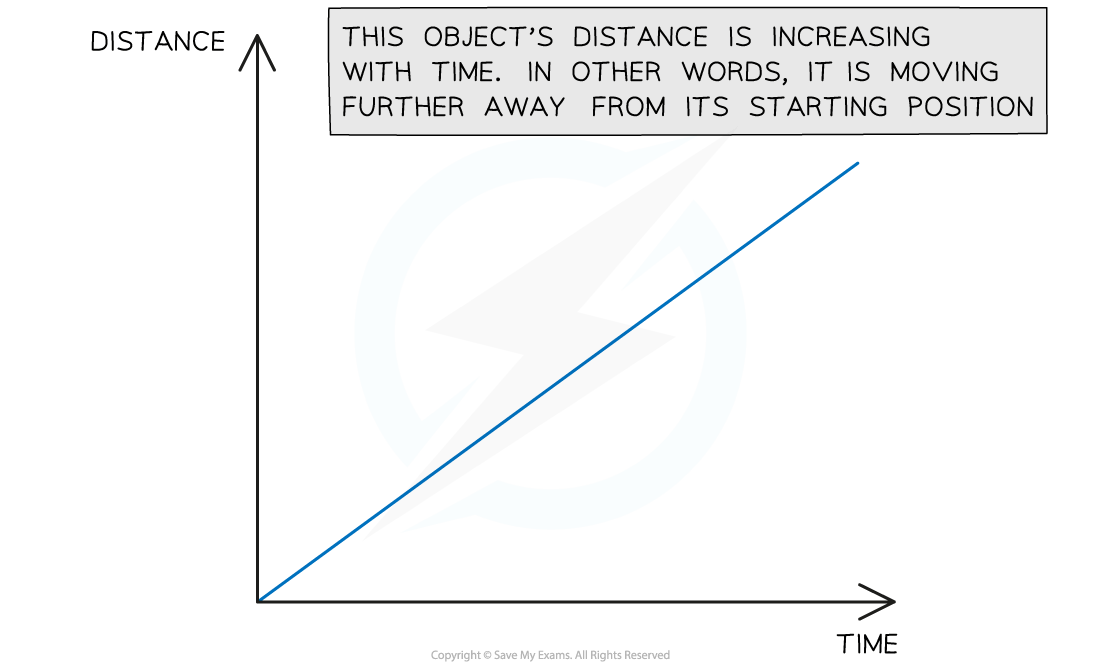
This graph shows a moving object moving further away from its origin
Constant Speed on a Distance-Time Graph
- Distance-time graphs also show the following information:
- If the object is moving at a?constant speed
- How?large?or?small?the speed is
- A?straight line?represents?constant speed
- The slope of the straight line represents the?magnitude?of the speed:
- A very?steep?slope means the object is moving at a?large?speed
- A?shallow?slope means the object is moving at a?small?speed
- A?flat,?horizontal?line?means the object is?stationary?(not moving)
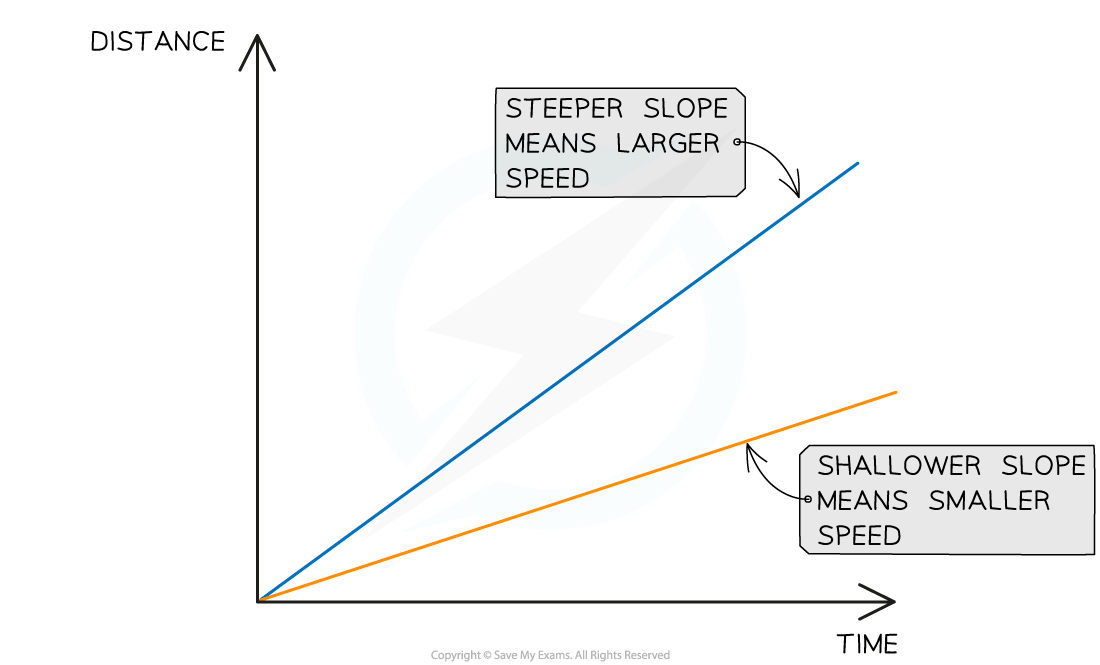
This graph shows how the slope of a line is used to interpret the speed of moving objects. Both of these objects are moving with a constant speed, because the lines are straight.
Changing Speed on a Distance-Time Graph
- Objects might be moving at a?changing speed
- This is represented by a?curve
- In this case, the slope of the line will be changing
- If the slope is?increasing, the?speed?is?increasing?(accelerating)
- If the slope is?decreasing, the?speed?is?decreasing?(decelerating)
- The image below shows two different objects moving with changing speeds
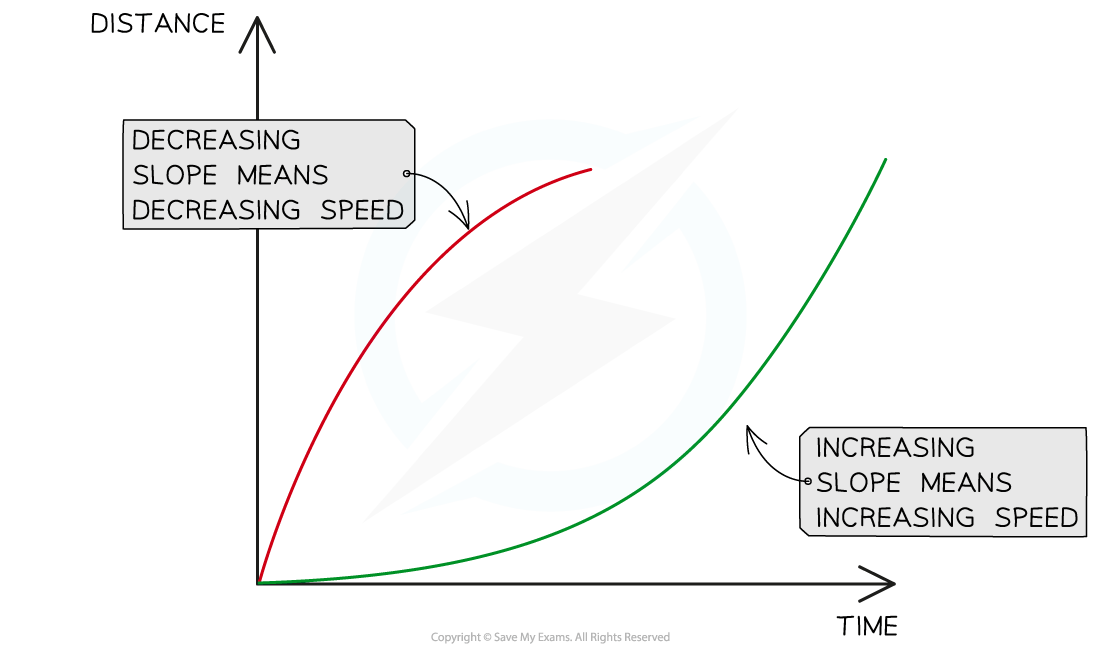
Changing speeds are represented by changing slopes. The red line represents an object slowing down and the green line represents an object speeding up.
Gradient of a Distance-Time Graph
- The?speed?of a moving object can be calculated from the?gradient?of the line on a?distance-time?graph:

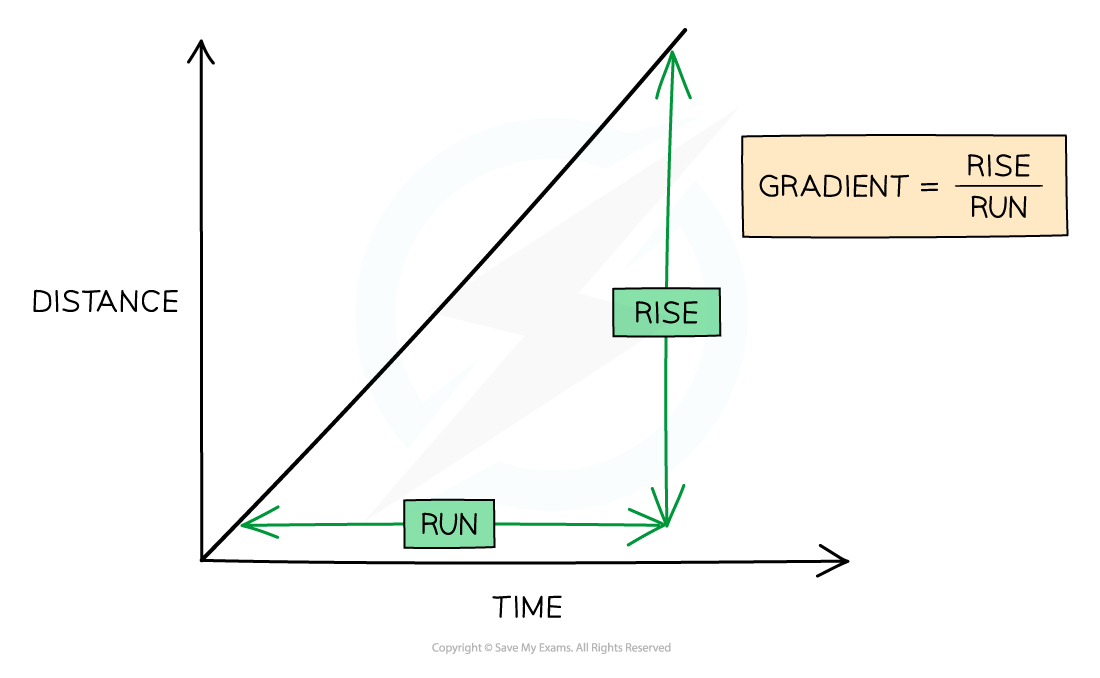
The speed of an object can be found by calculating the gradient of a distance-time graph
- The?rise?is the?change?in y (distance) values
- The?run?is the?change?in x (time) values
Worked Example
A distance-time graph is drawn below for part of a train journey. The train is travelling at a constant speed.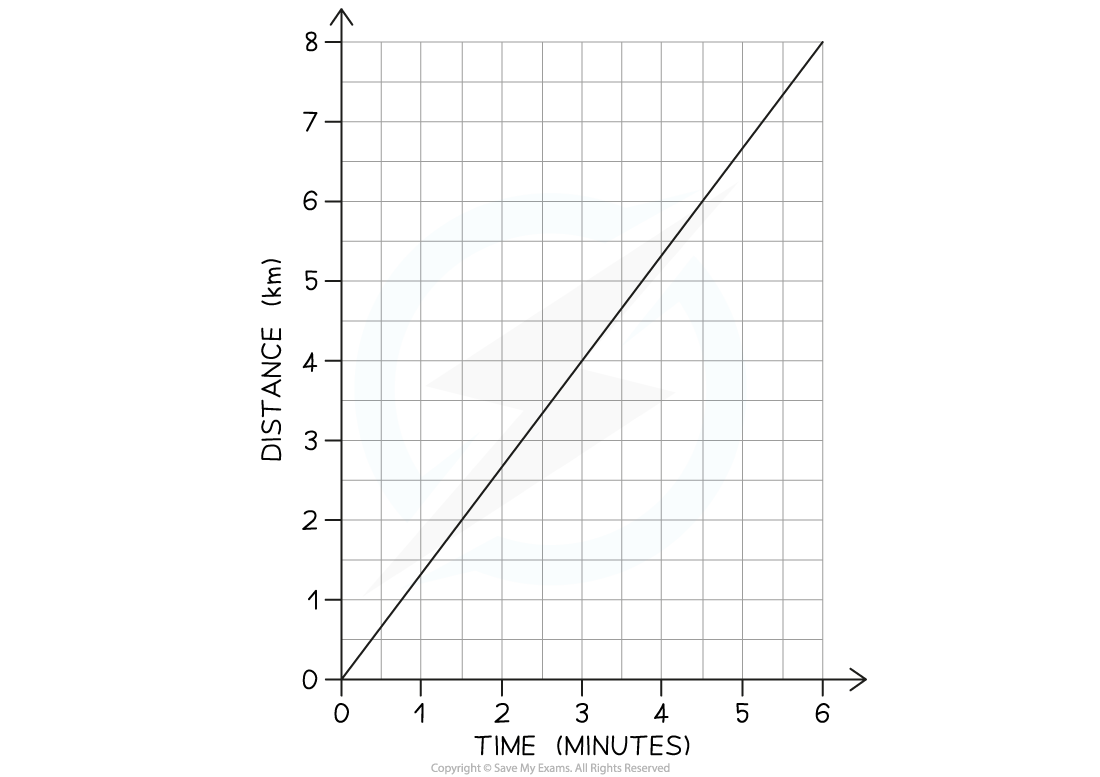 Calculate the speed of the train.
Step 1: Draw a large gradient triangle on the graph and label the magnitude of the rise and run
-
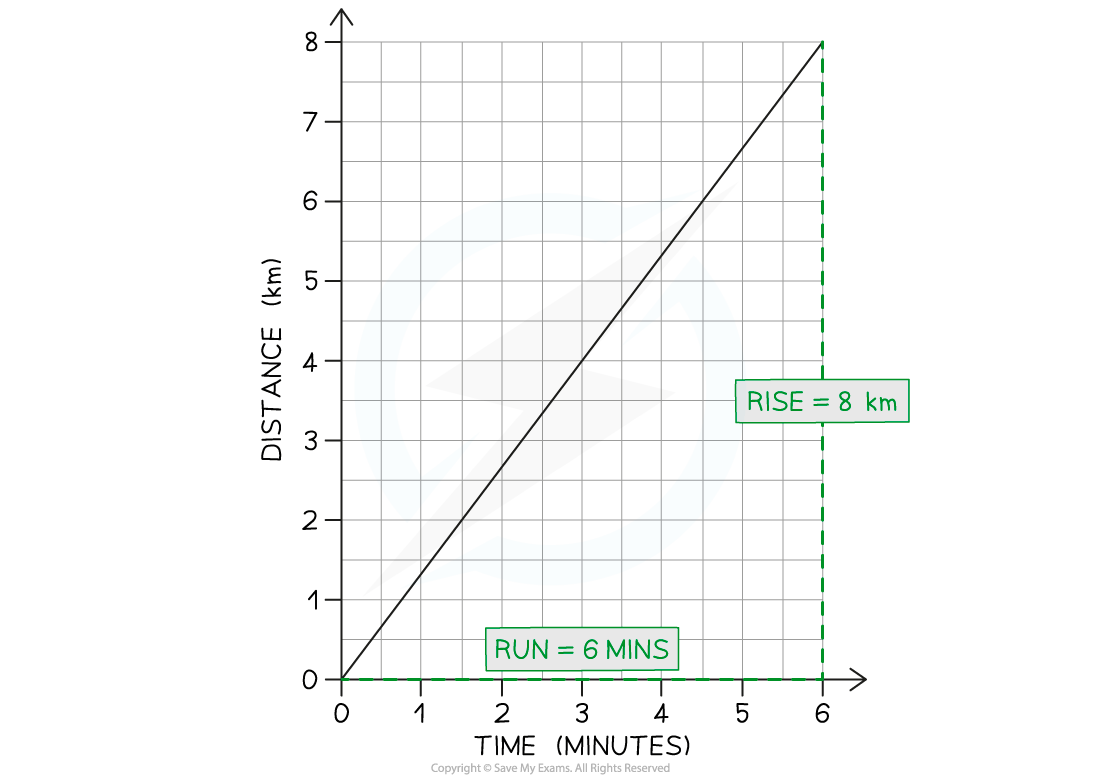
- The image below shows a large?gradient triangle?drawn with dashed lines
- The?rise?and?run?magnitude is labelled, using the?units?as stated on each axes
Step 2: Convert units for distance and time into standard units
-
- The distance travelled (rise) = 8 km =?8000 m
- The time taken (run) = 6 mins =?360 s
Step 3: State that speed is equal to the gradient of a distance-time graph
-
- The?gradient?of a?distance-time?graph is equal to the?speed?of a moving object:
Step 4: Substitute values in to calculate the speed
speed = gradient = 8000 ÷ 360
speed =?22.2 m/s
Worked Example
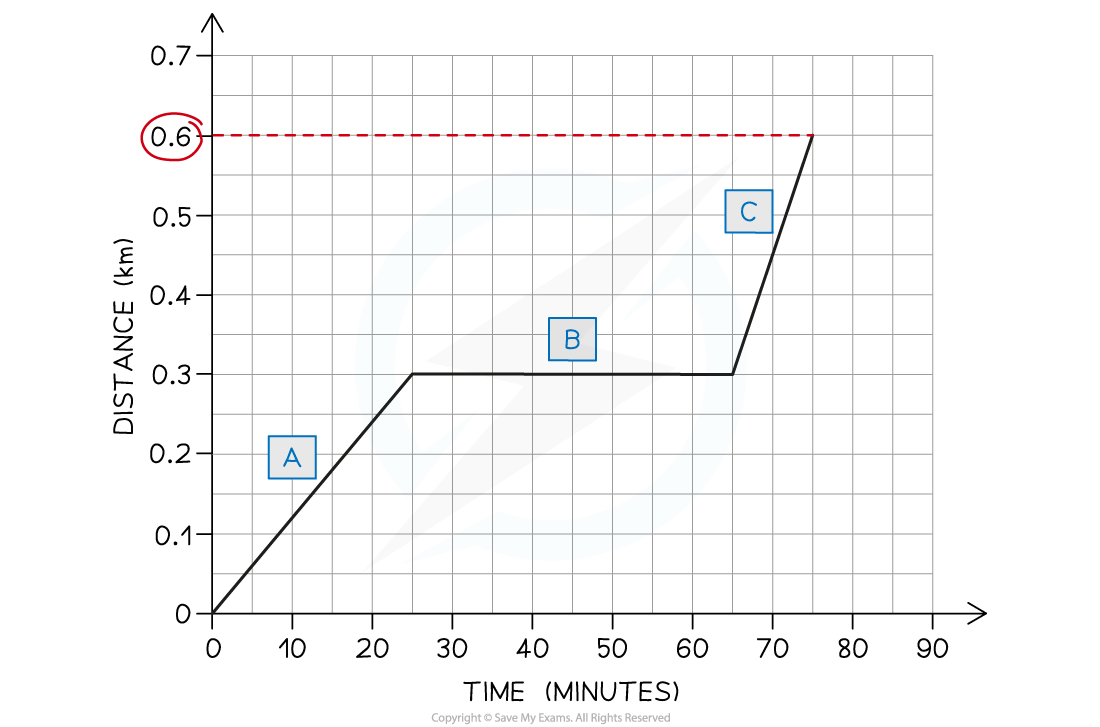
Ose decides to take a stroll to the park. He finds a bench in a quiet spot and takes a seat, picking up where he left off reading his book on Black Holes.After some time reading, Ose realises he lost track of time and runs home.A distance-time graph for his trip is drawn below: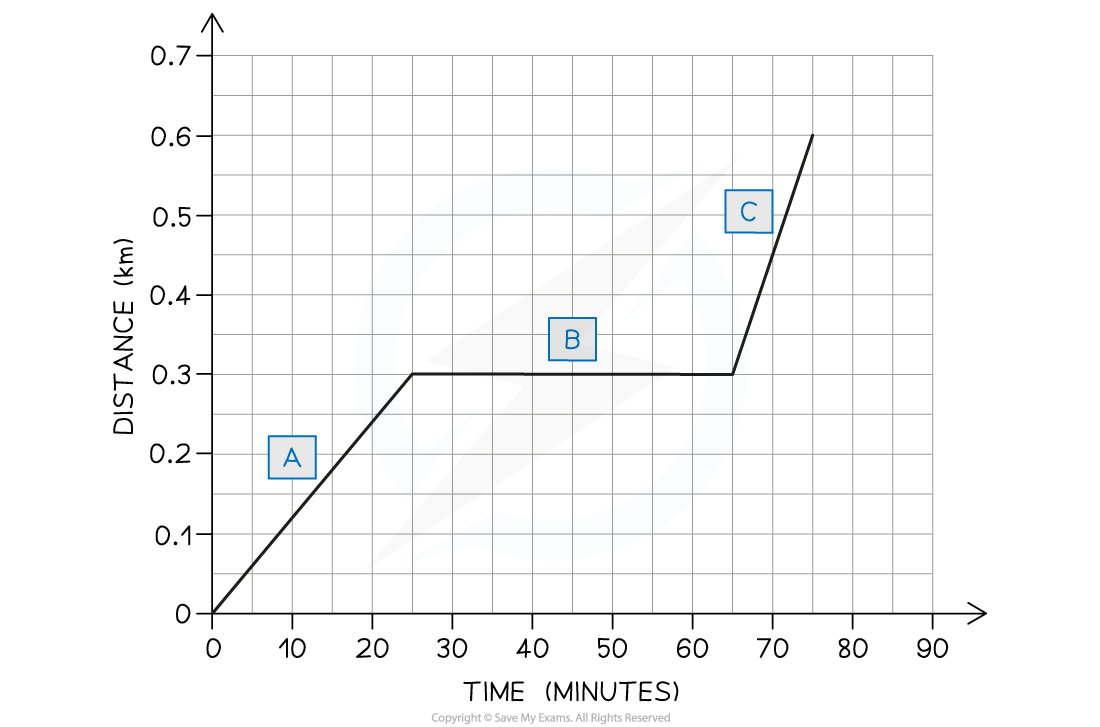 a) How long does Ose spend reading his book?There are three sections labelled on the graph: A, B and C.b) Which section represents Ose running home?
c) What is the total distance travelled by Ose?
Part (a)
-
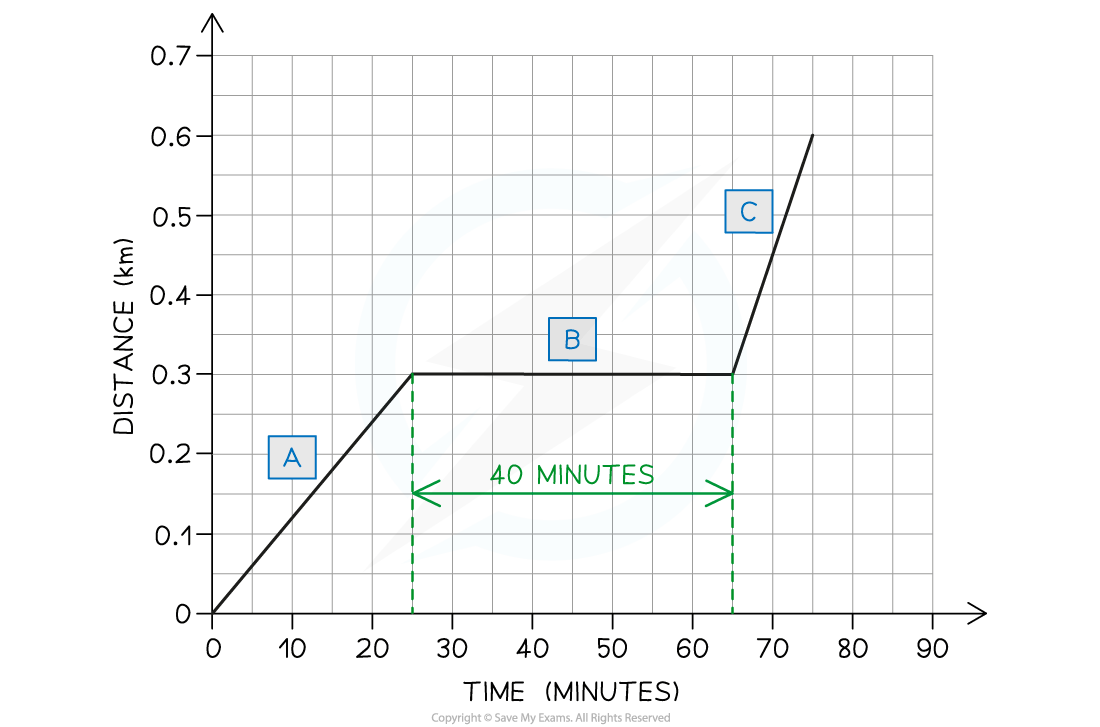
- Ose spends?40 minutes?reading his book
- The?flat?section of the line (section B) represents an object which is?stationary?- so section B represents Ose sitting on the bench reading
- This section lasts for?40 minutes?- as shown in the graph below
Part (b)
-
- Section C?represents Ose running home
- The?slope?of the line in section C is?steeper?than the slope in section A
- This means Ose was moving with a?larger?speed (running) in section C
Part (c)
-
- The total distance travelled by Ose is?0.6 km
- The total?distance?travelled by an object is given by the final point on the line - in this case, the line ends at?0.6 km?on the?distance?axis. This is shown in the image below:
Exam Tip
- Use the?entire line, where possible, to calculate the gradient. Examiners tend to award credit if they see a?large gradient triangle?used - so remember to draw these directly on the graph itself!
- Remember to check the?units?of variables measured on each axis. These may not always be in standard units - in our example, the unit of distance was?km?and the unit of time was?minutes. Double-check which units to use in your answer.
轉載自savemyexams
以上就是關于【Edexcel IGCSE Physics: Double Science 復習筆記:1.1.1 Distance-Time Graphs】的解答,如需了解學校/賽事/課程動態,可至翰林教育官網獲取更多信息。
往期文章閱讀推薦:
IGCSE全A*,A-Level階段卻崩了?別忽視IGCSE選課的重要性!
2026 CAIE IGCSE 夏季大考放榜!A* 線全面揭曉,今年真的卷到新高度?


翰林AMC8視頻課重磅上線!

國際競賽真題資源免費領取






