CIE A Level Chemistry復習筆記7.6.5 Relative Basicity of Ammonia, Ethylamine & Phenylamine

Relative Basicity of Aqueous Ammonia, Ethylamine & Phenylamine
- Ammonia and amines act as?bases?as they can donate their lone pair of electrons to form a dative covalent bond with a proton
- The?basicity?of the amines depends on how readily available their lone pair of electrons is
- Electron-donating?groups (such as alkyl groups) increase the electron density on the nitrogen atom and cause the lone pair of electrons to become?more?available for dative covalent bonding
- The amine becomes?more?basic
- Delocalisation?of the lone pair of electrons into an aromatic ring (such as a benzene ring) causes the lone pair of electrons to become?less?available for dative covalent bonding
- The amine becomes?less?basic
Comparing basicity of ammonia, ethylamine & phenylamine
- The order of basicity of ammonia, ethylamine and phenylamine is as follows:
Ethylamine > ammonia > phenylamine
STRONGEST BASE???????????????????????????????????????????????????? ? WEAKEST BASE
- This trend can be explained by looking at the groups attached to the amine (-NH2) group
- In ethylamine, the electron-donating alkyl group donates electron density to the nitrogen atom causing its lone pair to become more available to form a dative covalent bond with a proton
- Ammonia lacks an electron-donating group hence it is less basic than ethylamine however it is more basic than phenylamine as the lone pair on the nitrogen is?not delocalised
- In phenylamine the lone pair of electrons overlap with the conjugated system on the benzene ring and become delocalised; As a result, the lone pair of electrons become less readily available to form a bond with a proton
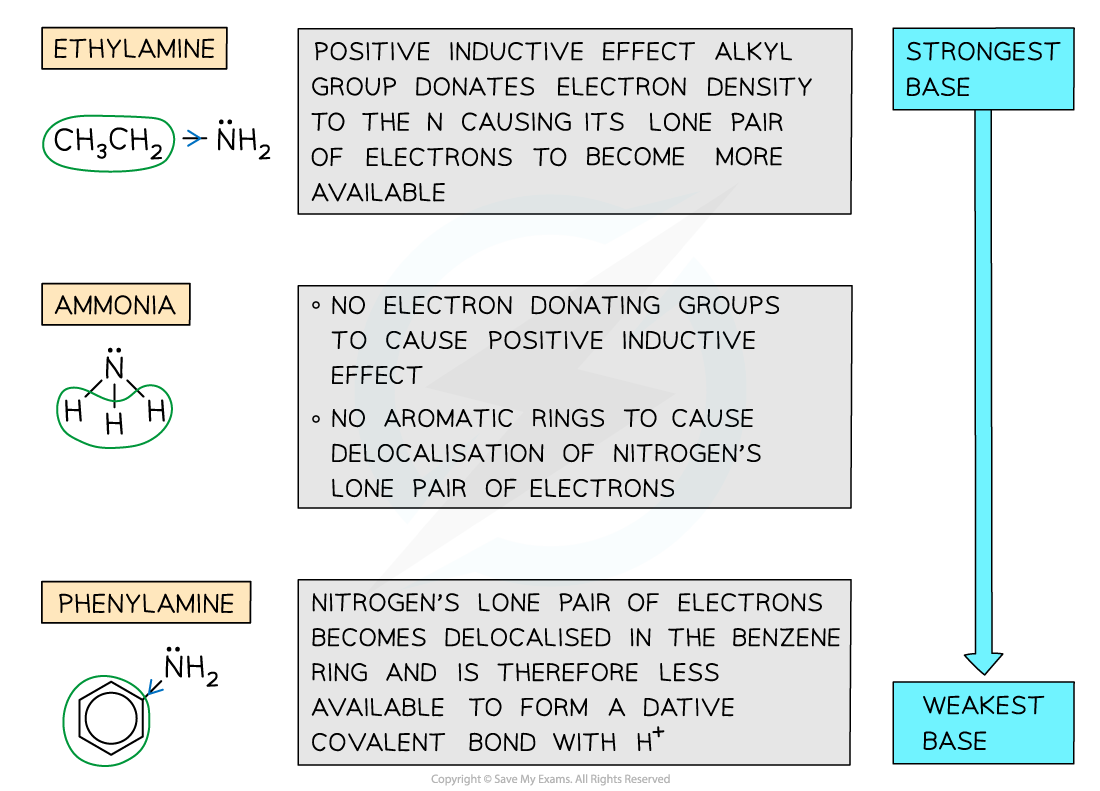
Trends in the basicity of ammonia, ethylamine, and phenylamine
轉載自savemyexams
以上就是關于【CIE A Level Chemistry復習筆記7.6.5 Relative Basicity of Ammonia, Ethylamine & Phenylamine】的解答,如需了解學校/賽事/課程動態,可至翰林教育官網獲取更多信息。
往期文章閱讀推薦:
生物競賽金牌教練的實戰書單!生物學/生物化學/病理學...電子版免費領!
哈佛商學院2026暑期書單曝光!十余位教授私藏書單,本本是“商科天花板”


翰林AMC8視頻課重磅上線!

國際競賽真題資源免費領取






