Edexcel IGCSE Biology 復習筆記 3.2.2 Protein Synthesis

Edexcel IGCSE Biology 復習筆記 3.2.2 Protein Synthesis
RNA
- Like DNA, the nucleic acid RNA (ribonucleic acid) is a?polynucleotide?– it is made up of many nucleotides linked together in a long chain
- Like DNA, RNA nucleotides contain the nitrogenous bases?adenine (A), guanine (G) and cytosine (C)
- Unlike DNA, RNA nucleotides never contain the nitrogenous base thymine (T) – in place of this they contain the nitrogenous base?uracil (U)
- Unlike DNA, RNA molecules are only made up of one polynucleotide strand (they are?single-stranded)
- Each RNA polynucleotide strand is made up of alternating ribose sugars and phosphate groups linked together, with the nitrogenous bases of each nucleotide?projecting out?sideways from the single-stranded RNA molecule
- An example of an RNA molecule is?messenger RNA?(mRNA), which is the transcript copy of a gene that encodes a specific polypeptide. Two other examples are?transfer RNA?(tRNA) and?ribosomal RNA?(rRNA)
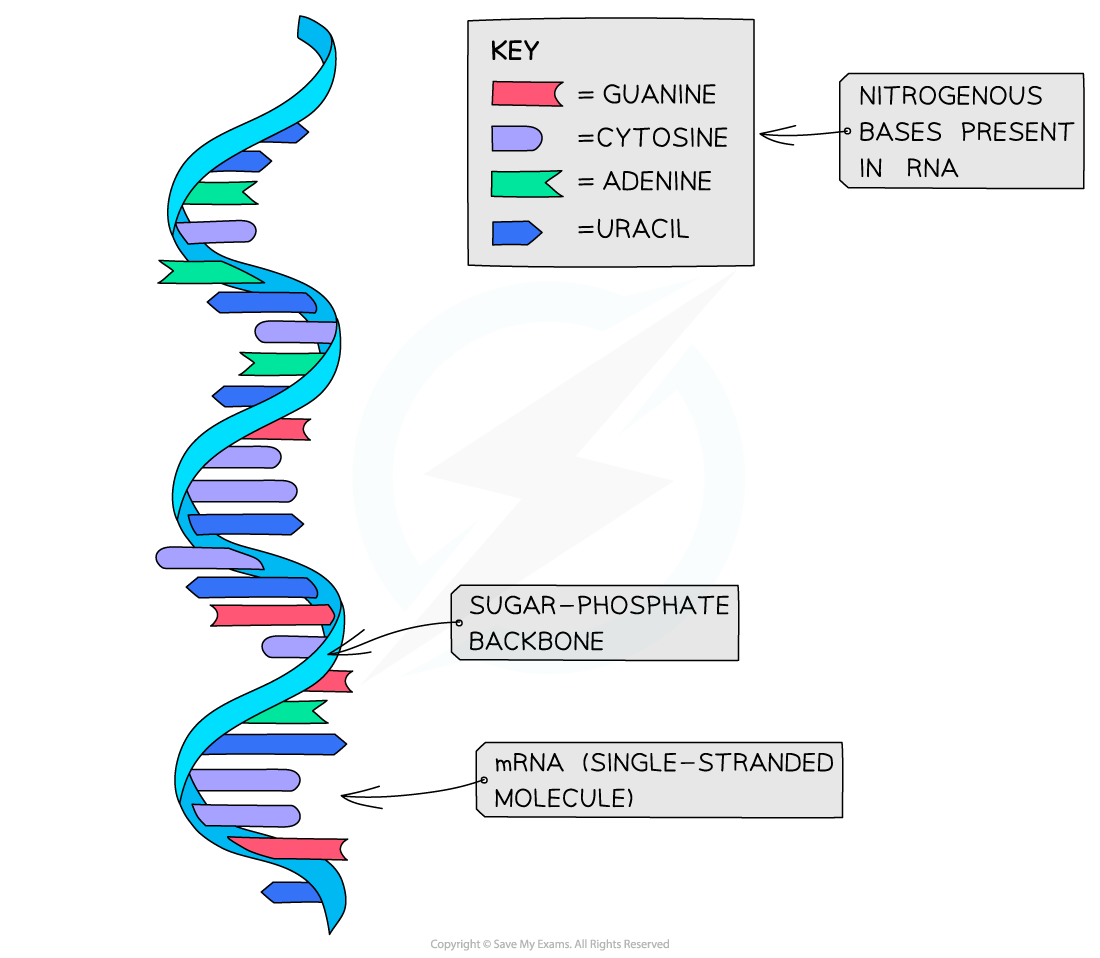
Messenger RNA (mRNA) provides a good example of the structure of RNA
Exam Tip
- The main differences you need to know between RNA and DNA:
- RNA is single-stranded
- RNA contains uracil instead of thymine
Transcription & Translation
- A?gene?is a?sequence of nucleotide bases?in a DNA molecule that?codes for the production of a specific sequence of amino acids, that in turn make up a?specific polypeptide?(protein)
- This process of protein synthesis occurs in?two stages:
- Transcription?–?DNA?is transcribed and an?mRNA?molecule is produced
- Translation?–?mRNA?(messenger RNA) is translated and an?amino acid sequence?(protein) is produced
Transcription
- This stage of protein synthesis occurs in the?nucleus?of the cell
- Part of a DNA molecule?unwinds?(the hydrogen bonds between the complementary base pairs break)
- This exposes the gene to be transcribed (the gene from which a particular polypeptide will be produced)
- A?complimentary?copy of the code from the gene is made by building a single-stranded nucleic acid molecule known as?mRNA?(messenger RNA)
- The mRNA molecule?leaves the nucleus?via a pore in the nuclear envelope
Translation
- This stage of protein synthesis occurs in the?cytoplasm?of the cell
- After leaving the nucleus, the mRNA molecule attaches to a?ribosome
- In the cytoplasm, there are free molecules of?tRNA?(transfer RNA)
- These tRNA molecules have a triplet of unpaired bases at one end (known as the?anticodon) and a region where a?specific amino acid?can attach at the other
- There are at least 20 different tRNA molecules, each with a specific anticodon and specific amino acid binding site
- The tRNA molecules bind with their specific amino acids (also in the cytoplasm) and bring them to the mRNA molecule on the ribosome
- The triplet of bases (anticodon) on each tRNA molecule?pairs with a complementary triplet (codon)?on the mRNA molecule
- Two tRNA molecules fit onto the ribosome at any one time, bringing the amino acid they are each carrying side by side
- A?peptide bond?is then formed between the two amino acids
- This process continues until a ‘stop’ codon on the mRNA molecule is reached – this acts as a signal for translation to stop and at this point the amino acid chain coded for by the mRNA molecule is complete
- This amino acid chain then forms the final polypeptide (protein)
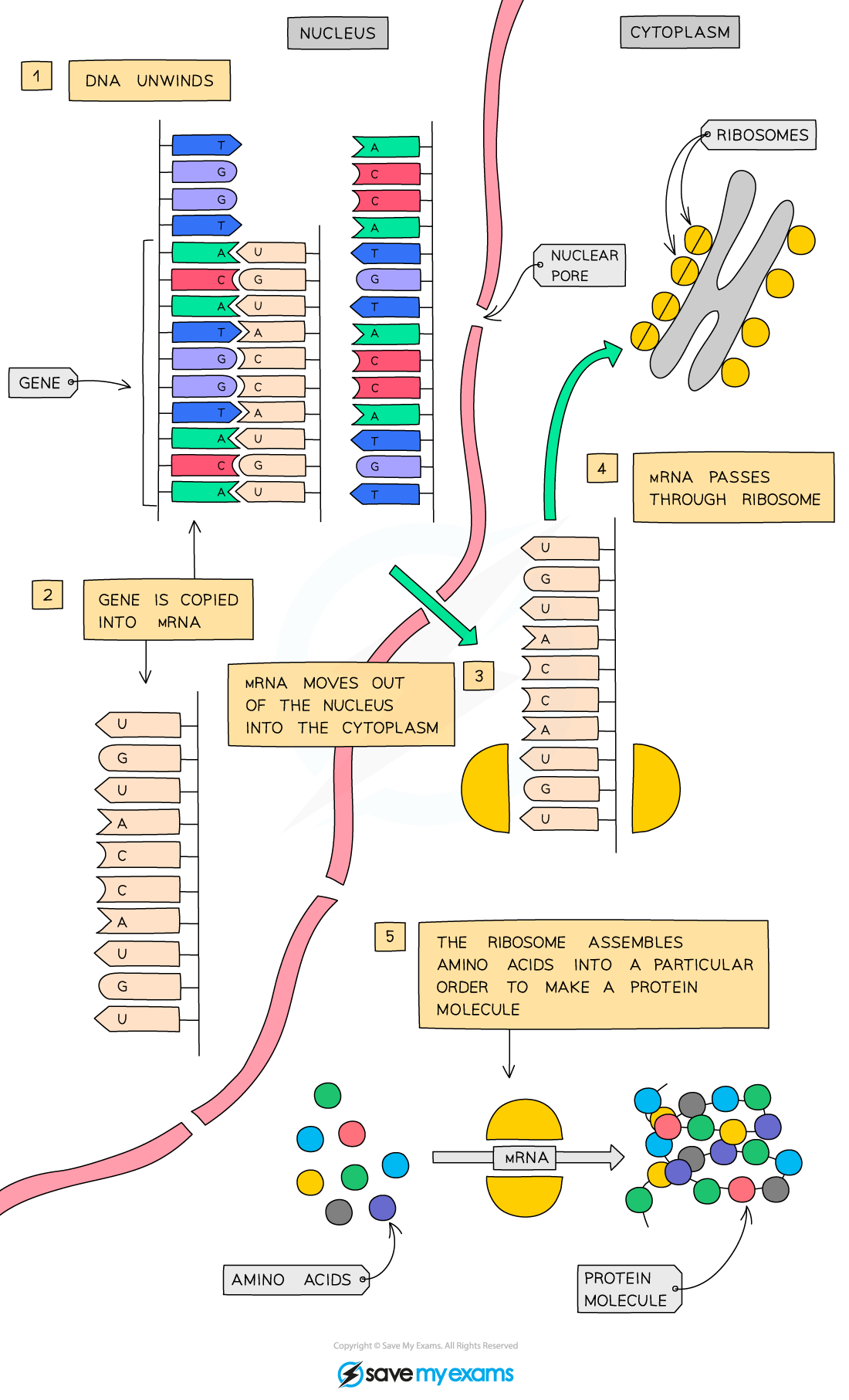
An overview of protein synthesis
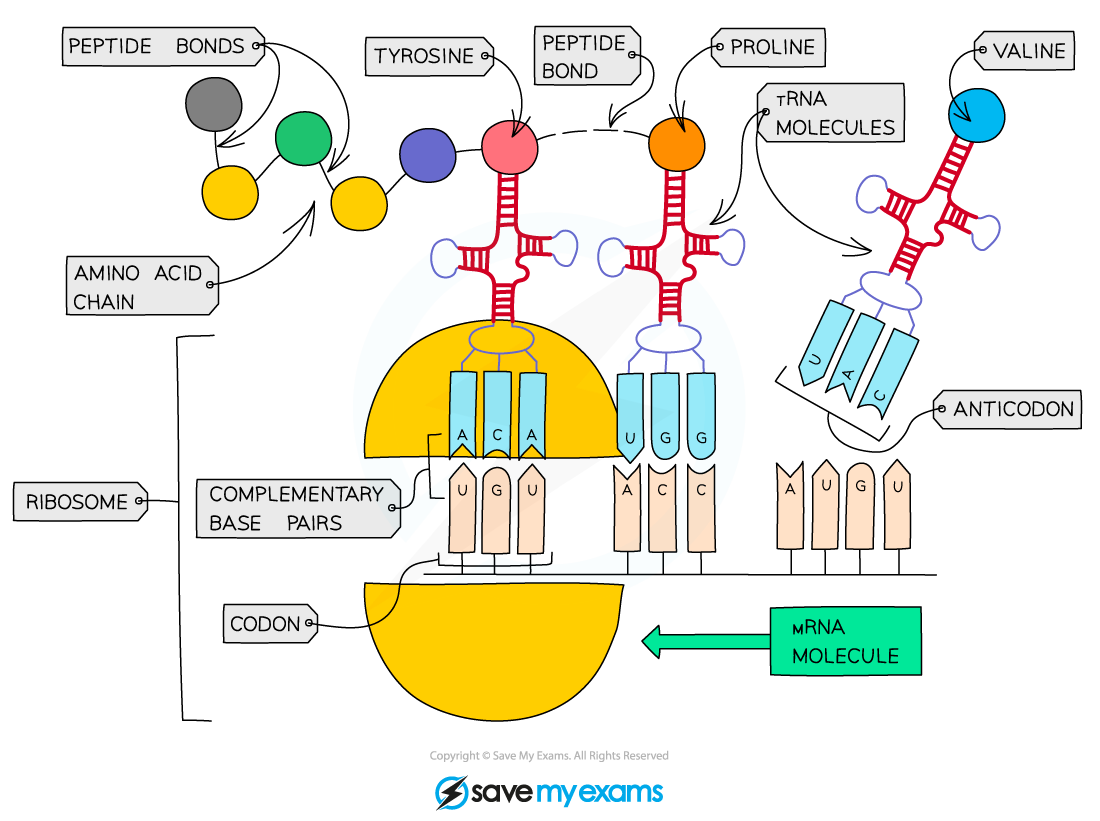
The triplet code of DNA (carried by mRNA) is read by the ribosome and amino acids are attached together in a specific sequence to form the protein
轉載自savemyexam
以上就是關于【Edexcel IGCSE Biology 復習筆記 3.2.2 Protein Synthesis】的解答,如需了解學校/賽事/課程動態,可至翰林教育官網獲取更多信息。
往期文章閱讀推薦:
IGCSE全A*,A-Level階段卻崩了?別忽視IGCSE選課的重要性!
2026 CAIE IGCSE 夏季大考放榜!A* 線全面揭曉,今年真的卷到新高度?


翰林AMC8視頻課重磅上線!

國際競賽真題資源免費領取






