AQA A Level Biology復習筆記5.3.7 Secondary Productivity

Primary & Secondary Productivity
- During photosynthesis, primary producers (such as plants and algae) convert light energy into chemical energy in biological molecules
- The storing of this chemical energy in the biomass of primary producers is known as?primary production
- This can be measured in units of?mass per unit area?or units of?energy per unit area, for example, kg ha–1?(kilograms per hectare) or kJ ha–1?(kilojoules per hectare)
- 1 hectare = 10,000 m2?(i.e. 100m × 100m)
- The chemical energy stored as biomass during primary production is available to organisms in higher trophic levels in the ecosystem
- These organisms are known as consumers
- When consumers ingest producers, the chemical energy in the biomass of the producers is transferred to the consumers
- Like producers, the consumers also store this chemical energy in their biomass
- This process is known as?secondary production?or the?production of consumers
Productivity
- When measuring the?production?of producers or consumers, it is often useful to measure the average production over a?period of time. For example:
- A farmer’s crops might grow very fast in the summer but very slow in the winter (the production of?producers?often?varies?during the year due to?abiotic factors?such as?temperature?and?light?availability). It may be useful to the farmer to know the average growth rate of his crops per month or year so that they can estimate how much crop biomass they can expect to harvest
- A cattle farmer may want to know the average biomass they can expect their cows to produce per month or year. They need to know how much?secondary production?is occurring in a?given period of time
- Productivity?means the?rate?of production
- The rate of primary production is known as?primary productivity
- The rate of secondary production is known as?secondary productivity
- In the examples above, the crop farmer needs to know the?primary?productivity of his?crops?and the cattle farmer needs to know the?secondary?productivity of his?cows
- This means primary and secondary productivity is expressed in units of?mass per unit area per unit time, for example:
- g m–2?day–1?(grams per square metre per day)
- kg ha–1?yr-1?(kilograms per hectare per year)
- In this case,?‘area’?refers to the?area of land?that is being?studied?(this land contains the?producers?or?consumers?that are producing the?biomass)
- Primary and secondary production can also be expressed in terms of how much?chemical energy?is stored in the biomass of producers or consumers
- This means primary and secondary productivity can also be expressed in units of?energy per unit area per unit time, for example:
- J m–2?day–1?(joules per square metre per day)
- kJ ha-1?yr-1?(kilojoules per hectare per year)
Worked Example
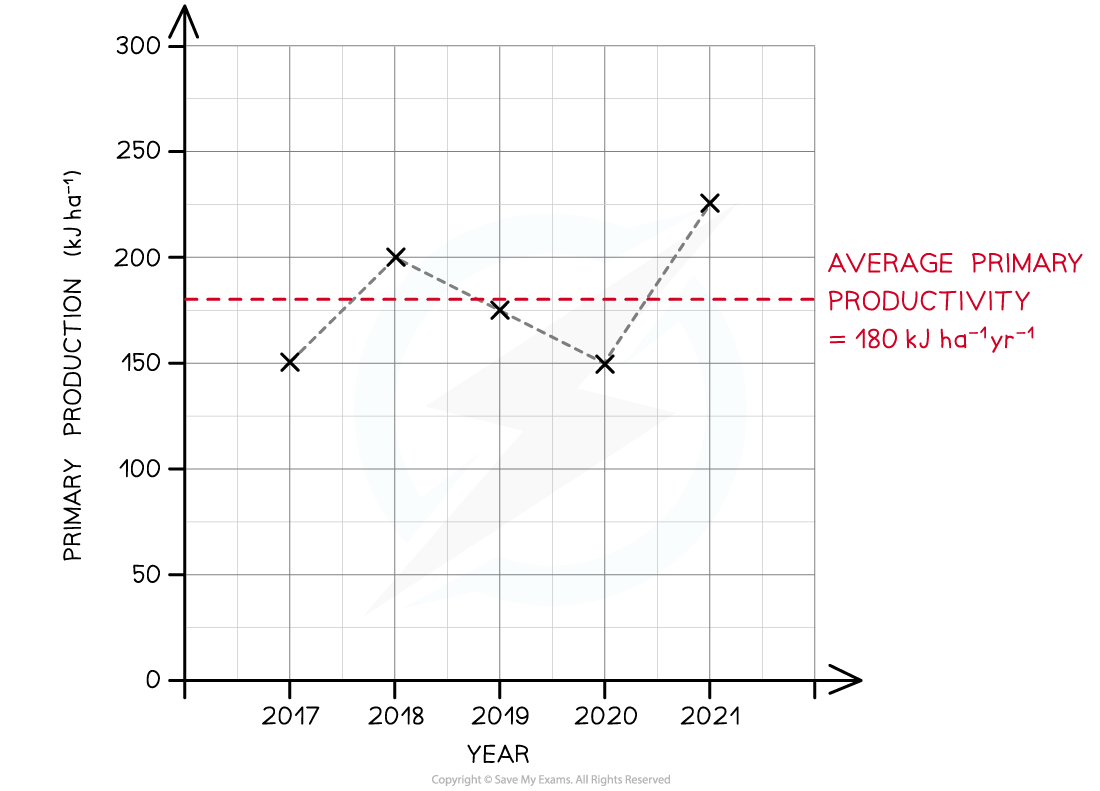
A company that produces sunflower oil wants to know the primary productivity of their sunflower crop. They record the primary production of the crop each year for five years. This information is provided in the table below. Calculate the primary productivity of the sunflower crop, giving appropriate units. Draw a graph of the data provided, adding a line showing the primary productivity of the sunflower crop over the five year period.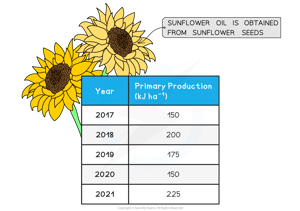
Step 1: calculate the mean primary production per year
150 + 200 + 175 + 150 + 225 = 900
900 ÷ 5 = 180
Step 2: Give the appropriate units
180 kJ ha-1?yr-1
Step 3: Draw a graph of the data provided, adding a line showing the primary productivity of the sunflower crop over the five year period
Exam Tip
Don’t forget - in?aquatic environments, it may be more suitable to measure primary and secondary productivity?per unit volume. For example, for aquatic?algae, primary productivity could be given in g?m-3?yr-1?(grams per?cubic metre?per year) or J?m-3?yr-1?(joules per?cubic metre?per year). Or for the fish that consume the algae, secondary productivity could be given in kg?m-3?yr-1?(kilograms per?cubic metre?per year) or kJ?m-3?yr-1?(kilojoules per?cubic metre?per year).
Net Production of Consumers
- Organisms that get energy by ingesting?other?organisms?(including?producers?or other organisms that?feed on?producers) are known as?consumers
- When consumers ingest other organisms, the?chemical energy?in the?biomass?of these organisms is?transferred?to the consumers
- The consumers then?store?this chemical energy in their?own?biomass
- This process is known as?secondary production?or the?production of consumers
- However,?not all?the chemical energy in the consumers’ food is transferred to the consumer
- In fact,?only around 10% of the energy is available to the consumer to store as new biomass
- This means?around 90%?of the energy is?lost
- Not all the energy is transferred to the consumer because:
- Not all?of the biomass of the food is?eaten?(e.g. the roots and woody parts of plants or the bones of animals), meaning that the chemical energy this biomass contains is?lost?to the?environment
- Consumers are?not able?to?digest?100% of the food they ingest, so some is always?egested?as?faeces. Again, the chemical energy in this undigested biomass is also lost to the environment
- Lots of chemical energy is lost to the environment when consumers?respire?(this energy is mainly lost as?heat) and during the?excretion?of?waste products?(e.g.?urine)
- The energy that is?left?after these losses is available to the consumer to store as new biomass and is known as the?net production of consumers?(or simply as the?net production)
- The net production of consumers (N) can be?calculated?using the following equation:
N = I - (F + R)
- Where:
- I?= the chemical energy store in?ingested?food
- F?= the chemical energy lost to the environment in?faeces?and?urine
- R?= the?respiratory losses?to the environment
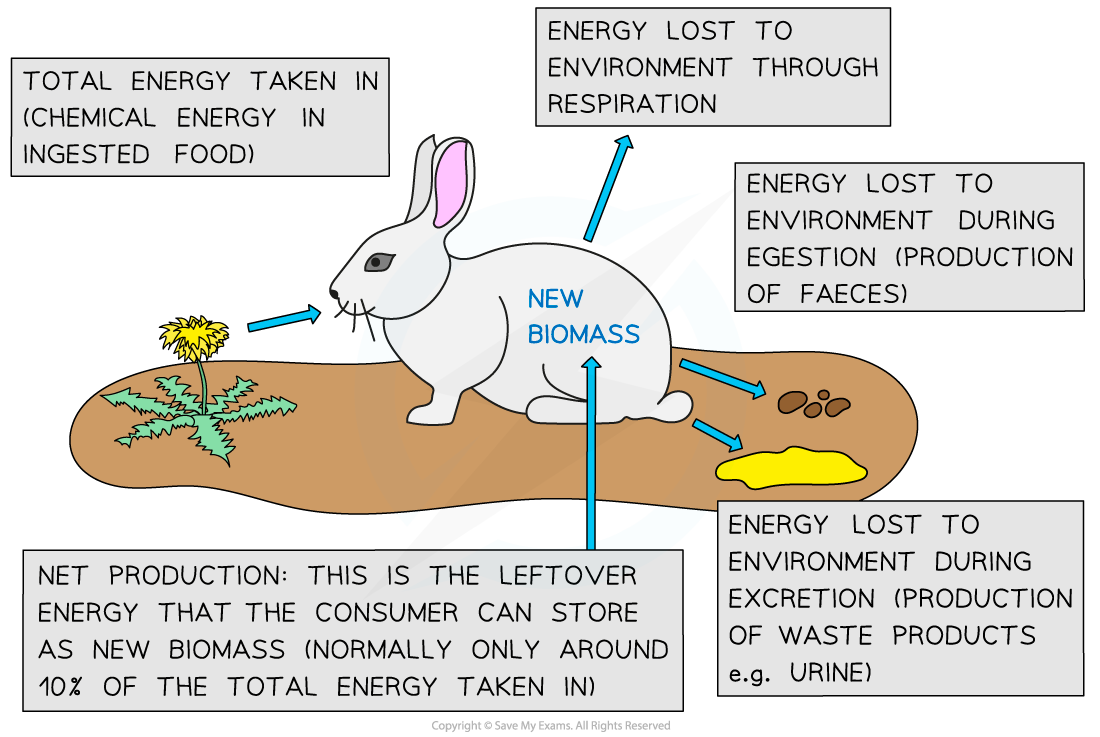
The chemical energy that consumers can store as new biomass after energy losses due to respiration, egestion (faeces) and excretion (urine) is known as the net production
Worked Example
In a patch of woodland, caterpillars ingest 2,000 kJ m?2 yr?1??of chemical energy from the biomass of oak leaves. The caterpillars lose 1,200 kJ m?2 yr?1 of this energy in faeces and urine. They lose a further 600 kJ m?2 yr?1 of this energy through respiration. Calculate the net production of the caterpillars.
Step 1: Write out the equation and substitute in the known values
N = I - (F + R)
N = 2,000 - (1,200 + 600)
Step 2: Calculate the net production (N) and give appropriate units
N = 2,000 - 1,800
N = 200 kJ m?2?yr?1
Exam Tip
Don’t get confused between?net primary production?and?net production. Plants and algae are?primary?producers, so the chemical energy their biomass contains after respiratory losses is known as the net?primary?production. For consumers, the chemical energy their biomass contains after losses due to respiration, egestion (faeces) and excretion (urine) is known simply as the?net production?or the?net production of consumers.
轉載自savemyexams
以上就是關于【AQA A Level Biology復習筆記5.3.7 Secondary Productivity】的解答,如需了解學校/賽事/課程動態,可至翰林教育官網獲取更多信息。
往期文章閱讀推薦:
2026 AMC10/12美國數學競賽新賽季!【翰林教育 × 清華大學出版社】獨家教材全面發售!
CAIE A-Level分數線新鮮出爐!三大考試局查分攻略+出分急救指南速覽!


翰林AMC8視頻課重磅上線!

國際競賽真題資源免費領取






