Edexcel IGCSE Maths 復習筆記 3.11.4 Differentiation - Kinematics

Edexcel IGCSE Maths 復習筆記 3.11.4 Differentiation - Kinematics
What is kinematics?
- Kinematics?is the analysis of the motion of a?particle?linking the three vector quantities?displacement,?velocity?and?acceleration?– see below
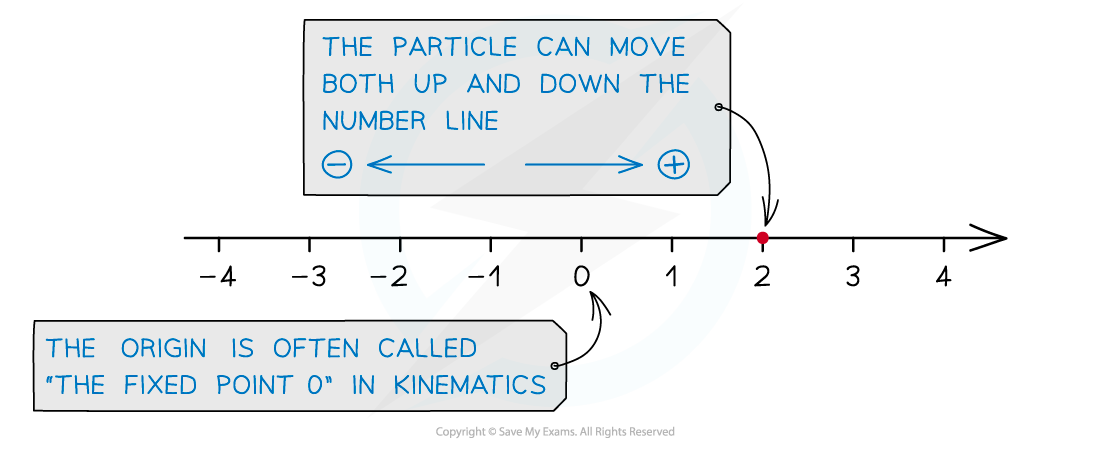
- Motion is in a?straight?line –?think of the particle as moving along a number line
- The number line has a?fixed point O?(the origin)
- The number line has both negative and positive values
- The particle can move in both directions along the number line
- Note that in kinematics, a particle is an object – it could be a football, a car, a train - anything that has motion.? A particle is modelled as taking up a single point in space
- Ensure you are familiar with Differentiation - Basics andDifferentiation – Turning Points before continuing
- It may be wise to look at Differentiation – Problem Solving too
What is displacement; isn’t it the same as distance?
- Displacement?is a vector quantity, so it can be negative
- Distance?is always positive
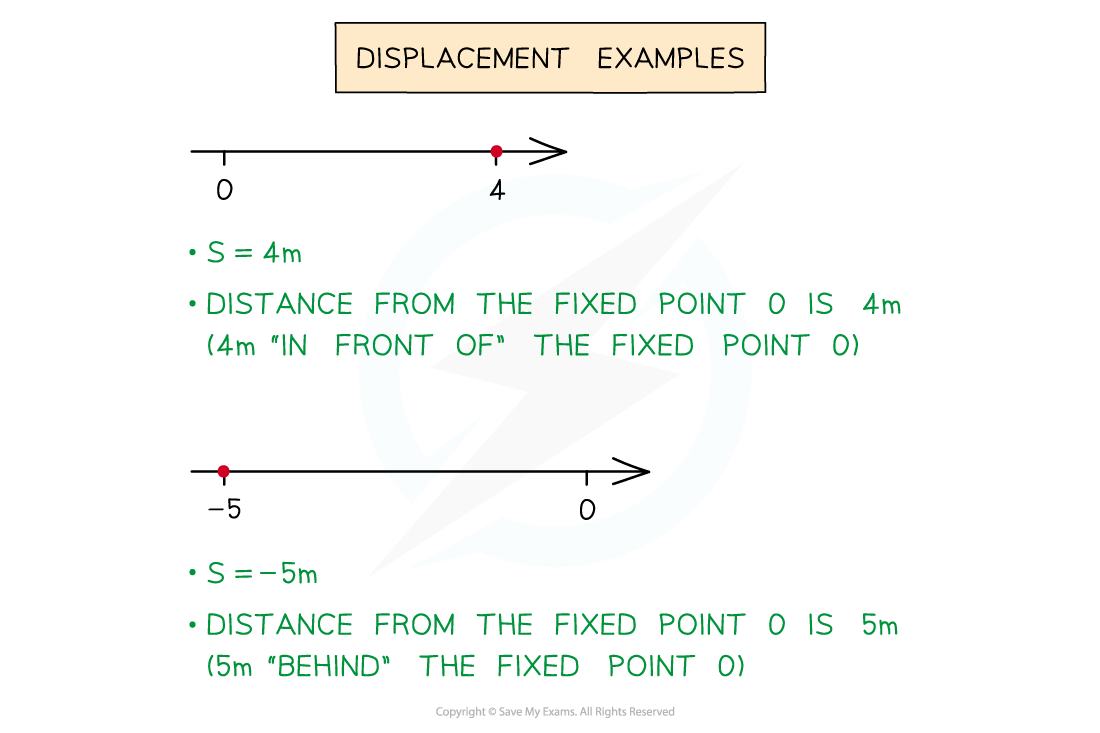
- Displacement?is measured from?the?fixed point?O
- The letter?s?is used for displacement
- It is usually measured in metres (m)
- If?s = 4?then the distance from the origin is 4 m and the particle is 4 m “in front of” the origin
- If?s =-5?then the distance from the origin is 5 m and the particle is 5 m “behind” the origin
- The + or - indicates the particle’s?position?relative to the origin
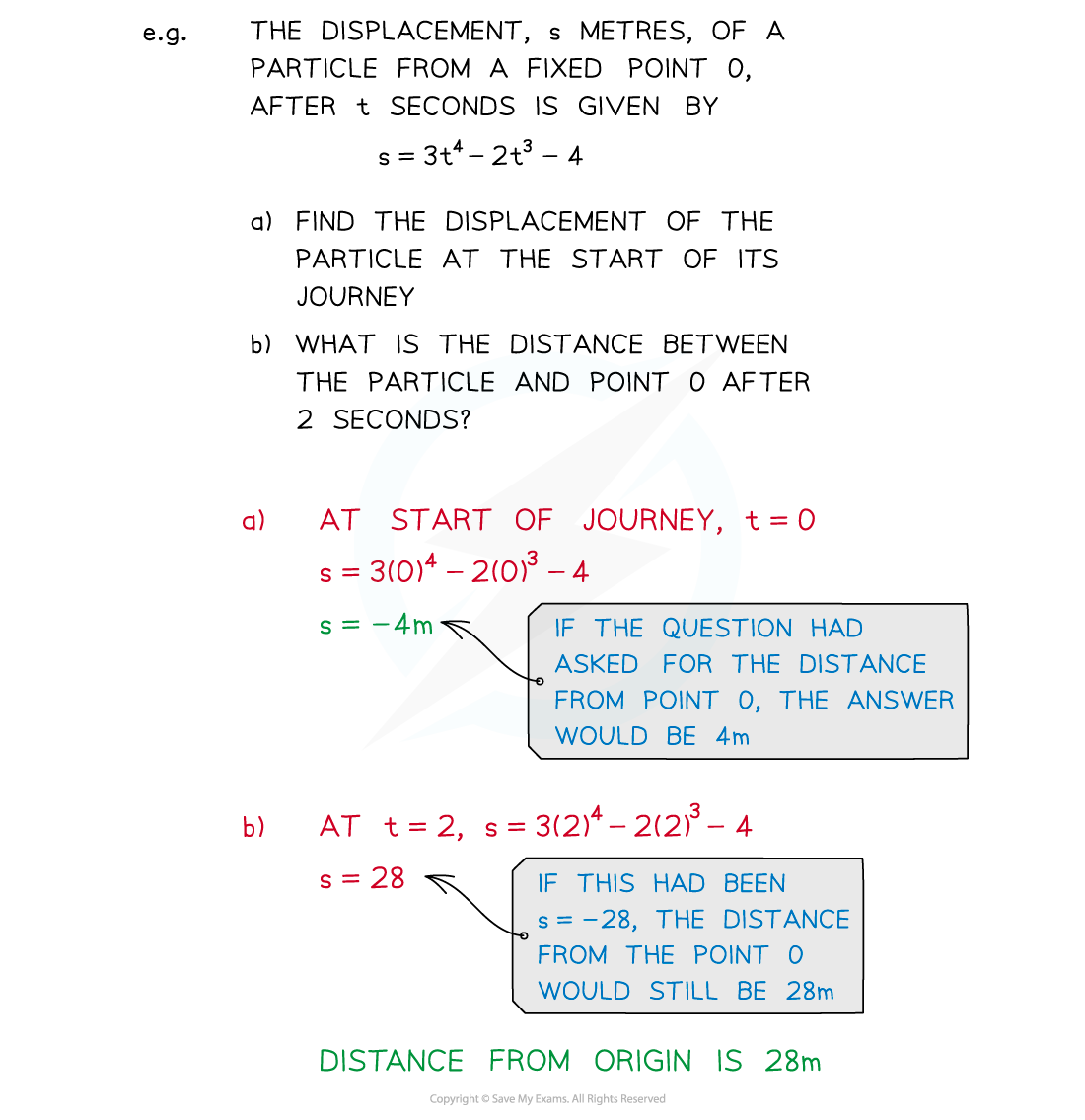
- Displacement?is a function of?time,?t, where time is usually measured in seconds
- eg.?s = 3t3?- 2t + 1
At time?t = 0,?s = 1At time?t = 2,?s = 21
- eg.?s = 3t3?- 2t + 1
?
What is velocity; isn’t it the same as speed?
- Velocity?is a vector quantity, so it can be negative
- Speed?is always positive
- The letter?v?is used for velocity
- It is usually measured in metres per second (m/s)
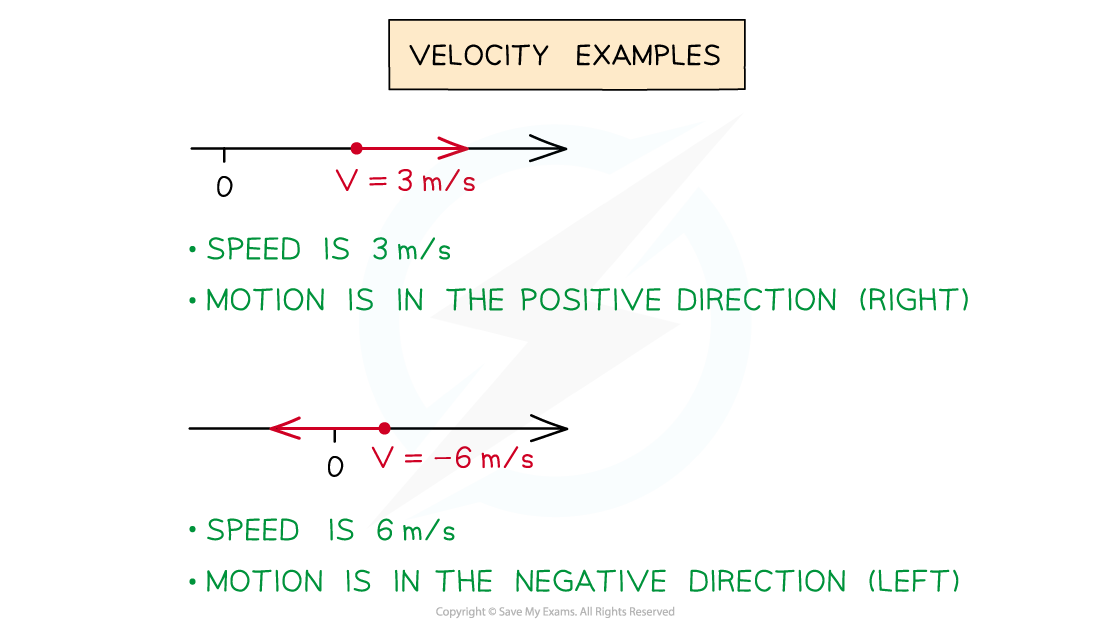
- If?v = 3?then the speed of the particle is 3 m/s and it is moving in the positive direction
- If?v = -6?then the speed of the particle is 5 m/s and it is moving in the negative direction
- The + or - indicates the particle’s?direction?of motion
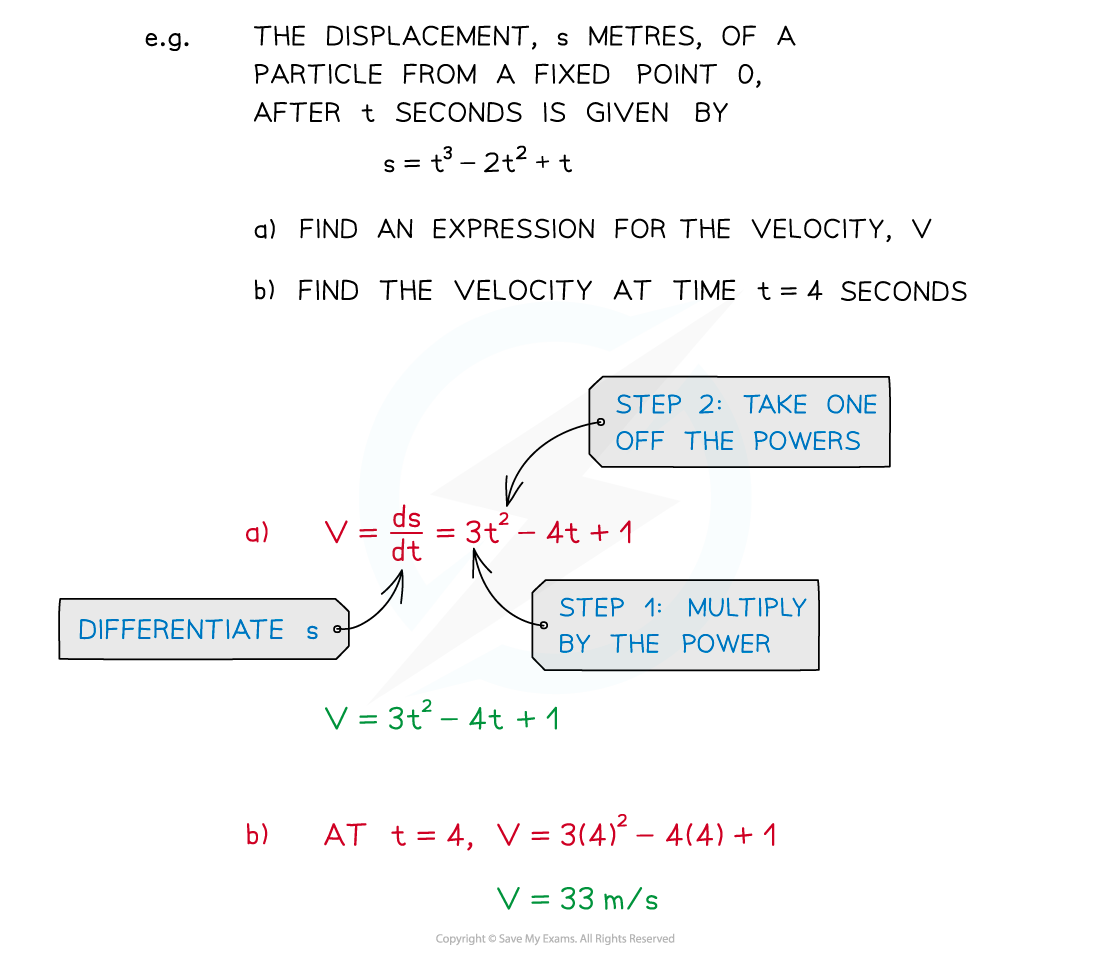
- Velocity?is a function of?time,?t, and is the?rate of change?of?displacement
- To find?v,?differentiate?s, ie.?v = ds/dt
If?s = t3?- 2t2then?v = ds/dt = 3t2?– 4t
- To find?v,?differentiate?s, ie.?v = ds/dt
- If?velocity?is?zero?then the particle is?stationary?(not moving)
?
What is acceleration?
- Acceleration?is a vector quantity, so it can be negative
- The?magnitude?of acceleration is always positive
- The letter?a?is used for acceleration
- It is usually measured in metres per square second (m/s2)
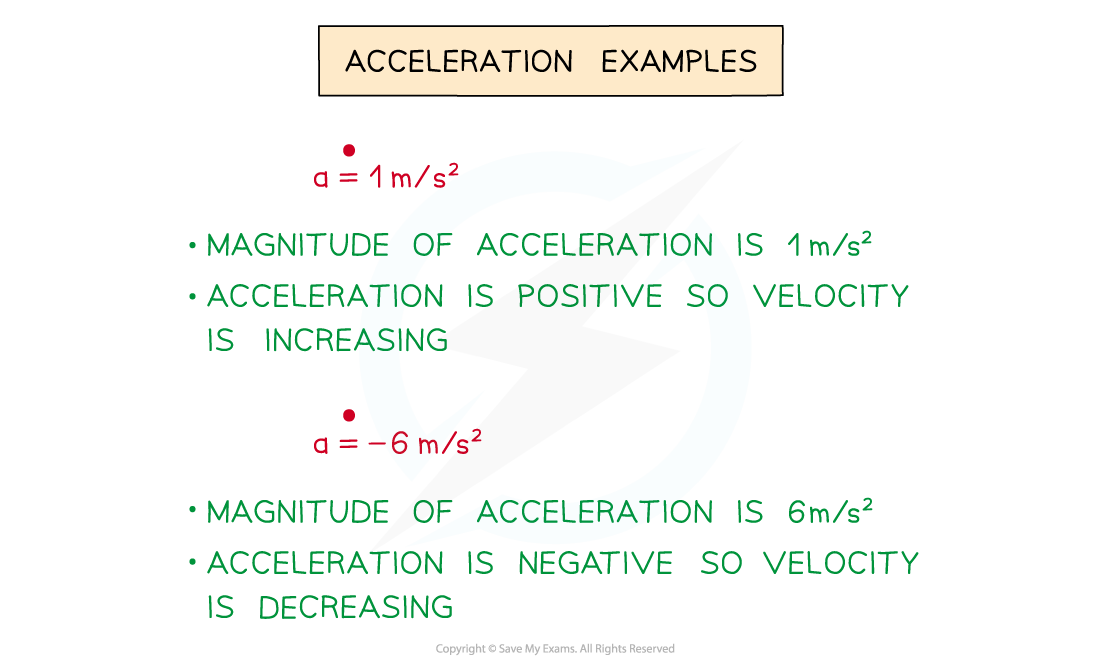
- If?a = 1?then the magnitude of acceleration is 1 m/s2?and the particle is?accelerating?(velocity increasing)
- If?a = -6?then the magnitude of acceleration is 6 m/s2?and the particle is?decelerating?(velocity decreasing)
- The + or - indicates whether the particle is?accelerating?or?decelerating
?
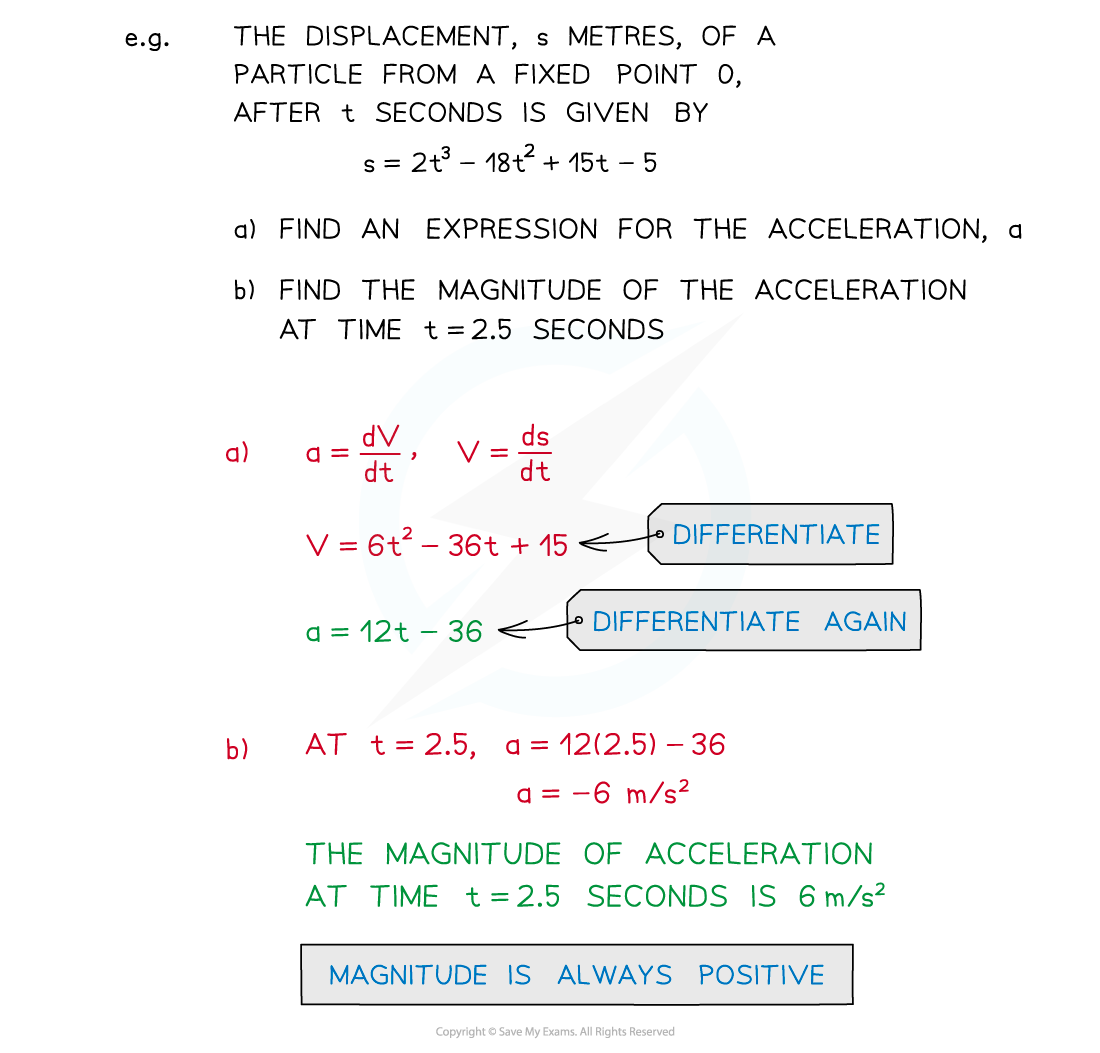
- Acceleration?is a function of?time,?t, and is the?rate of change?of?velocity
- To find?a, differentiate?v, ie.?a = dv/dt
If?v = 3t2?– 4tthen?a = dv/dt = 6t - 4
- To find?a, differentiate?v, ie.?a = dv/dt
- If?acceleration?is?zero?then the particle is moving at a?constant?velocity
?
How do I solve kinematics problems?
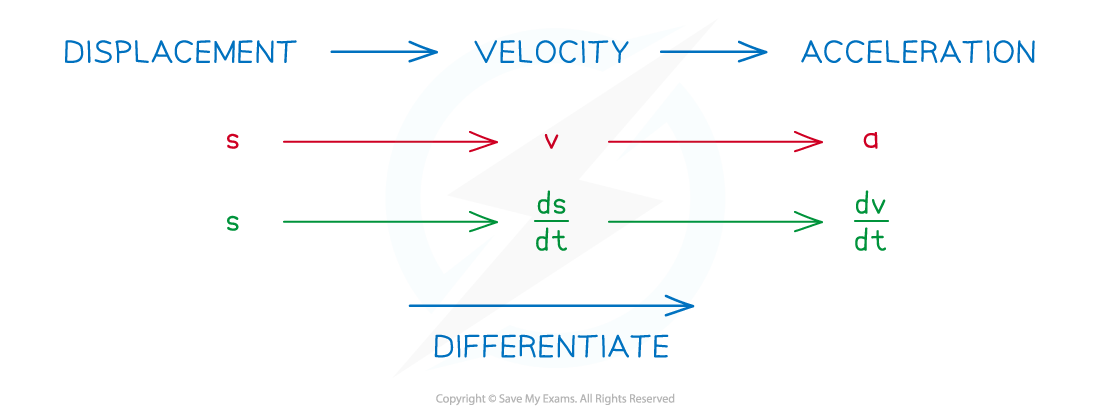
- Be clear about how the three quantities are related through differentiation
- v = ds/dt
- a = dv/dt
- There are some key phrases to look out for
- “...?initial?...” / “...?initially?...”
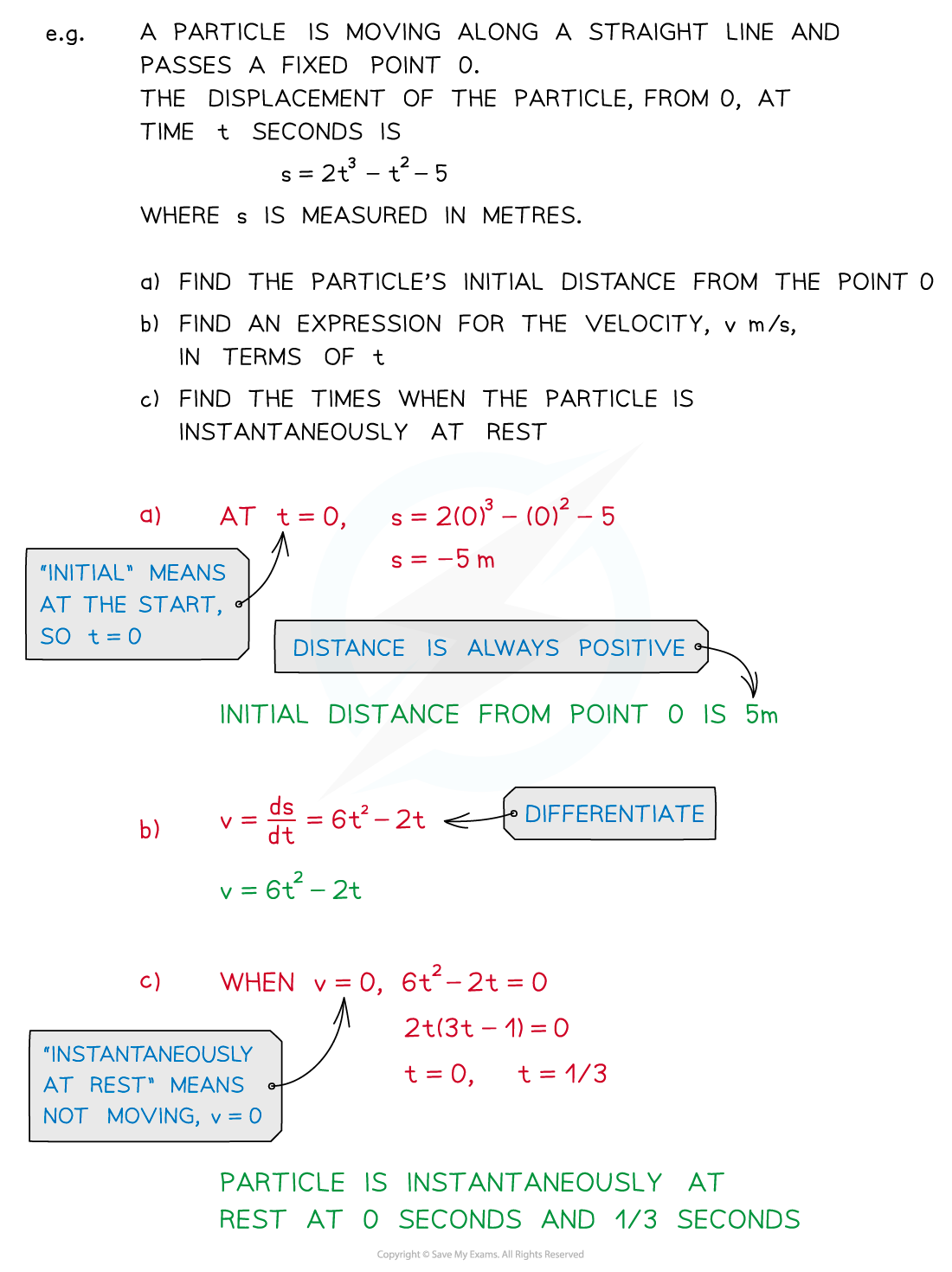
This means at the?start, so when?t = 0
- “... at?rest?...”
This means the particle is?stationaryso?v = 0
- “...?instantaneously?...”This means at some point in time, for some value of t
- “...?initial?...” / “...?initially?...”
- For example,“Find the value(s)s of?t?for which the particle is instantaneously at rest”
- means find the time(s) when?v = 0,
- ie. solve the equation?v = 0
Exam Tip
Displacement,?velocity?and?acceleration?can all be negative whereas?distance,?speed?and?magnitude?of?acceleration?are always positive.
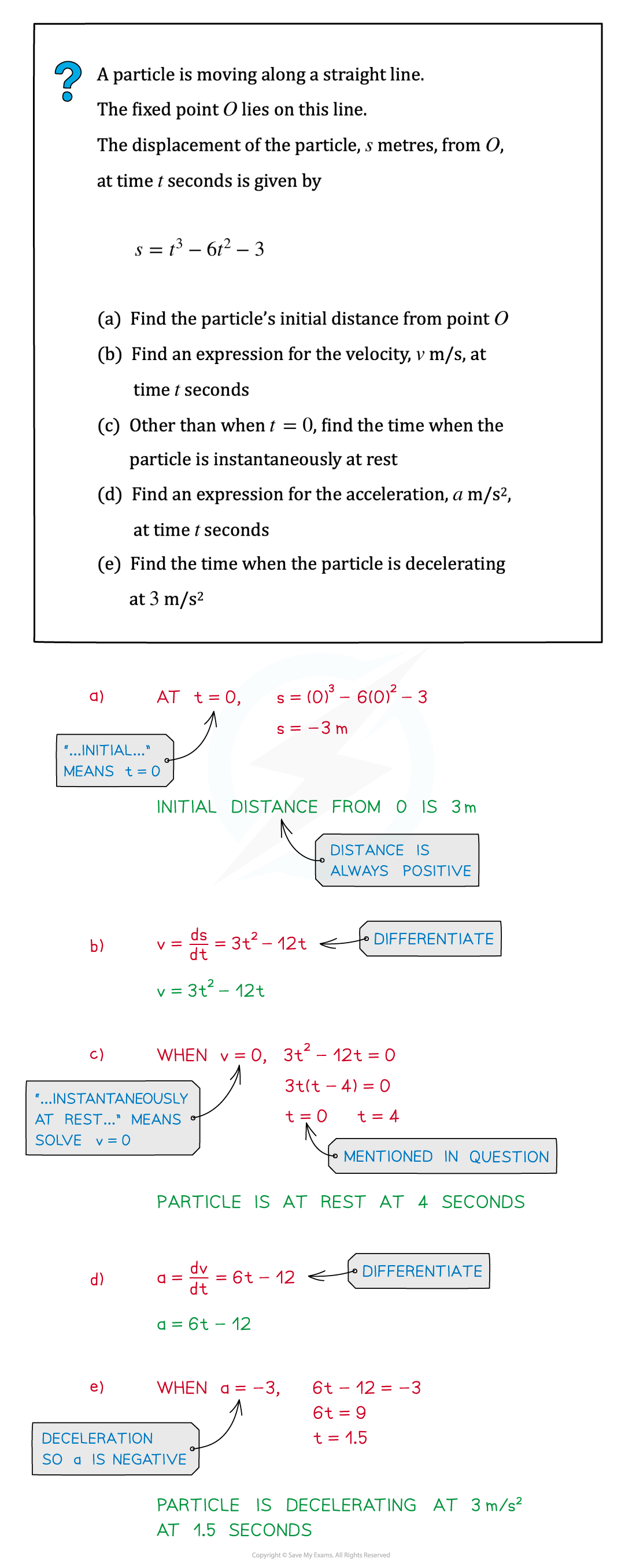
Worked Example
轉載自savemyexam
以上就是關于【Edexcel IGCSE Maths 復習筆記 3.11.4 Differentiation - Kinematics】的解答,如需了解學校/賽事/課程動態,可至翰林教育官網獲取更多信息。
往期文章閱讀推薦:
IGCSE全A*,A-Level階段卻崩了?別忽視IGCSE選課的重要性!
2026 CAIE IGCSE 夏季大考放榜!A* 線全面揭曉,今年真的卷到新高度?


翰林AMC8視頻課重磅上線!

國際競賽真題資源免費領取






