AQA A Level Biology復習筆記5.3.1 Primary Producers

Plants are Primary Producers
- An?ecosystem?in a?particular area?includes:
- All the?living?components (i.e.?biotic factors?such as organisms and their interactions)
- All the?non-living?components (i.e.?abiotic factors?such as temperature and rainfall)
- All ecosystems include (and depend on)?primary producers
- Primary producers are organisms that?make their own glucose
- For example,?plants?and?algae?produce glucose via?photosynthesis
- Even deep-sea ecosystems such as those around hydrothermal vents (where there is?no light) depend on?primary producers?(in this case bacteria) that use a process known as chemosynthesis to make glucose from the chemicals released from these vents
- In ecosystems where?sunlight?and?water?is available, the process of photosynthesis enables plants to?synthesise?organic compounds (glucose?and other sugars) from?carbon dioxide
- In?terrestrial?(land-based) ecosystems, plants use CO2?from the?atmosphere
- In?aquatic?(water-based) ecosystems, plants use CO2?dissolved in the water
- The process of photosynthesis transforms?light energy?into?chemical energy?held in biological molecules
- The chemical energy in these biological molecules can then be used by other organisms within the community known as?consumers?(i.e. the organisms in?higher trophic levels)
- Primary consumers?(herbivores or omnivores) feed on producers
- Secondary consumers?(carnivores or omnivores) feed on primary consumers
- Tertiary consumers?(carnivores or omnivores) feed on secondary consumers
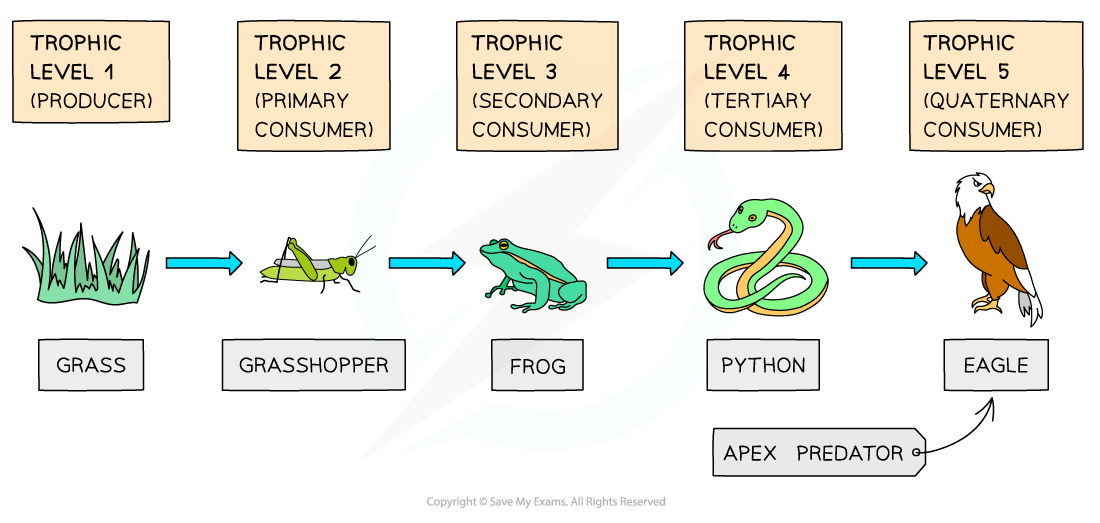
Trophic levels for a simple food chain - the blue arrows show how the chemical energy originally produced by the primary producer (grass) is transferred to other organisms in the community
轉載自savemyexams
以上就是關于【AQA A Level Biology復習筆記5.3.1 Primary Producers】的解答,如需了解學校/賽事/課程動態,可至翰林教育官網獲取更多信息。
往期文章閱讀推薦:
MIT官方發布【2026年夏季推薦閱讀書單】!橫跨科學/人文/經濟...


翰林AMC8視頻課重磅上線!

國際競賽真題資源免費領取






