CIE A Level Chemistry復習筆記2.3.2 Chemical Properties: Halogens & Hydrogen Halides

Group 17: Oxidising Agents
- Halogens react with metals by accepting an electron from the metal atom to become an ion with 1- charge
Eg.? ?Ca(s) + Cl2(g) → Ca2+(Cl-)2(s)
- Halogens are therefore?oxidising agents:
- Halogens?oxidise?the metal by removing an electron from the metal (the oxidation number of the metal increases)
- Halogens become?reduced?as they gain an extra electron from the metal atom (the oxidation number of the halogen decreases)
- The?oxidising power?of the halogens?decreases?going?down the group?(the halogens get less reactive)
- This can be explained by looking at their electronegativities:
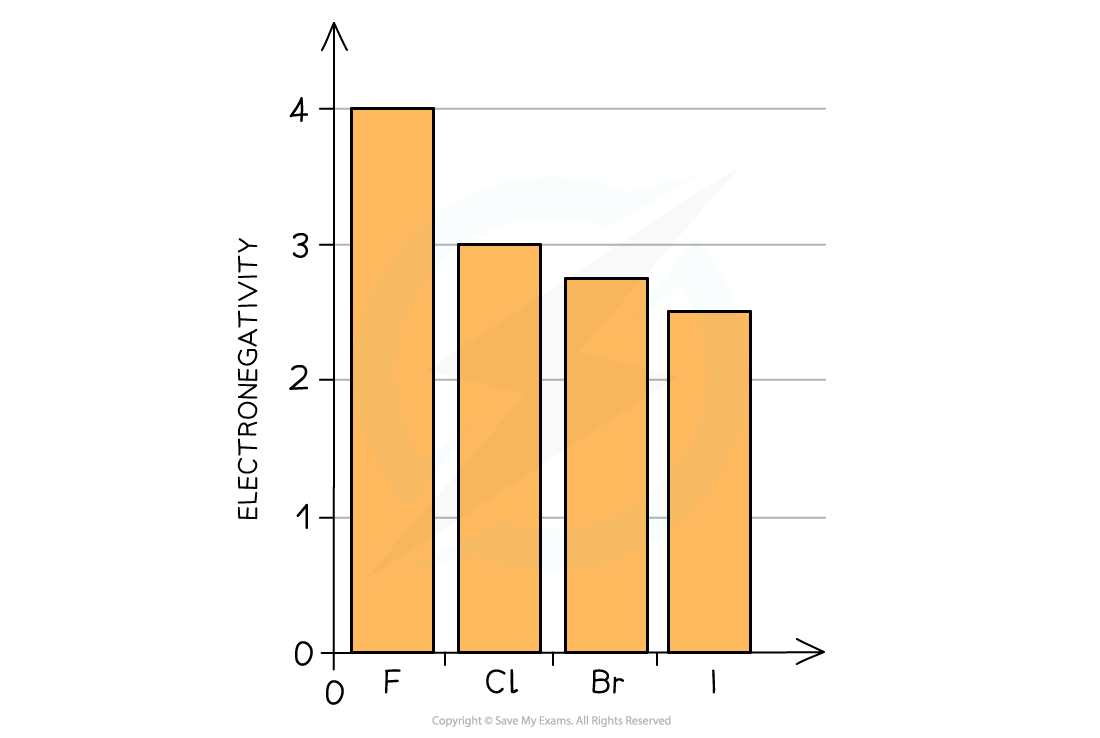
The electronegativity of the halogens decreases going down the group
- The?electronegativity?of an atom refers to how strongly it attracts electrons towards itself in a covalent bond
- The decrease in electronegativity is linked to the size of the halogens
- Going down the group, the atomic radii of the elements increase which means that the outer shells get further away from the nucleus
- An ‘incoming’ electron will therefore experience more?shielding?from the attraction of the positive nuclear charge
- The halogens’ ability to accept an electron (their?oxidising power) therefore decreases going down the group
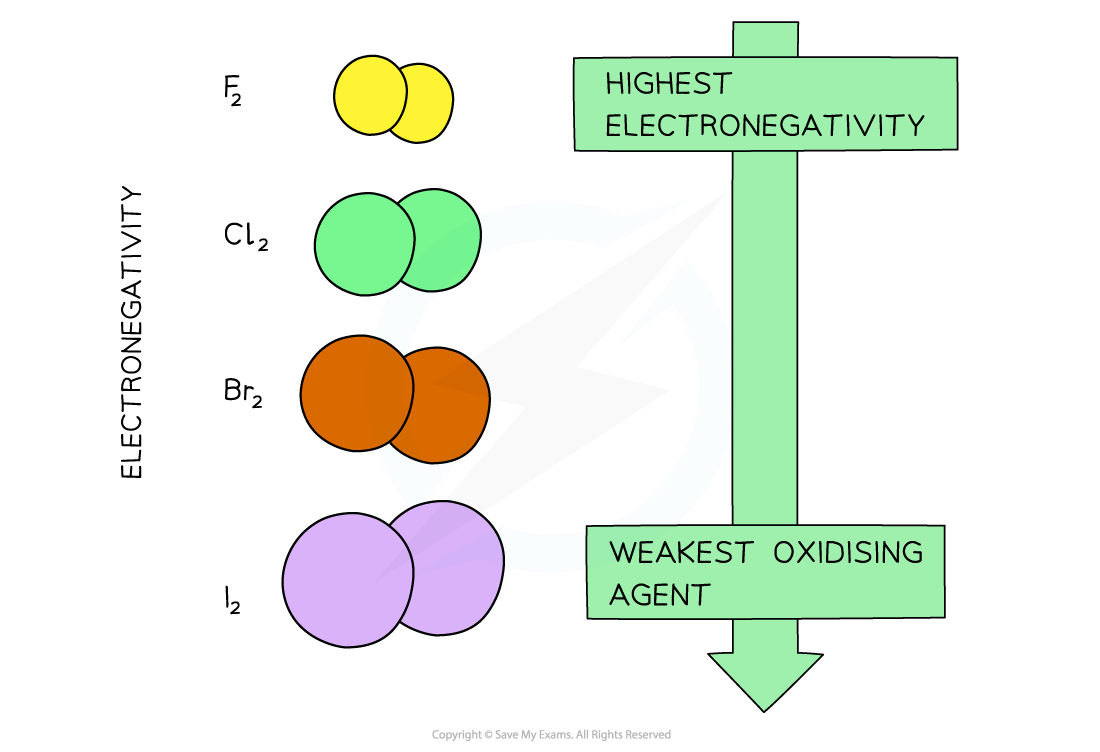
With increasing atomic size of the halogens (going down the group) their electronegativity, and therefore oxidising power, decreases
- The reactivity of halogens is also shown by their?displacement?reactions?with other halide ions in solutions
- A?more?reactive?halogen can displace a?less reactive?halogen from a halide solution of the less reactive halogen
- Eg. The addition of chlorine water to a solution of bromine water:
Cl2(aq) + 2NaBr(aq) → 2NaCl(aq) + Br2(aq)
-
- The chlorine has displaced the bromine from solution as it is more reactive which can be summarised in the following ionic equation:
Cl2(aq) + 2Br-(aq) → 2Cl-(aq) + Br2(aq)
Group 17: Reaction with Hydrogen
- Halogens react with hydrogen gas to form?hydrogen halides
- Due to the decrease in reactivity of the halogens going down the group, the reactions between halogen and hydrogen gas become less vigorous
- The table below shows a summary of the reaction between halogen and hydrogen gas
Reaction between halogen & hydrogen gas
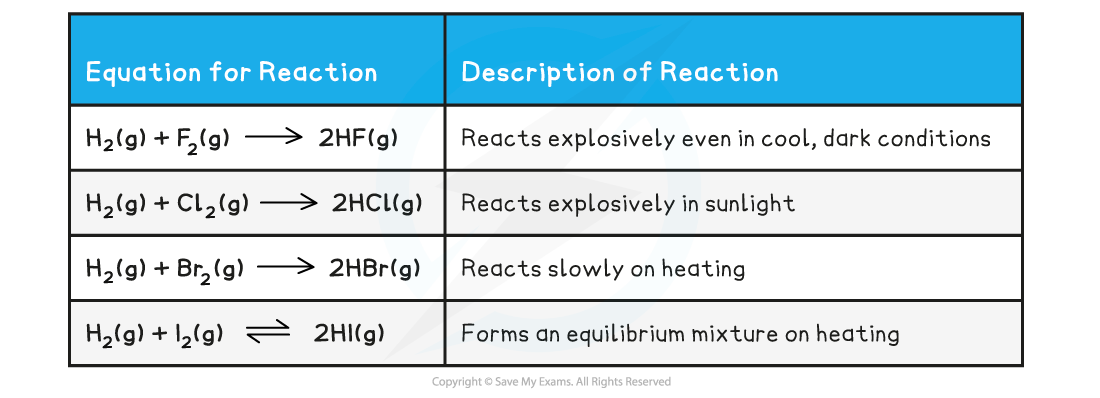
Thermal Stability of the Hydrogen Halides
- Thermal stability?refers to how well a substance can resist breaking down when heated
- A substance that is thermally stable will break down at high temperatures
- The hydrogen halides formed from the reaction of halogen and hydrogen gas decrease in?thermal?stability?going down the group
- The decrease in thermal stability can be explained by looking at the bond energies of the hydrogen-halogen bond
- Going down the group, the atomic radius of the halogens increases
- The overlap of its outer shell with a hydrogen atom therefore gives a longer bond length
- The longer the bond, the weaker it is, and the less energy required to break it
- As the bonds get weaker, the hydrogen halogens become less stable to heat going down the group
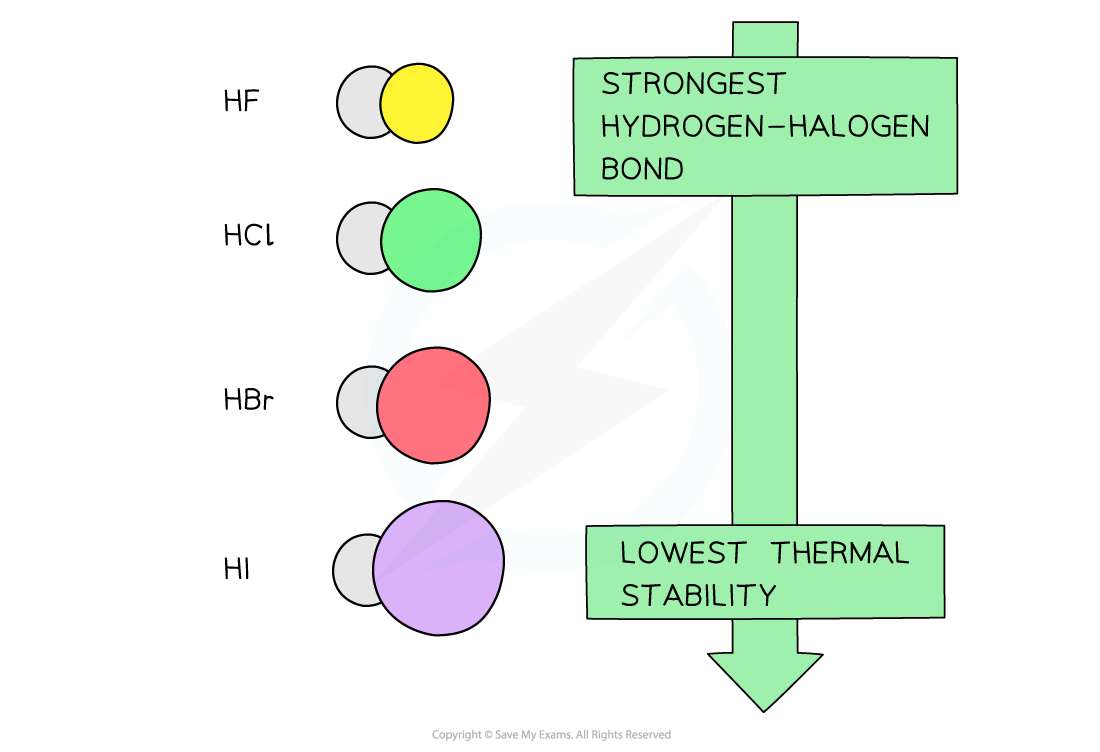
The thermal stability of the hydrogen halide decreases going down the group as their bonds become weaker due to the increased atomic radius of the halogens
轉載自savemyexams
以上就是關于【CIE A Level Chemistry復習筆記2.3.2 Chemical Properties: Halogens & Hydrogen Halides】的解答,如需了解學校/賽事/課程動態,可至翰林教育官網獲取更多信息。
往期文章閱讀推薦:
2026 ALEVEL 夏考A率出爐!愛德思vs牛津AQA,哪些科目真的“好出分”?
2026 AMC10/12美國數學競賽新賽季!【翰林教育 × 清華大學出版社】獨家教材全面發售!


翰林AMC8視頻課重磅上線!

國際競賽真題資源免費領取






