CIE A Level Chemistry復(fù)習(xí)筆記2.3.1 Physical Properties of the Group 17 Elements

Group 17: Physical Trends
- The group 17 elements are called?halogens
- The halogens have uses in water purification and as bleaches agents (chlorine), as flame-retardants and fire extinguishers (bromine) and as antiseptic and disinfectant agents (iodine)
Colours
- All halogens have distinct?colours?which get?darker?going down the group
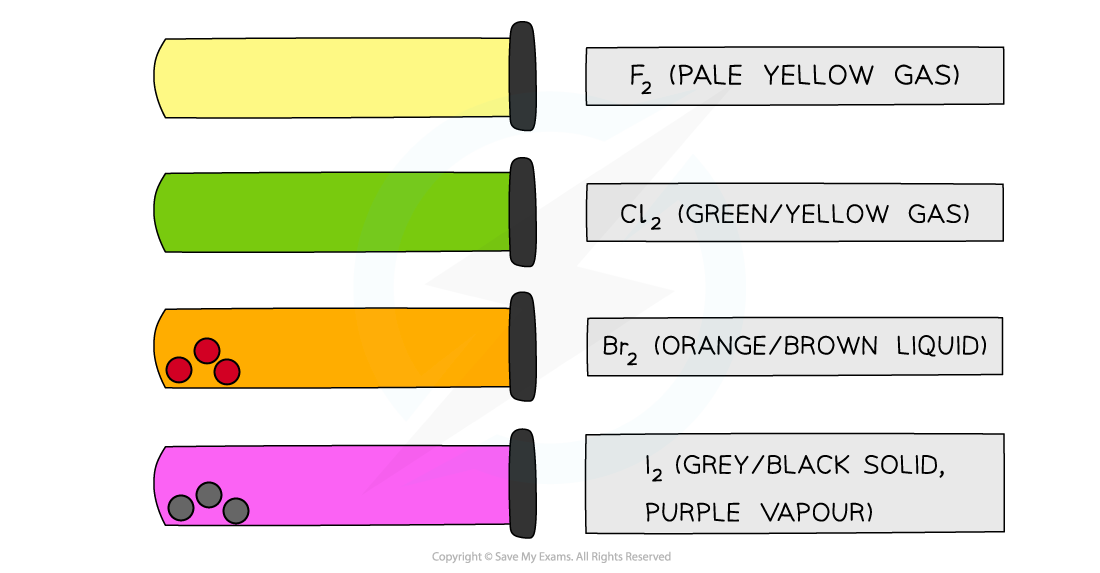 The colours of the Group 17 elements get darker going down the group
Volatility
- Volatility?refers to how easily a substance can evaporate
- A volatile substance will have a low melting and boiling point
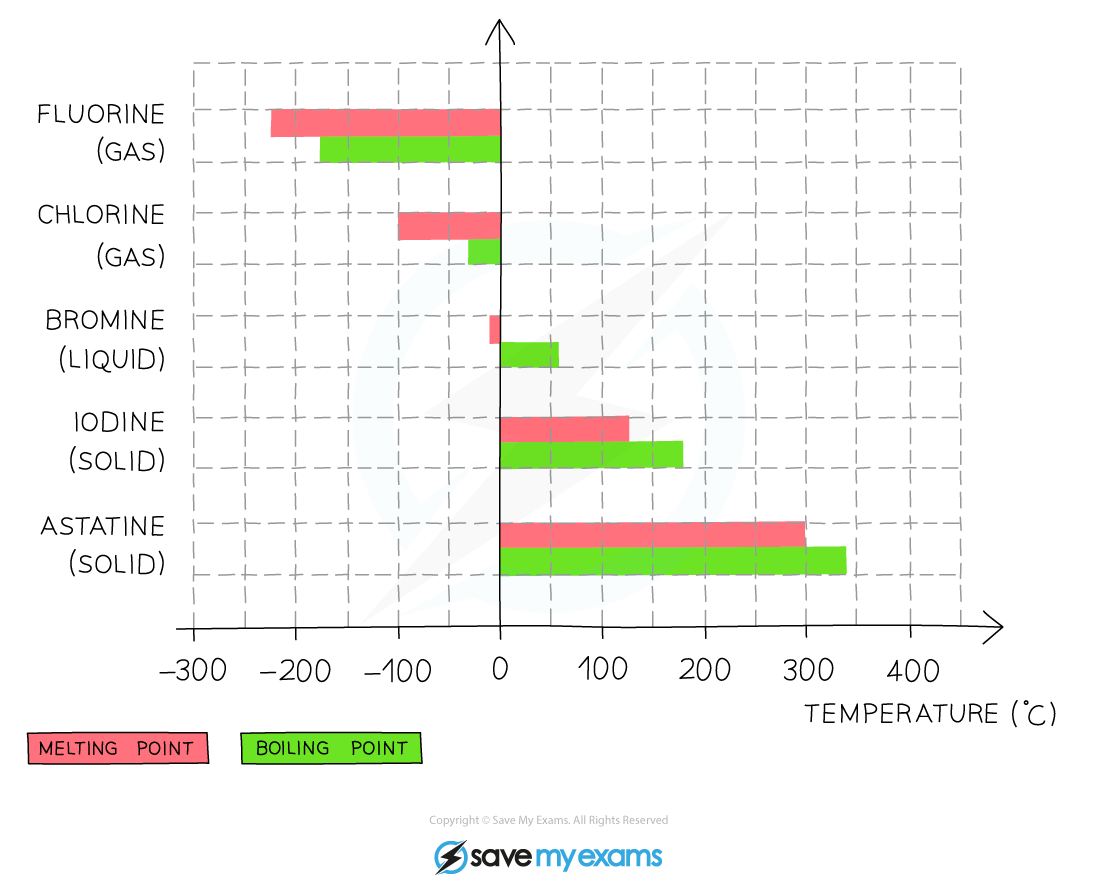
The melting & boiling points of the Group 17 elements increase going down the group which indicates that the elements become less volatile
- Going down the group, the?boiling point?of the elements increases which means that the?volatility?of the halogens decreases
- This means that fluorine is the most volatile and iodine the least volatile
Group 17: Trends in Bond Strength
- Halogens are?diatomic?molecules in which?covalent bonds?are formed by overlapping their orbitals
- In a covalent bond, the?bonding pair?of electrons is attracted to the nuclei on either side and it is this attraction that holds the molecule together
- Going down the group, the atomic size of the halogens?increases
- The bonding pair of electrons get further away from the halogen nucleus and are therefore less strongly attracted towards in
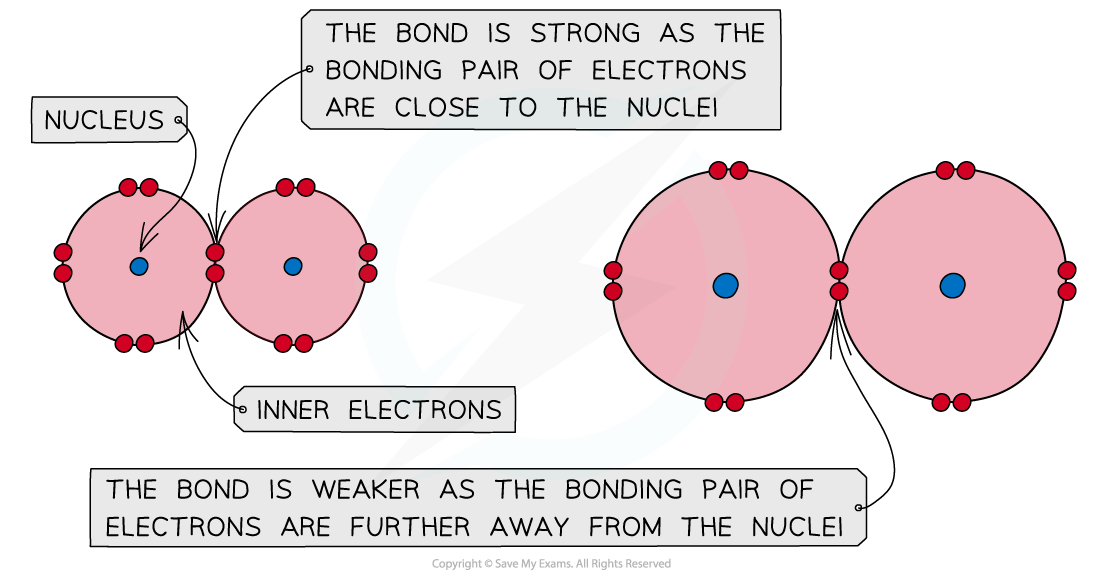
A covalent bond is formed by the orbital overlap of two atoms and the attraction of electrons towards the nuclei; The bigger the atom, the weaker the covalent bond
- The bond strength of the halogen molecules therefore decreases going down the group
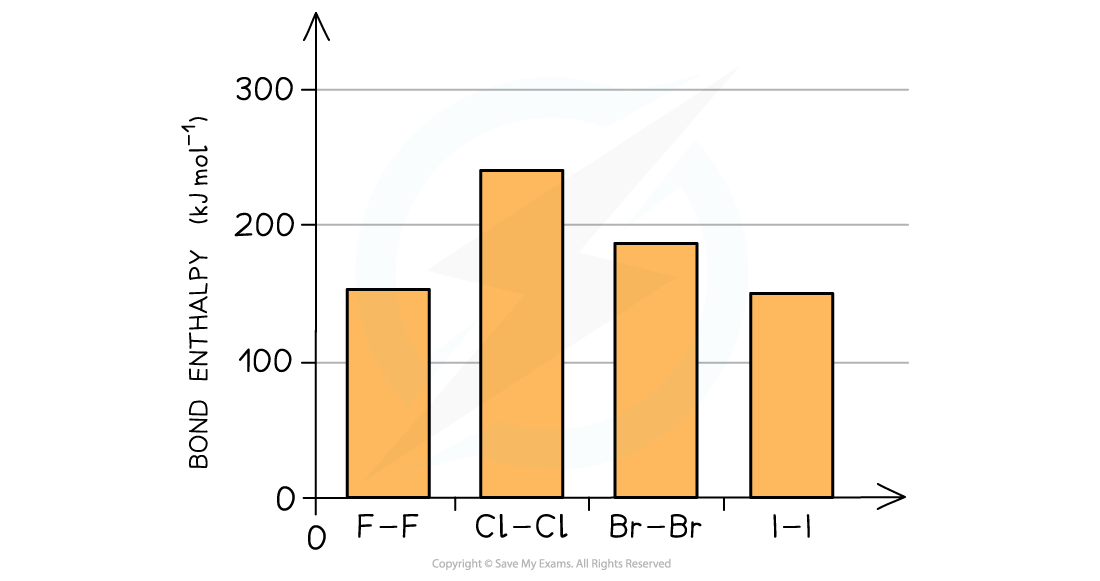 The bond enthalpies decrease indicating that the bond strengths decrease going down the group
- Bond enthalpy is the heat needed to break one mole of a covalent bond
- The higher the bond enthalpy, the stronger the bond
- An exception to this is?fluorine?which has a smaller bond enthalpy than chlorine and bromine
- Fluorine is so small that when two atoms of fluorine get together their?lone?pairs?get so close that they cause significant?repulsion?counteracting the attracting between the bonding pair of electrons and two nuclei
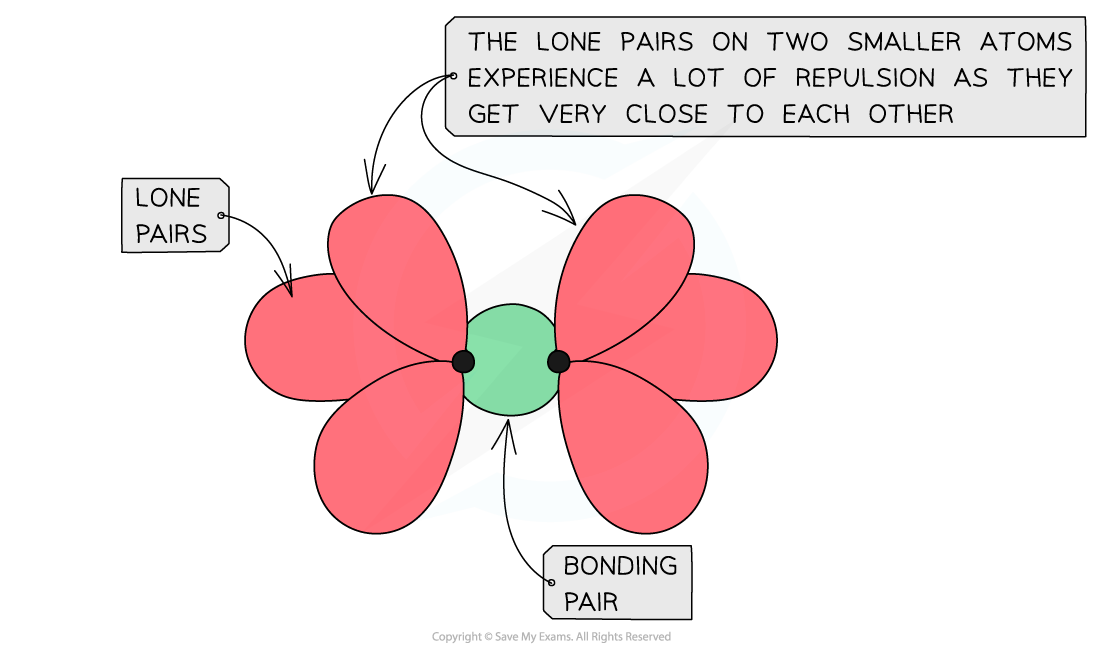 The lone pairs on fluorine get so close to each other in a fluorine molecule that they cause repulsion which decreases the bond strength
Group 17: Dipole Forces & Volatility
- Halogens are non-metals and are?diatomic molecules?at room temperature
- This means that they exist as molecules which are made up of two similar atoms, such as F2
- The halogens are?simple molecular structures?with?weak?van der Waals’ forces between the diatomic molecules caused by instantaneous dipole-induced dipole forces
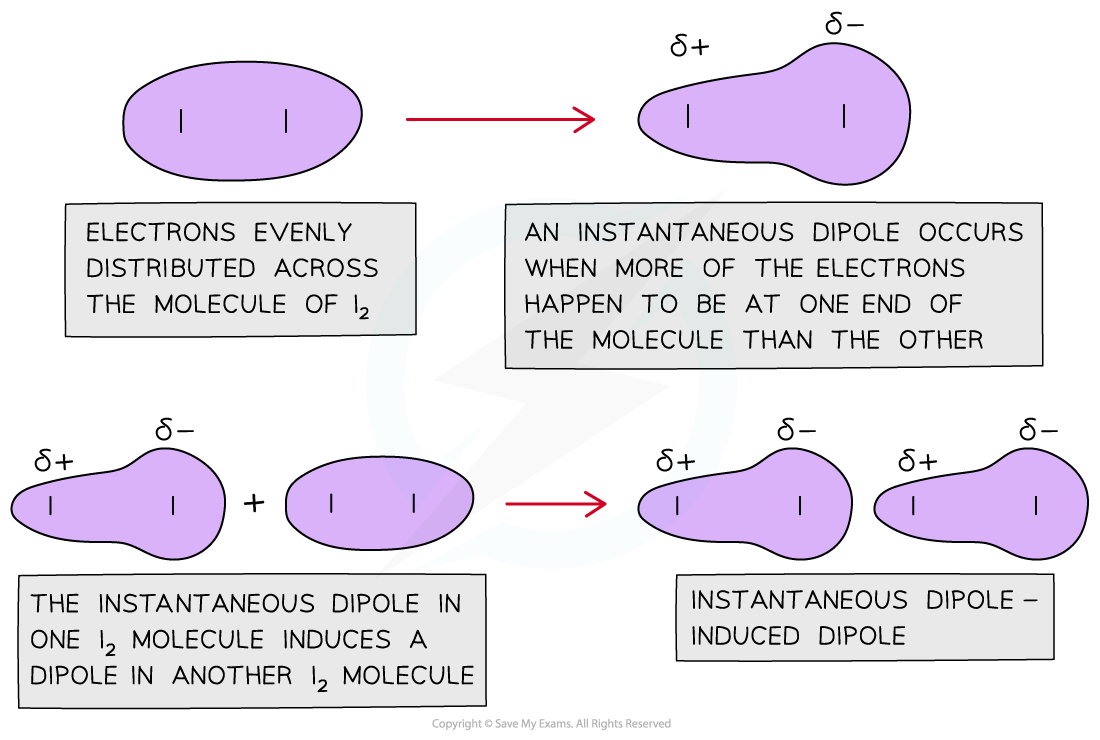 The diagram shows that a sudden distribution of electrons in a nonpolar molecule can cause an instantaneous dipole. When this molecule gets close to another non-polar molecule it can induce a dipole as the cloud of electrons repel the electrons in the neighbouring molecule to the other side
- The more?electrons?there are in a molecule, the greater the instantaneous dipole-induced dipole forces
- Therefore, the?larger?the molecule the?stronger?the van der Waals’ forces between molecules
- This is why as you go down the group, it gets more difficult to separate the molecules and the?melting?and?boiling points?increase
- As it gets more difficult to separate the molecules, the?volatility?of the halogens?decreases?going down the group
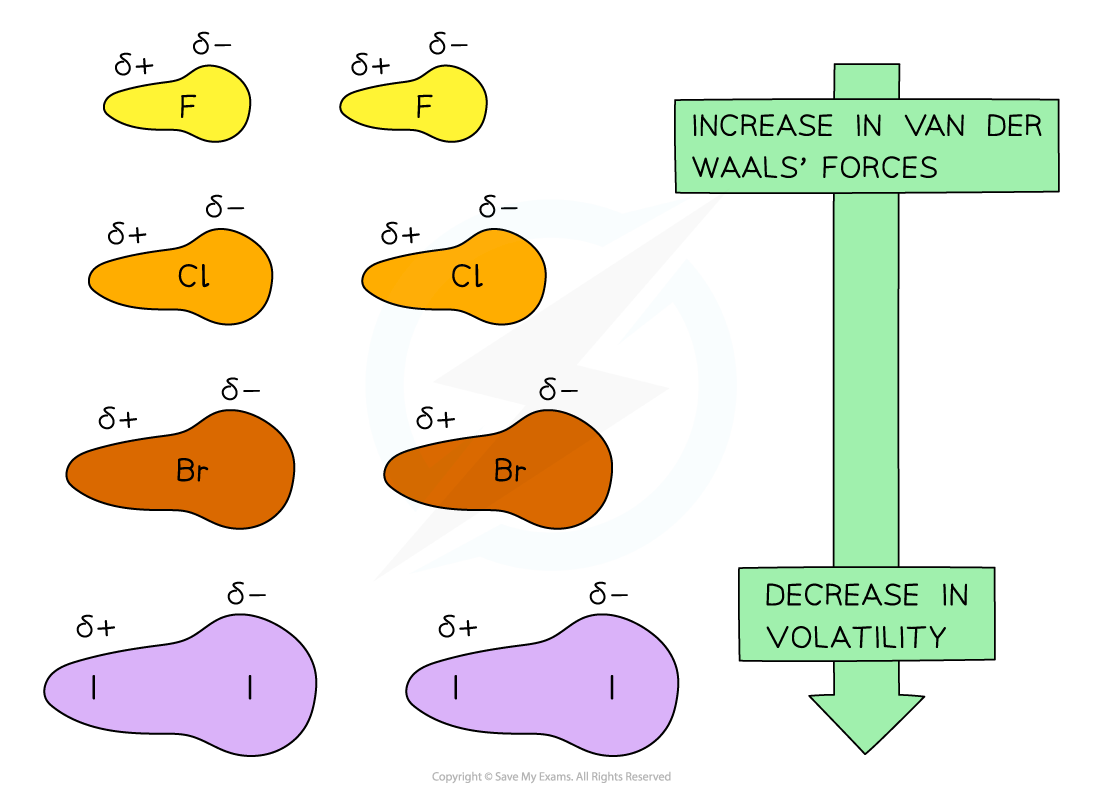 Going down the group, the van der Waals’ forces increase due to an increased number of electrons in the molecules which means that the volatility decreases
Exam Tip
Instantaneous induced – induced dipole forces are a type of van der Waals’ forces.
轉(zhuǎn)載自savemyexams
以上就是關(guān)于【CIE A Level Chemistry復(fù)習(xí)筆記2.3.1 Physical Properties of the Group 17 Elements】的解答,如需了解學(xué)校/賽事/課程動(dòng)態(tài),可至翰林教育官網(wǎng)獲取更多信息。
往期文章閱讀推薦:
2026 ALEVEL 夏考A率出爐!愛德思vs牛津AQA,哪些科目真的“好出分”?
2026 AMC10/12美國(guó)數(shù)學(xué)競(jìng)賽新賽季!【翰林教育 × 清華大學(xué)出版社】獨(dú)家教材全面發(fā)售!


翰林AMC8視頻課重磅上線!

國(guó)際競(jìng)賽真題資源免費(fèi)領(lǐng)取






