IB DP Chemistry: HL復(fù)習(xí)筆記11.1.4 Infrared Spectroscopy

How IR Spectroscopy works
- All?covalent bonds?act rather like springs, as opposed to rigid bars
- Like springs, the bonds can vibrate in a number of different ways
- The frequency of vibration occurs in the?infra-red region?of the?electromagnetic spectrum
- If an organic molecule is irradiated with?infra-red?energy?that matches the?natural vibration frequency?of its bonds, it absorbs some of that energy and the amplitude of vibration increases
- This is known as?resonance
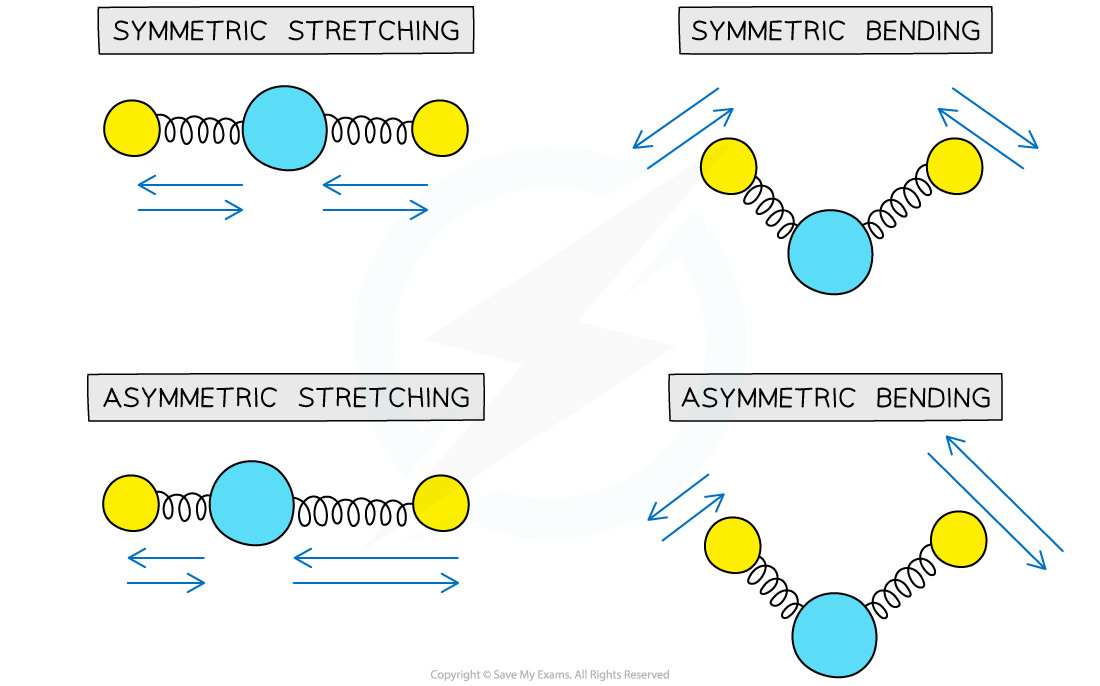
Different modes of vibration in molecules. Each mode has a characteristic frequency of vibration
Infrared (IR) spectroscopy
- Infrared (IR) spectroscopy?is a technique used to identify compounds based on changes in?vibrations?of atoms when they?absorb?IR of certain?frequencies
- A?spectrophotometer?irradiates the sample with IR radiation and then detects the?intensity?of?IR radiation?absorbed by the molecule
- IR?energy?is absorbed only if a molecule has a?permanent dipole?that changes as it vibrates
- Symmetrical molecules such as O2?or H2, are therefore?IR inactive
- The?resonance frequency?is the specific frequency at which the bonds will vibrate
- Rather than displaying frequency, an?IR spectrum?shows a unit called?wavenumber
- Wavenumber?is the reciprocal of the?wavelength?and has units of?cm-1
- Characteristic absorptions can be matched to specific bonds in molecules
- This enables chemists to determine the?functional groups?present
Absorption Range of Bonds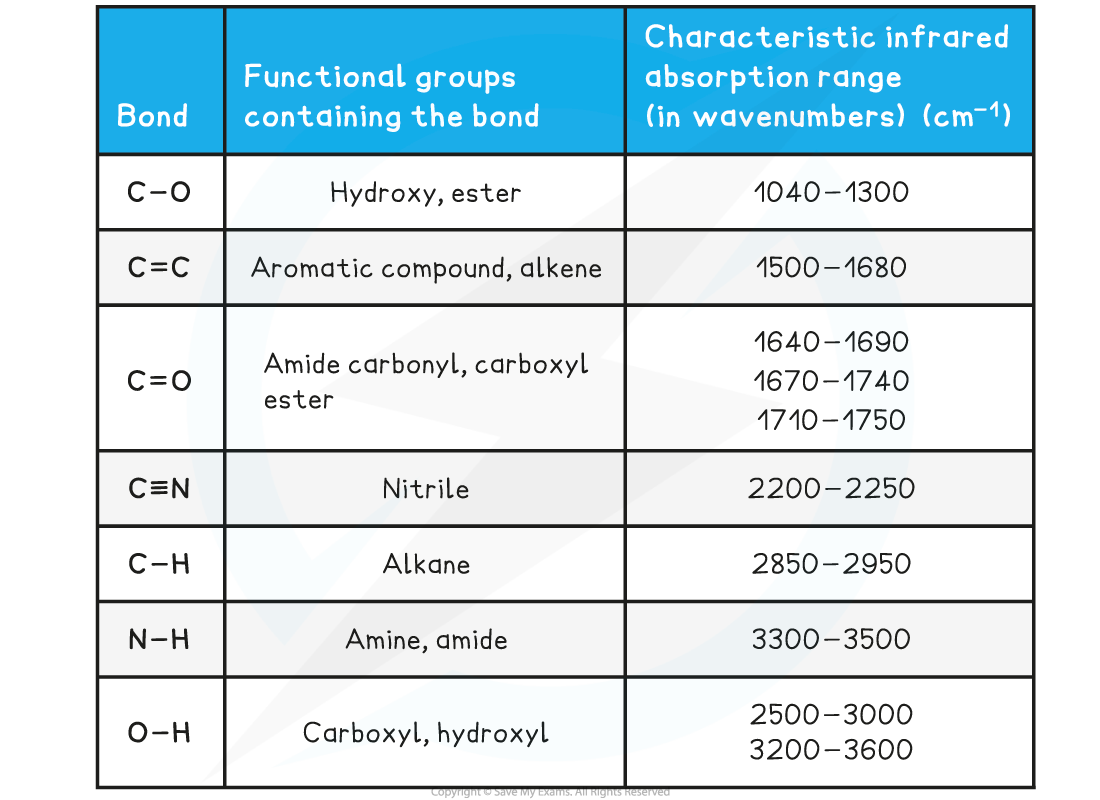
- Due to some absorption bands overlapping each other, other analytical techniques such as?mass spectroscopy?should be used alongside?IR spectroscopy?to identify an unknown compound
Interpreting an IR Spectrum
- The best way to understand how to interpret an?IR spectrum?is by looking at examples and becoming familiar with the characteristic features of an?IR spectrum
Worked Example
Examine the two spectra shown and determine which one belongs to propan-2-ol and which one belongs to propanone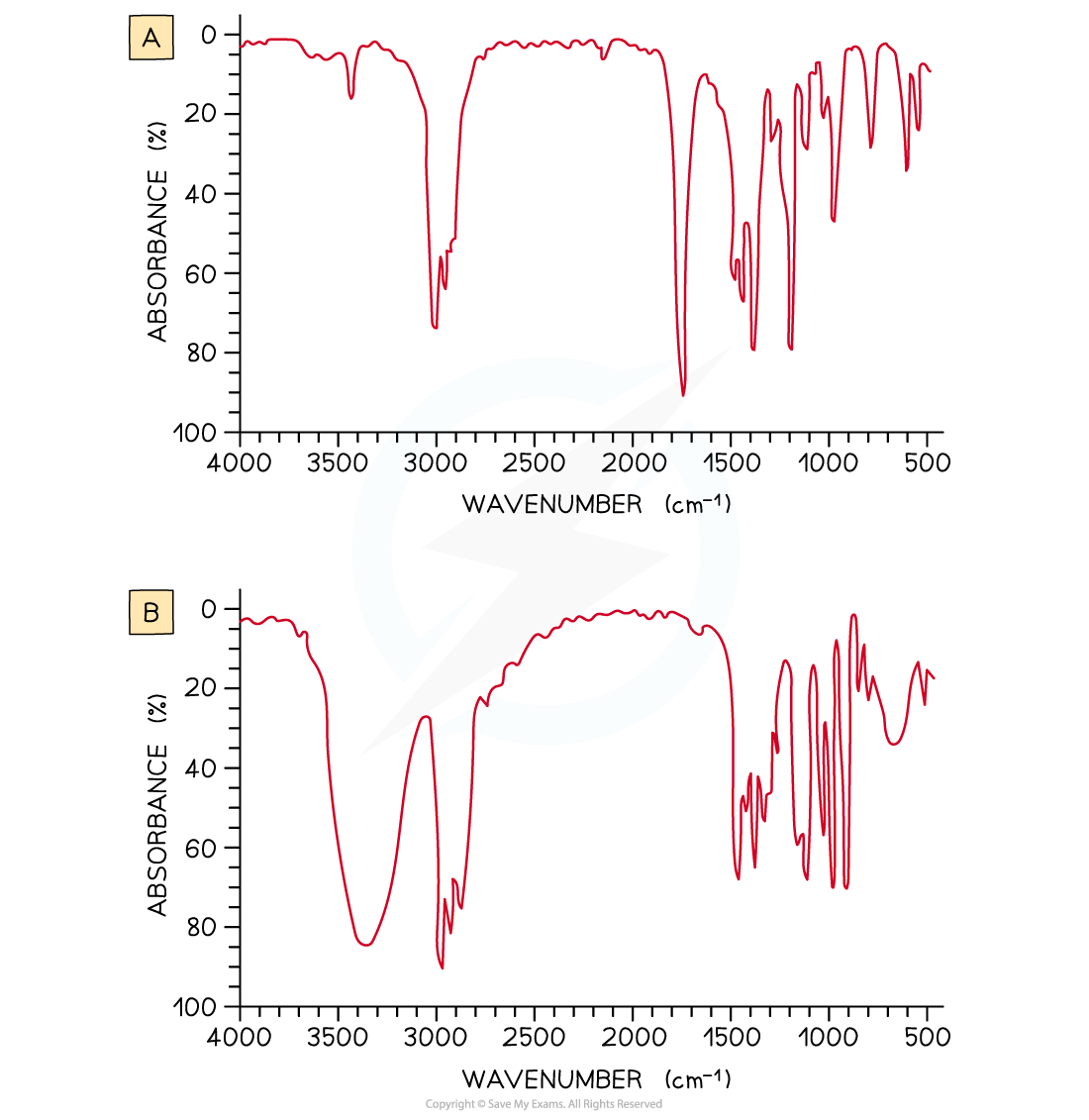
Answer:
-
- IR spectrum?A?is?propanone?and spectrum?B?is?propan-2-ol.
- In IR spectrum?A?the presence of a strong, sharp absorption around 1710 cm-1?corresponds to the characteristic C=O, carbonyl, group in a ketone.
- In spectrum?B?the presence of a strong, broad absorption around 3200-3500 cm-1?suggests that there is an alcohol group present, which corresponds to the -OH group in propan-2-ol.
Fingerprint Region
- The region below about 1500 cm-1?is called the?fingerprint region?and is unique to every molecule
- It has many peaks that can be difficult to assign
- These peaks represent the complex vibrational interactions that occur between different bonds within a molecule
- The value of the?fingerprint region?is in being able to compare the?IR spectrum?to a known compund from a database and coming up with an exact match
- This is particularly useful, for example, in identifying a specific member of a?homologous series
- All members of the series will show the same type of bonds present, but no two molecules will have the same fingerprint region
Exam Tip
Infrared data is found in Section 26 of the IB Chemistry Data Booklet so there is no need to learn specific wavenumber ranges of bonds
轉(zhuǎn)載自savemyexams
以上就是關(guān)于【IB DP Chemistry: HL復(fù)習(xí)筆記11.1.4 Infrared Spectroscopy】的解答,如需了解學(xué)校/賽事/課程動態(tài),可至翰林教育官網(wǎng)獲取更多信息。
往期文章閱讀推薦:
斯坦福大學(xué)官方推薦書單!名校學(xué)霸們暑假都在讀什么?
MIT官方發(fā)布【2026年夏季推薦閱讀書單】!橫跨科學(xué)/人文/經(jīng)濟(jì)...


翰林AMC8視頻課重磅上線!

國際競賽真題資源免費(fèi)領(lǐng)取






