AQA A Level Physics復(fù)習(xí)筆記8.2.1 Radioactive Decay

Radioactive Decay
- Radioactive decay is defined as:
The spontaneous disintegration of a nucleus to form a more stable nucleus, resulting in the emission of an alpha, beta or gamma particle
- Radioactive decay is a?random?process, this means that:
- There is an?equal probability?of any nucleus decaying
- It cannot be known?which particular nucleus will decay next
- It cannot be known?at what time a particular nucleus will decay
- The rate of decay is?unaffected?by the surrounding conditions
- It is only possible to estimate the?proportion?of nuclei decaying in a given time period
- The random nature of radioactive decay can be demonstrated by observing the count rate of a Geiger-Muller (GM) tube
- When a GM tube is placed near a radioactive source, the counts are found to be irregular and cannot be predicted
- Each count represents a decay of an unstable nucleus
- These fluctuations in count rate on the GM tube?provide evidence for the randomness of radioactive decay
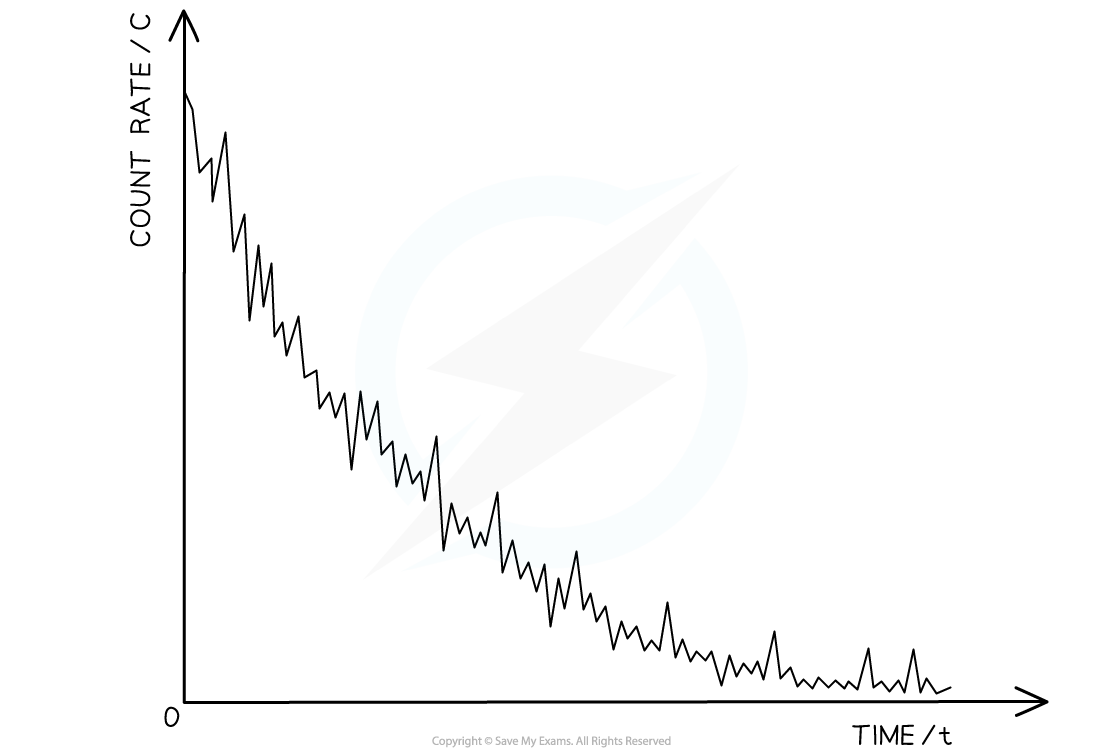
The variation of count rate over time of a sample radioactive gas. The fluctuations show the randomness of radioactive decay
Activity & The Decay Constant
- Since radioactive decay is spontaneous and random, it is useful to consider the average number of nuclei that are expected to decay per unit time
- This is known as the?average decay rate
- As a result, each radioactive element can be assigned a?decay constant
- The decay constant λ is defined as:
The probability that an individual nucleus will decay per unit of time
- When a sample is highly radioactive, this means the number of decays per unit time is very high
- This suggests it has a high level of?activity
- Activity, or the number of decays per unit time can be calculated using:

- Where:
- A?= activity of the sample (Bq)
- ΔN?= number of decayed nuclei
- Δt?= time interval (s)
- λ = decay constant (s-1)
- N?= number of nuclei remaining in a sample
- The activity of a sample is measured in?Becquerels?(Bq)
- An activity of 1 Bq is equal to one decay per second, or 1 s-1
- This equation shows:
- The greater the decay constant, the?greater the activity?of the sample
- The activity depends on the number of?undecayed nuclei remaining?in the sample
- The minus sign indicates that the number of nuclei remaining?decreases?with time
Worked Example
Radium is a radioactive element first discovered by Marie and Pierre Curie. They used the radiation emitted from radium-226 to define a unit called the Curie (Ci) which they defined as the activity of 1 gram of radium.It was found that in a 1 g sample of radium, 2.22 × 10¹²?atoms decayed in 1 minute.Another sample containing 3.2 × 10²²?radium-226 atoms had an activity of 12 Ci.
a) Determine the value of 1 Curie
b) Determine the decay constant for radium-226
Part a)
Step 1: Write down the known quantities
-
- Number of atoms decayed, ΔN?= 2.22 × 10¹²
- Time, Δt?= 1 minutes = 60 s
Step 2: Write down the activity equation
 Step 3: Calculate the value of 1 Ci

Part b)
Step 1: Write down the known quantities
-
- Number of atoms,?N?= 3.2 × 10²²
- Activity,?A?= 12 Ci = 12 × (3.7 × 1010) = 4.44 × 10¹¹ Bq
Step 2: Write down the activity equation
A?= λN
Step 3: Calculate the decay constant of radium

-
- Therefore, the decay constant of radium-226 is 1.4 × 10⁻¹¹?s–1
轉(zhuǎn)載自savemyexams
以上就是關(guān)于【AQA A Level Physics復(fù)習(xí)筆記8.2.1 Radioactive Decay】的解答,如需了解學(xué)校/賽事/課程動(dòng)態(tài),可至翰林教育官網(wǎng)獲取更多信息。
往期文章閱讀推薦:
斯坦福大學(xué)官方推薦書(shū)單!名校學(xué)霸們暑假都在讀什么?
MIT官方發(fā)布【2026年夏季推薦閱讀書(shū)單】!橫跨科學(xué)/人文/經(jīng)濟(jì)...


翰林AMC8視頻課重磅上線!

國(guó)際競(jìng)賽真題資源免費(fèi)領(lǐng)取






