AQA A Level Physics復(fù)習(xí)筆記4.5.5 Collisions

Elastic & Inelastic Collisions
- In both collisions and explosions, momentum is always conserved
- However,?kinetic energy?might not always be
- A collision (or explosion) is either:
- Elastic?– if the kinetic energy?is?conserved
- Inelastic?– if the kinetic energy is?not?conserved
- Collisions are when objects striking against each other
- Elastic?collisions are commonly those where objects colliding do not stick together and then?move in opposite directions
- Inelastic?collision are commonly those where objects collide and?stick together?after the collision
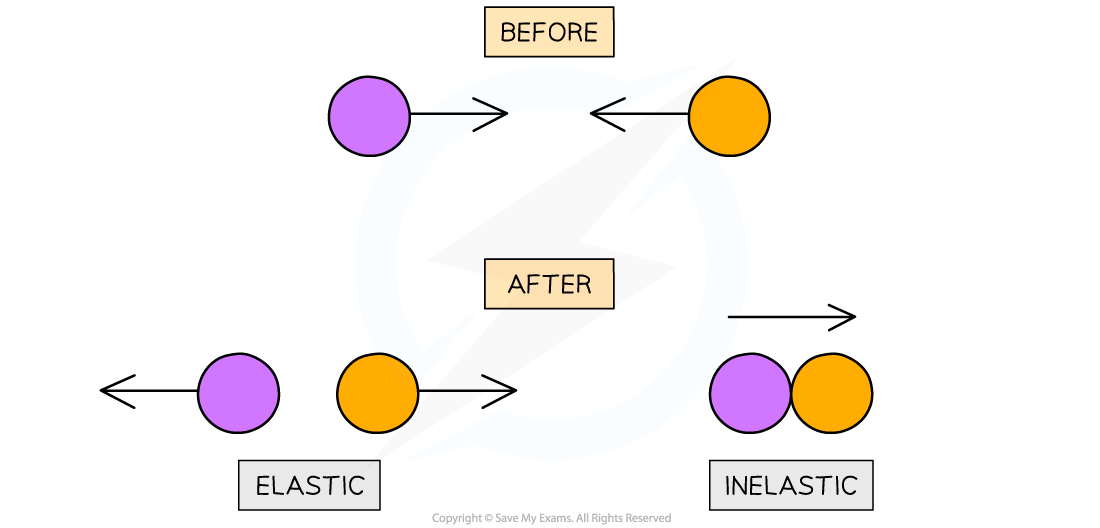
Elastic collisions are where two objects move in opposite directions. Inelastic collisions are where two objects stick together
- An explosion is commonly to do with?recoil
- For example, a gun recoiling after shooting a bullet or an unstable nucleus emitting an alpha particle and a daughter nucleus
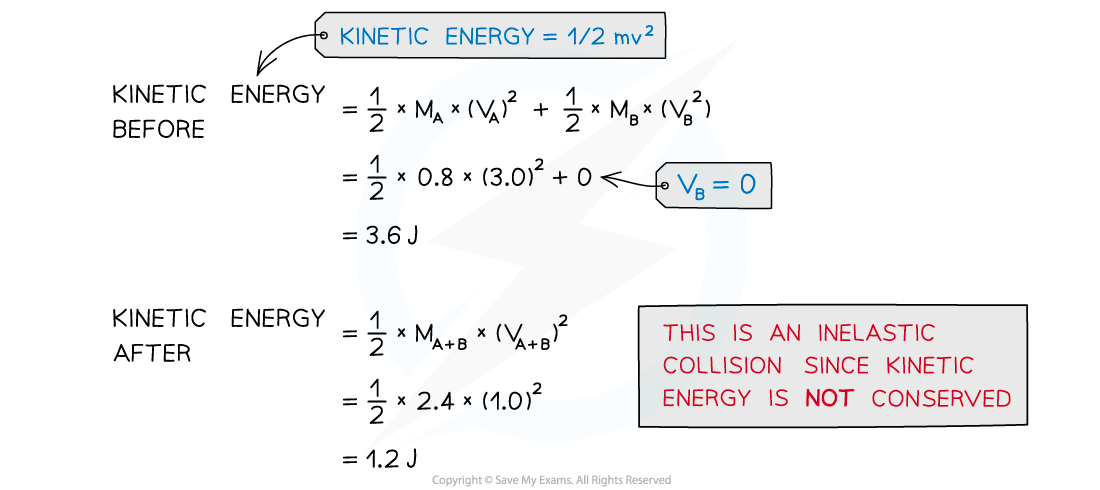
- To find out whether a collision is elastic or inelastic,?compare the kinetic energy before and after the collision
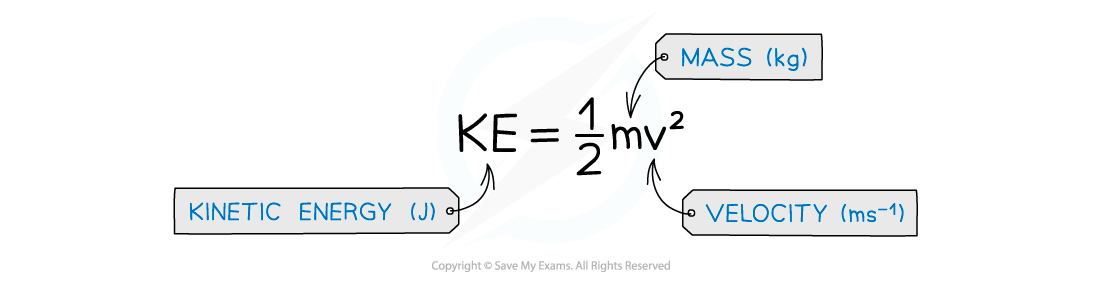
- The equation for kinetic energy is:
Worked Example
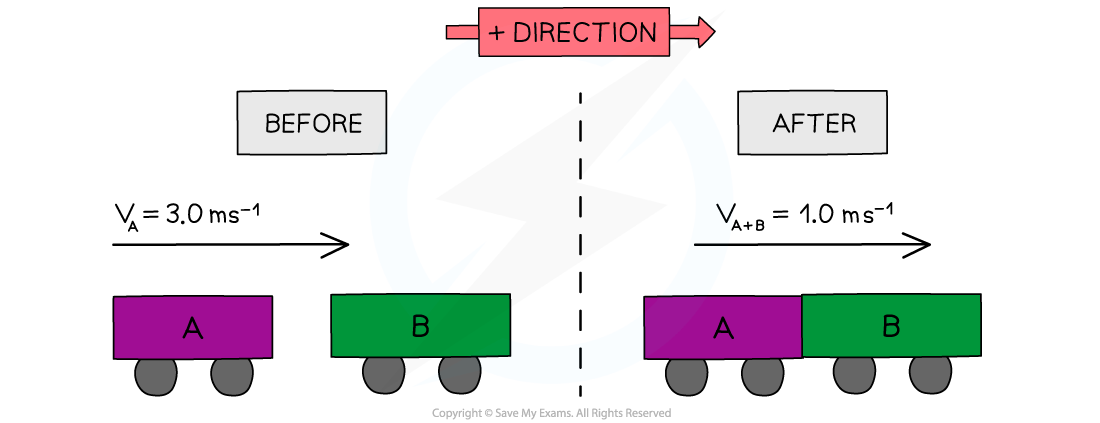
Trolley A of mass 0.80 kg collides head-on with stationary trolley B at speed 3.0 m s–1. Trolley B has twice the mass of trolley A.The trolleys stick together and travel at a velocity of 1.0 m s–1. Determine whether this is an elastic or inelastic collision.
Exam Tip
If an object is stationary or at rest, it’s velocity equals?0, therefore, the momentum and kinetic energy are also equal to 0.When a collision occurs in which two objects are stuck together, treat the final object as a single object with a mass equal to the?sum?of the two individual objects.
Momentum Conservation Issues
- The force of an impact in a vehicle collision can be?decreased?by?increasing?the contact time over which the collision occurs
- The contact time is the time in which the vehicle or the passenger is in contact with what it has collided with
- Vehicles have safety features such as?crumple zones,?seat belts?and?airbags?to account for this
- For a given force upon impact, these absorb the energy from the impact and increase the time over which the force takes place
- This, in turn, increases the time taken for the change in momentum of the passenger and the vehicle to come to rest
- The increased time reduces the force and risk of injury on a passenger
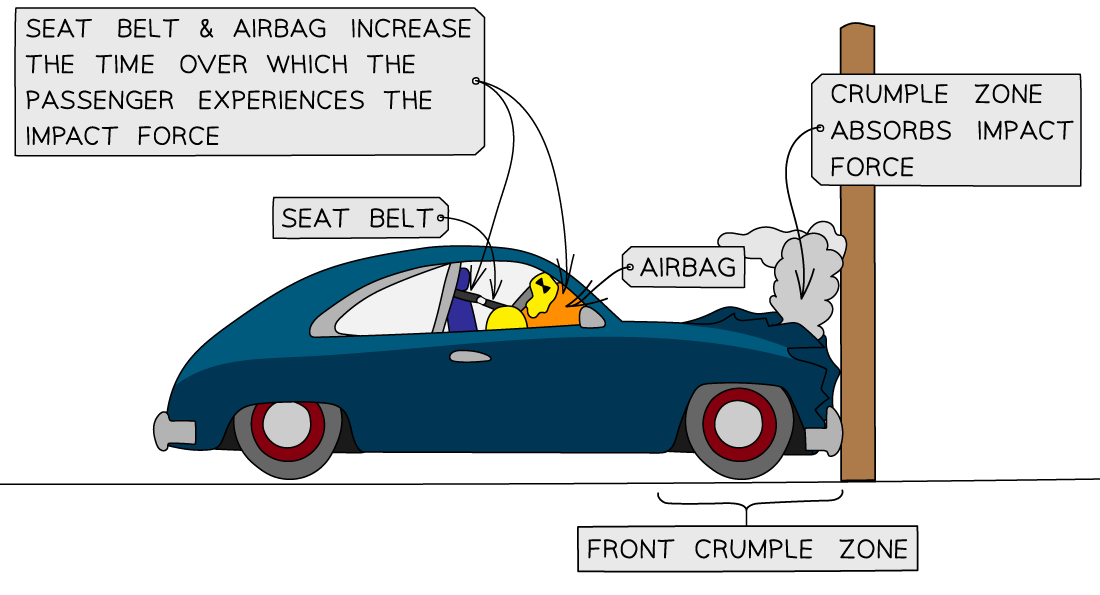
The seat belt, airbag and crumple zones help reduce the risk of injury on a passenger
Designing Safety Features
- Vehicle safety features are designed to absorb energy upon an impact by changing?shape
- Seat belts
- These are designed to stop a passenger from colliding with the interior of a vehicle by keeping them fixed to their seat in an abrupt stop
- They are designed to stretch slightly to increase the time for the passenger's momentum to reach zero and reduce the force on them in a collision
- Airbags
- These are deployed at the front on the dashboard and steering wheel when a collision occurs
- They act as a soft cushion to prevent injury on the passenger when they are thrown forward upon impact
- Crumple zones
- These are designed into the exterior of vehicles
- They are at the front and back and are designed to crush or crumple in a controlled way in a collision
- This is why vehicles after a collision look more heavily damaged than expected, even for relatively small collisions
- The crumple zones increase the time over which the vehicle comes to rest,?lowering the impact force?on the passengers
- The effect of the increase in time and force can be shown on a force-time graph
- For the same change in momentum, which depends on the mass and speed of a vehicle, the increase in contact time will result in a?decrease?in the maximum force exerted on the vehicle and passenger
- This is demonstrated by a lower peak and wider base on a force-time graph
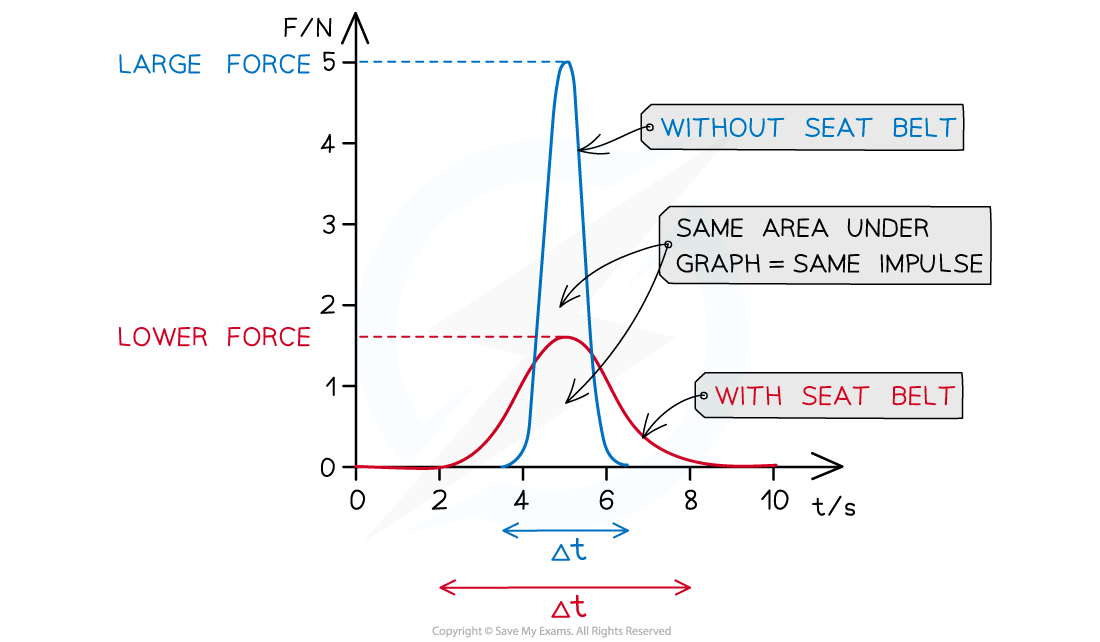
The increase in contact time Δt decreases the force for the same impulse
轉(zhuǎn)載自savemyexams
以上就是關(guān)于【AQA A Level Physics復(fù)習(xí)筆記4.5.5 Collisions】的解答,如需了解學(xué)校/賽事/課程動態(tài),可至翰林教育官網(wǎng)獲取更多信息。
往期文章閱讀推薦:
斯坦福大學(xué)官方推薦書單!名校學(xué)霸們暑假都在讀什么?
MIT官方發(fā)布【2026年夏季推薦閱讀書單】!橫跨科學(xué)/人文/經(jīng)濟...


翰林AMC8視頻課重磅上線!

國際競賽真題資源免費領(lǐng)取






