AQA A Level Physics復習筆記2.3.4 Feynman Diagrams

Feynman Diagrams
- Feynman diagrams are a clear way of representing particle interactions in terms of their incoming and outgoing particles and exchange particles
- Although there are many variations of Feynman diagrams, they follow a set of rules:
- The vertical axis represents?time
- The horizontal axis represents?space
- Gauge bosons?are represented by a wavy or dashed lines or a helix
- All other particles are represented by?straight?lines
- Each line (apart from neutral gauge bosons) must have an?arrow?with its direction forward in time
- The total charge, baryon number and lepton number must be?conserved?at each vertex
- Particle lines must?not?cross over
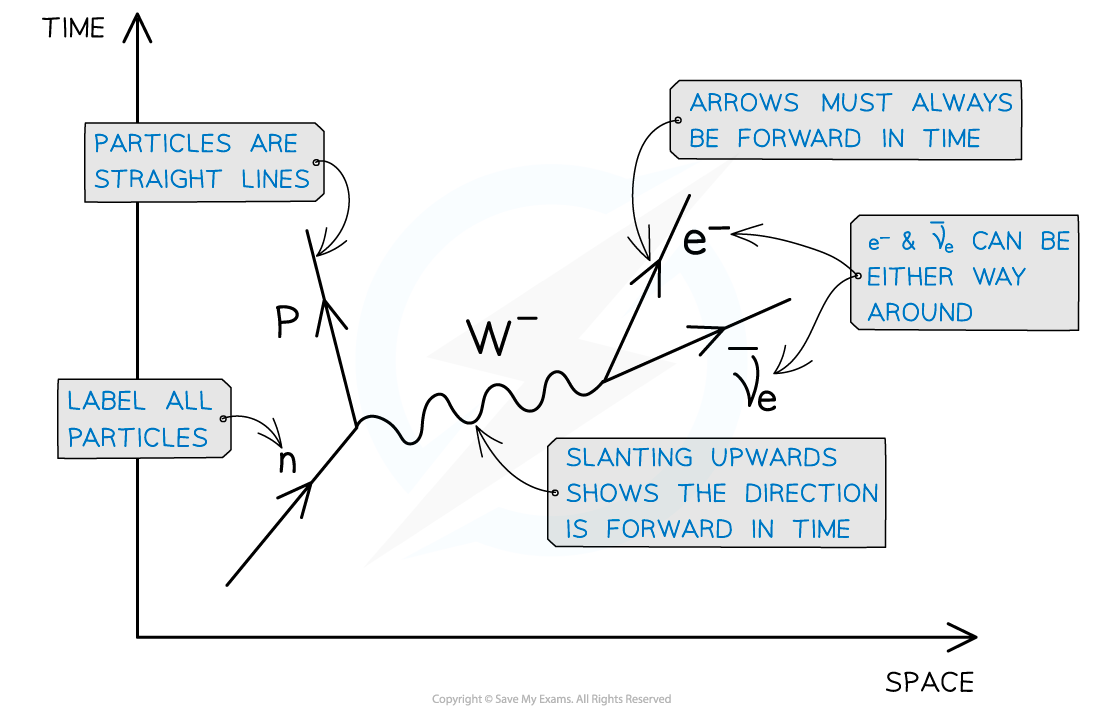
Feynman diagrams follow a set of rules which are needed to interpret them accurately
- Feynman diagrams show nothing about the actual path of the particles, so the angles in the diagram are of no significance
- Note that you might find the following variations of Feynman diagrams:
- The vertical axis representing space and the horizontal axis representing time
- Anti-particles represented as moving backwards in time
- However, it is best to stick to the rules given for this syllabus which have time on the vertical and space on the horizontal axis and all particles moving forward in time
Exchange Particles
- Gauge bosons?are represented differently in each Feynman diagram depending on the type of interaction
- Charged exchange particles (W+?and W–)?must?have their direction indicated
- Representing exchange particles:
- In the weak interaction, W and Z bosons are represented by a wavy line
- The W+?and W–?must have an arrow showing their direction (left or right) or must be slanted upwards, meaning that they are forward in time
- Pions are represented by a wavy or dashed line
- Photons are represented by a wavy line
- Gluons are represented by a helix
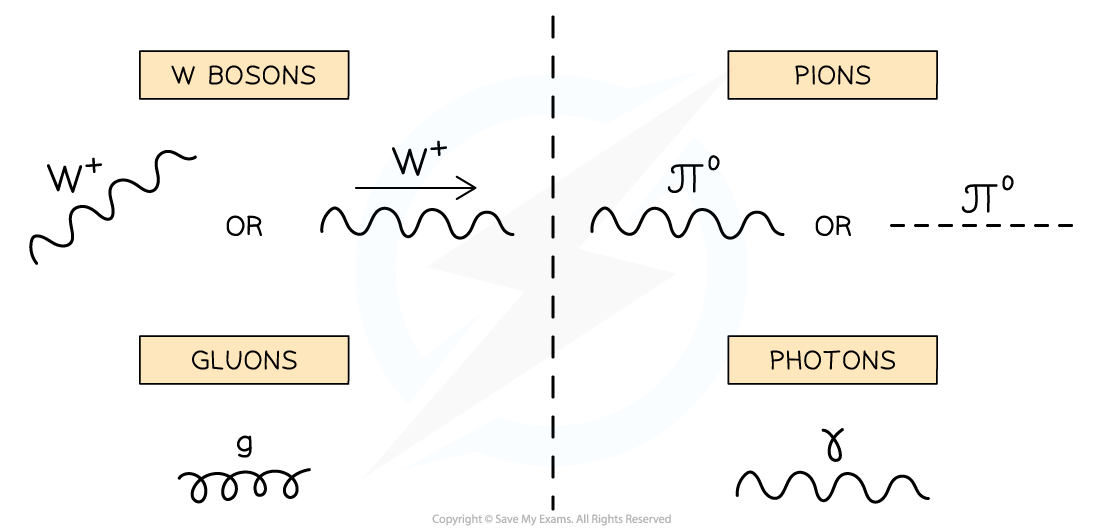
The gauge bosons are depicted by a wavy or dashed line, or a helix depending on the type of interaction
Worked Example
A neutron interacts with a neutrino in the following way: Draw the Feynman diagram that corresponds to the neutron and neutrino interaction represented in the equation.

- The vertical axis represents time and the horizontal axis represents space
- All particles are labelled correctly
- All particles are represented by straight lines and arrows pointing forward in time
- W+?boson represented by a wavy line with an arrow pointing towards the neutron-proton vertex
Exam Tip
The most common exam mistakes when asked to draw Feynman diagrams are missing out arrows indicating the direction of charged gauge bosons or particles. Although you are not required to sketch and label the space and time axes, all particles must be labelled accurately.
Quark Transformation in β decay
- β decay occurs because of the weak interaction between quarks
Quark Composition: β–?decay
- β–?decay is when a neutron turns into a proton emitting an electron and anti-electron neutrino
- More specifically, a neutron turns into a proton because a?down?quark turns?into an?up?quark
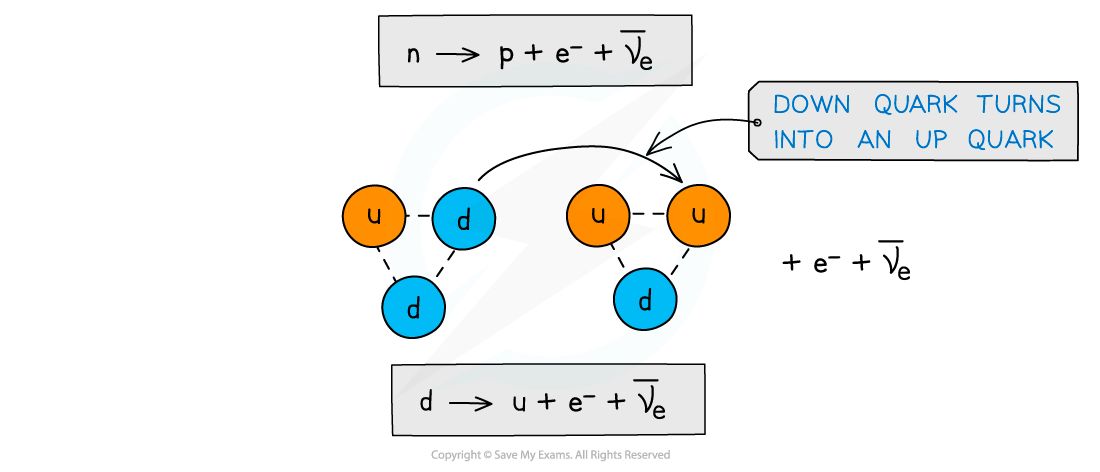
Beta minus decay is when a down quark turns into an up quark
- The W–?boson ‘carries away’ the negative charge of the down quark which provides the negative charge for the electron and anti-neutrino
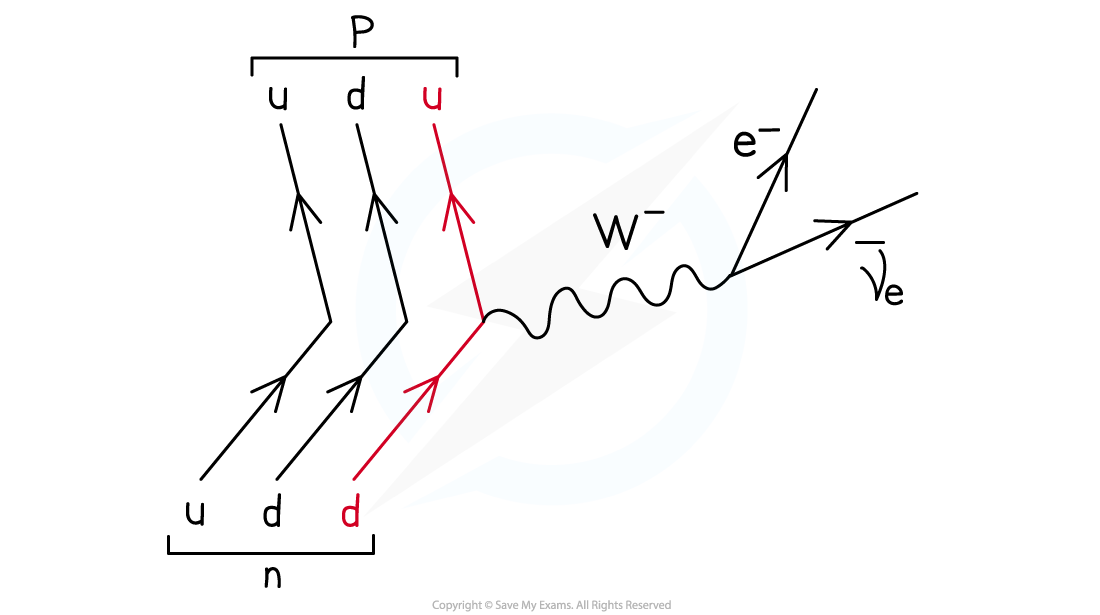
In beta minus decay, the weak interaction turns a down quark into an up quark
Quark Composition: β+?decay
- β+?decay is when a proton turns into a neutron emitting an positron and an electron neutrino
- More specifically, a proton turns into a neutron because an?up?quark turns into a?down?quark
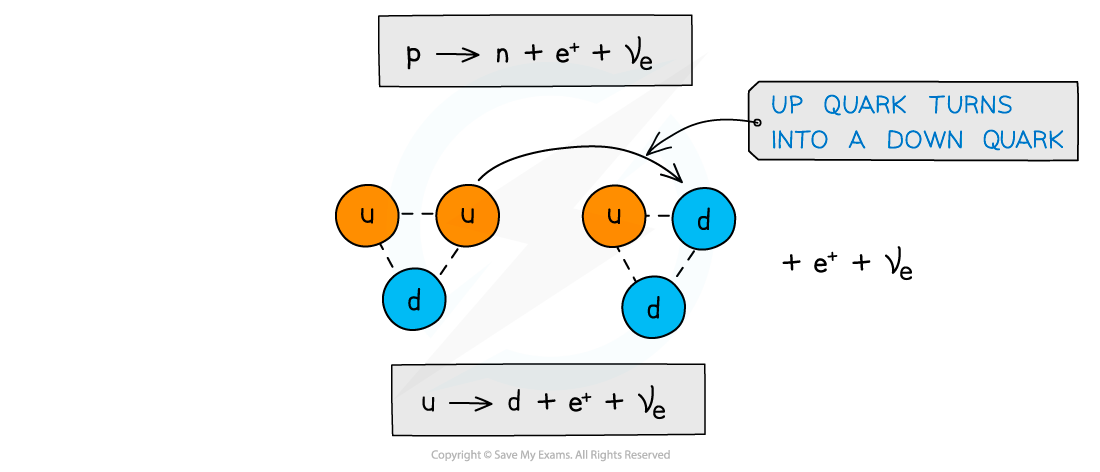
Beta plus decay is when an up quark turns into a down quark
- The W+?boson ‘carries away’ the positive charge of the up quark which provides the positive charge for the positron and neutrino
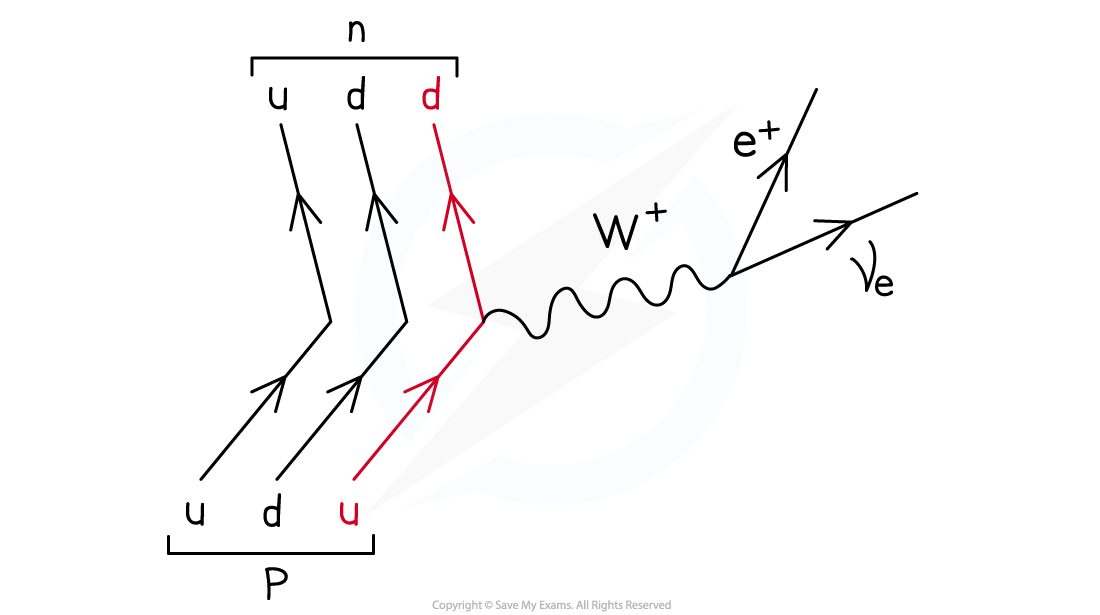
In beta plus decay, the weak interaction turns an up quark into a down quark
轉載自savemyexams
以上就是關于【AQA A Level Physics復習筆記2.3.4 Feynman Diagrams】的解答,如需了解學校/賽事/課程動態,可至翰林教育官網獲取更多信息。
往期文章閱讀推薦:
2026 ALEVEL 夏考A率出爐!愛德思vs牛津AQA,哪些科目真的“好出分”?
2026 AMC10/12美國數學競賽新賽季!【翰林教育 × 清華大學出版社】獨家教材全面發售!


翰林AMC8視頻課重磅上線!

國際競賽真題資源免費領取






