AQA A Level Chemistry復(fù)習(xí)筆記5.4.3 Predicting Reactions

Predicting Reactions
Direction of electron flow
- The?direction of electron flow?can be determined by comparing the?E??values of two half-cells in an electrochemical cell
Cl2?(g) + 2e-?? 2Cl-?(aq)? ? ? ??E??= +1.36 V
Cu2+?(aq) + 2e-?? Cu (s)? ? ? ??E??= +0.34 V
- The Cl2?more?readily accept?electrons from the Cu2+/Cu half-cell
- This is the?positive pole
- Cl2?gets more readily reduced
- The Cu2+?more?readily loses?electrons to the Cl2/Cl-?half-cell
- This is the?negative pole
- Cu2+?gets more readily oxidised
- The electrons flow from the Cu2+/Cu half-cell to the Cl2/Cl-?half-cell
- The flow of electrons is from the?negative pole?to the?positive pole
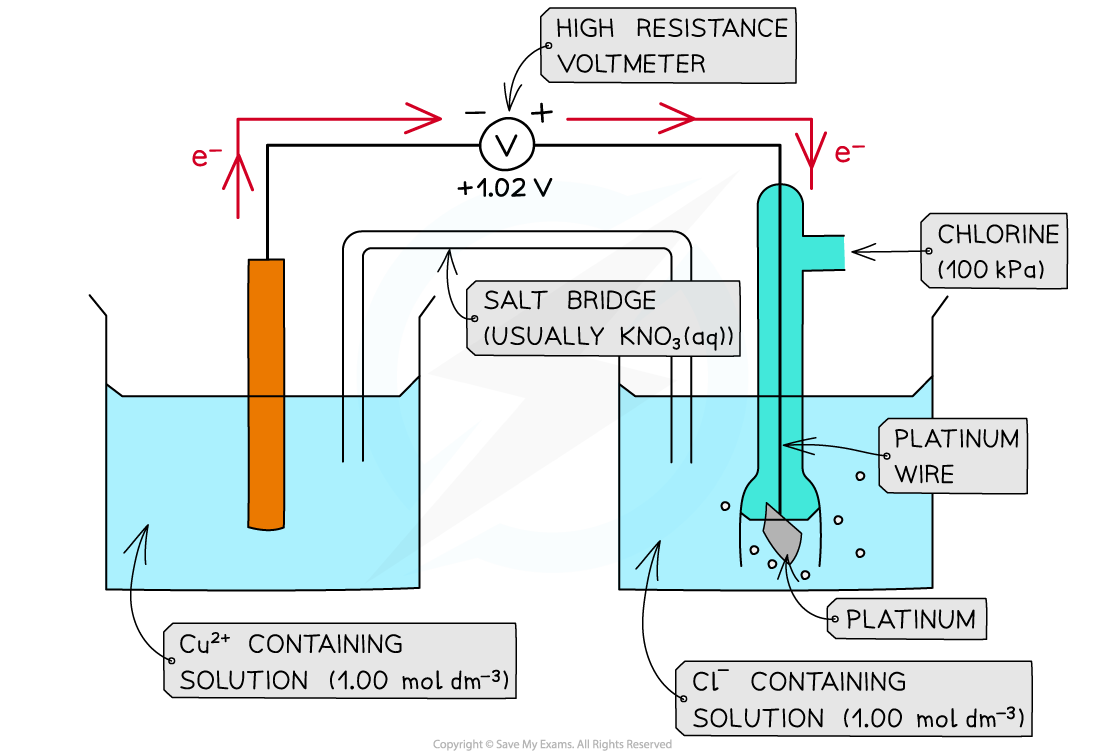
The electrons flow through the wires from the negative pole to the positive pole
Feasibility
- The?E??values of a species indicate how?easily?they can get?oxidised?or?reduced
- The?more?positive the value, the easier it is to reduce the species on the?left?of the half-equation
- The reaction will tend to proceed in the?forward direction
- The?less?positive the value, the easier it is to?oxidise?the species on the?right?of the half-equation
- The reaction will tend to proceed in the backward direction
- A reaction is?feasible?(likely to occur) when the?Ecell??is?positive
- For example, two half-cells in the following electrochemical cell are:
Cl2?(g) + 2e-?? 2Cl-?(aq)? ? ? ??E??= +1.36 V
Cu2+?(aq) + 2e-?? Cu (s)? ? ? ??E??= +0.34 V
- Cl2?molecules are?reduced?as they have a more positive?E??value
- The chemical reaction that occurs in this half cell is:
Cl2?(g) + 2e-?→ 2Cl-?(aq)
- Cu2+?ions are?oxidised?as they have a less positive?E??value
- The chemical reaction that occurs in this half cell is:
Cu (s) → Cu2+?(aq) + 2e-
- The?overall equation?of the electrochemical cell is (after cancelling out the electrons):
Cu (s) + Cl2?(g) → 2Cl-?(aq) + Cu2+?(aq)
OR
Cu (s) + Cl2?(g) → CuCl2?(s)
- The?forward?reaction is?feasible?(spontaneous) as it has a?positive?E???value of +1.02 V ((+1.36) - (+0.34))
- The?backward?reaction is?not feasible?(not spontaneous) as it has a?negative?E??value of -1.02 ((+0.34) - (+1.36))
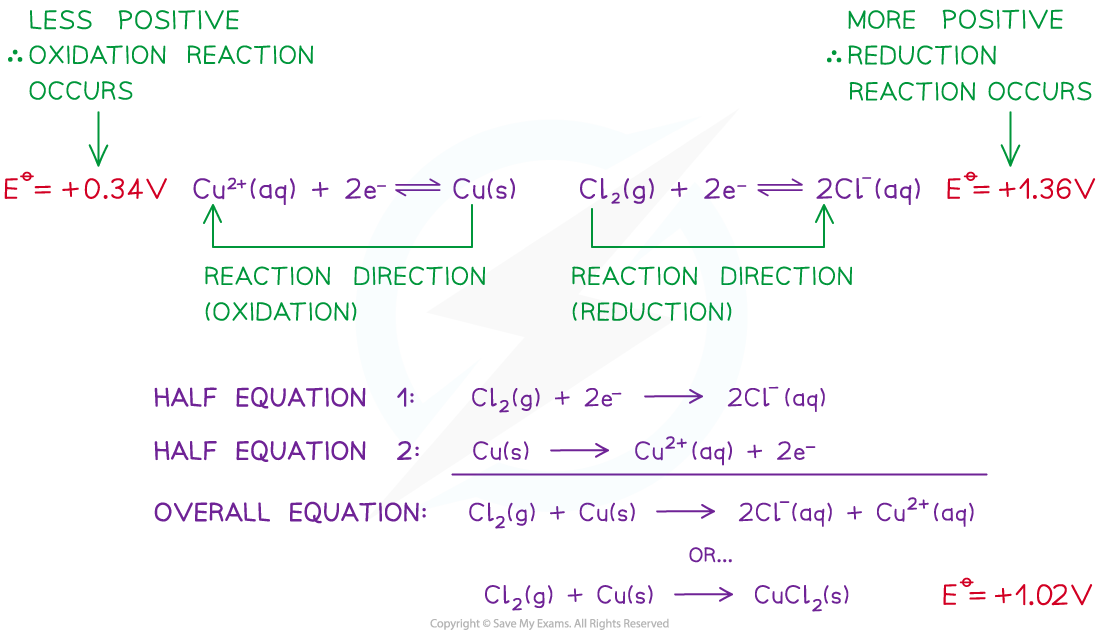
A reaction is feasible when the standard cell potential E??is positive
Exam Tip
Remember that the electrons only move through the wires in the external circuit and not through the electrolyte solution.
轉(zhuǎn)載自savemyexams
以上就是關(guān)于【AQA A Level Chemistry復(fù)習(xí)筆記5.4.3 Predicting Reactions】的解答,如需了解學(xué)校/賽事/課程動態(tài),可至翰林教育官網(wǎng)獲取更多信息。
往期文章閱讀推薦:
斯坦福大學(xué)官方推薦書單!名校學(xué)霸們暑假都在讀什么?
MIT官方發(fā)布【2026年夏季推薦閱讀書單】!橫跨科學(xué)/人文/經(jīng)濟...


翰林AMC8視頻課重磅上線!

國際競賽真題資源免費領(lǐng)取






