AQA A Level Chemistry復習筆記1.3.4 The Ideal Gas Equation

The Ideal Gas Equation
Kinetic theory of gases
- The kinetic theory of gases?states that molecules in gases are constantly moving
- The theory makes the following assumptions:
- That gas molecules are moving very fast and randomly
- That molecules hardly have any volume
- That gas molecules do not attract or repel each other (no?intermolecular forces)
- No kinetic energy is lost when the gas molecules collide with each other (elastic collisions)
- The temperature of the gas is related to the average kinetic energy of the molecules
- Gases that follow the kinetic theory of gases are called?ideal gases
- However, in reality gases do not fit this description exactly?but?may come very close and are called?real gases
Ideal gases
- The volume that an ideal gas occupies depends on:
- Its pressure
- Its temperature
- When a gas is?heated?(at constant pressure) the particles gain more?kinetic energy?and undergo more?frequent collisions?with the container wall
- To keep the?pressure constant, the molecules must get further apart and therefore the?volume increases
- The?volume?is therefore?directly proportional?to the?temperature?(at constant pressure)
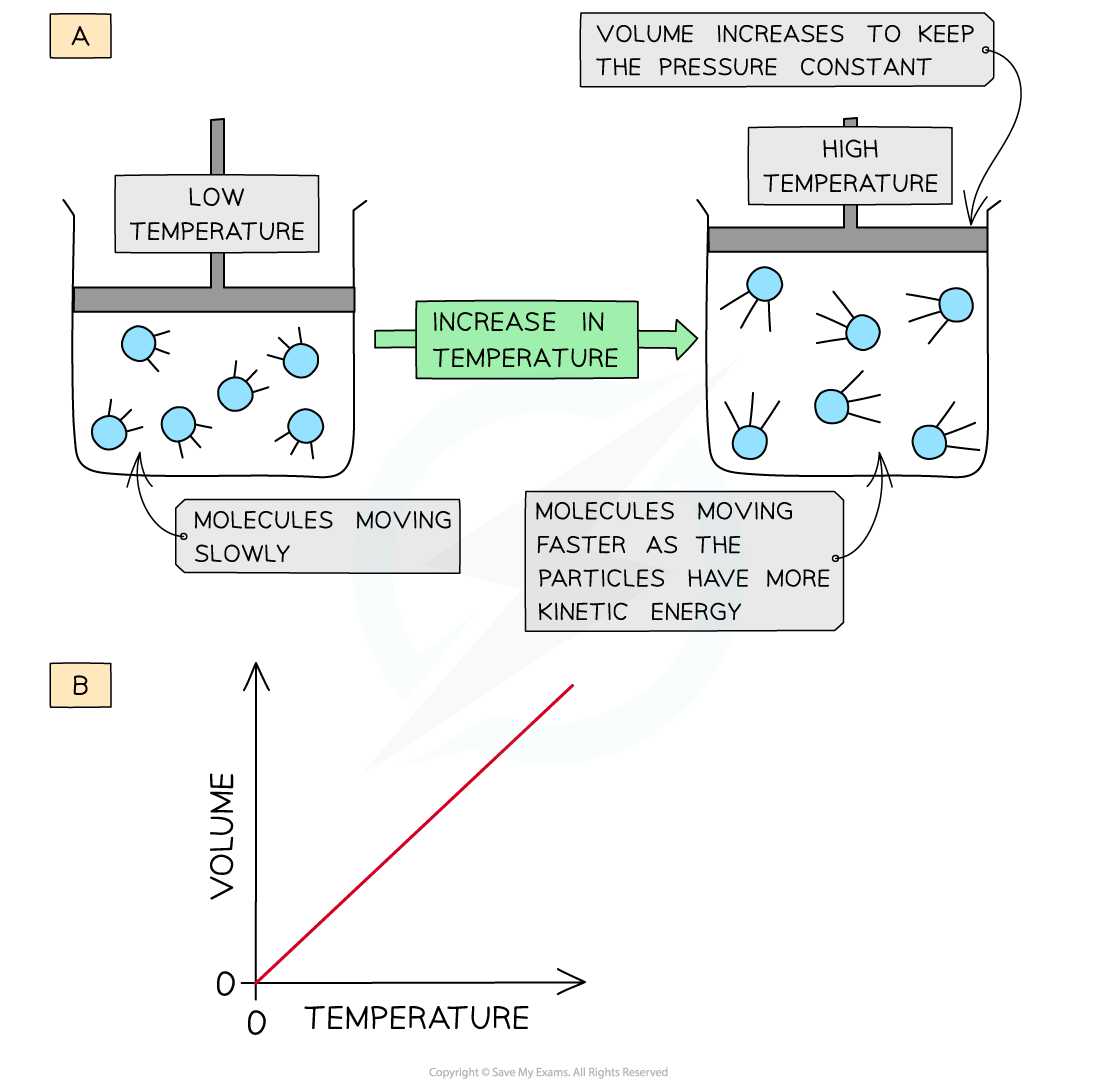
The volume of a gas increases upon heating to keep a constant pressure (a); volume is directly proportional to the temperature (b)
Limitations of the ideal gas law
- At very?low?temperatures?and?high?pressures?real gases do not obey the kinetic theory as under these conditions:
- Molecules are close to each other
- There are instantaneous dipole- induced dipole or permanent dipole- permanent dipole forces between the molecules
- These attractive forces pull the molecules away from the container wall
- The volume of the molecules is not negligible
- Real gases therefore do not obey the following kinetic theory?assumptions?at low temperatures and high pressures:
- There is zero attraction between molecules (due to attractive forces, the?pressure?is?lower?than expected for an ideal gas)
- The volume of the gas molecules can be ignored (volume?of the gas is?smaller?than expected for an ideal gas)
Ideal gas equation
- The?ideal gas equation?shows the relationship between pressure, volume, temperature and number of moles of gas of an ideal gas:
PV = nRT
P = pressure (pascals, Pa)
V = volume (m3)
n = number of moles of gas (mol)
R = gas constant (8.31 J K-1?mol-1)
T = temperature (kelvin, K)
Worked Example
Calculating the volume of a gas
Calculate the volume occupied by 0.781 mol of oxygen at a pressure of 220 kPa and a temperature of 21 °C
Answer
Step 1:?Rearrange the ideal gas equation to find volume of gas
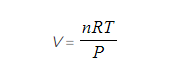
Step 2:?Calculate the volume the oxygen gas occupies
-
- P?= 220 kPa = 220 000 Pa
- n?= 0.781 mol
- R?= 8.31 J K-1?mol-1
- T?= 21?oC = 294 K

Worked Example
Calculating the molar mass of a gas
A flask of volume 1000 cm3?contains 6.39 g of a gas. The pressure in the flask was 300 kPa and the temperature was 23 °C.
Calculate the relative molecular mass of the gas.
Answer
Step 1:?Rearrange the ideal gas equation to find the number of moles of gas

Step 2:?Calculate the number of moles of gas
p = 300 kPa = 300 000 Pa
V = 1000 cm3?= 1 dm3?= 0.001 m3
R = 8.31 J K-1?mol-1
T = 23?oC = 296 K
Step 3:?Calculate the molar mass using the number of moles of gas


Exam Tip
To calculate the temperature in?Kelvin, add 273 to the Celsius temperature - e.g. 100?oC is 373 Kelvin.
You must be able to rearrange the ideal gas equation to work out all parts of it.
The?units?are incredibly important in this equation - make sure you know what units you should use, and do the necessary conversions when doing your calculations!
轉載自savemyexams
以上就是關于【AQA A Level Chemistry復習筆記1.3.4 The Ideal Gas Equation】的解答,如需了解學校/賽事/課程動態,可至翰林教育官網獲取更多信息。
往期文章閱讀推薦:
2026 ALEVEL 夏考A率出爐!愛德思vs牛津AQA,哪些科目真的“好出分”?
2026 AMC10/12美國數學競賽新賽季!【翰林教育 × 清華大學出版社】獨家教材全面發售!


翰林AMC8視頻課重磅上線!

國際競賽真題資源免費領取






