AQA A Level Chemistry復習筆記1.3.3 Reacting Volumes

Volumes & Concentrations of Solutions
- The?concentration?of a solution is the amount of?solute?dissolved in a?solvent?to make 1 dm3?of??solution
- The solute is the substance that dissolves in a solvent to form a solution
- The solvent is often water

- A?concentrated?solution is a solution that has a?high?concentration of solute
- A?dilute?solution is a solution with a?low?concentration of solute
- When carrying out calculations involve concentrations in mol dm-3?the following points need to be considered:
- Change mass in grams to?moles
- Change cm3?to dm3
- To calculate the?mass?of a substance present in solution of known?concentration and volume:
- Rearrange the concentration equation
number of moles (mol) = concentration (mol dm-3) x volume (dm3)
-
- Multiply the moles of solute by its molar mass
mass of solute (g) = number of moles (mol) x molar mass (g mol-1)
Worked Example
Calculating volume from concentration
Calculate the volume of hydrochloric acid of concentration 1.0 mol dm-3 that is required to react completely with 2.5 g of calcium carbonate
Answer
Step 1:?Write the balanced symbol equation
CaCO3??+ ?2HCl ?→ ?CaCl2??+ ?H2O ?+ ?CO2
Step 2:?Calculate the amount, in moles, of calcium carbonate that reacts

Step 3:?Calculate the moles of hydrochloric acid required using the reaction’s stoichiometry
1 mol of CaCO3?requires 2 mol of HCl
So 0.025 mol of CaCO3?requires 0.05 mol of HCl
Step 4:?Calculate the volume of HCl required

Volume of hydrochloric acid = 0.05 dm3
Worked Example
Neutralisation calculation
25.0 cm3?of 0.050 dm-3?sodium carbonate was completely neutralised by 20.00 cm3??of dilute hydrochloric acid.?Calculate the concentration in mol dm-3?of the hydrochloric acid.
Answer
Step 1:?Write the balanced symbol equation
Na2CO3??+ ?2HCl ?→? 2NaCl ?+ ?H2O ?+ ?CO2
Step 2:?Calculate the amount, in moles, of sodium carbonate reacted by rearranging the equation for amount of substance (mol) and dividing the volume by 1000 to convert cm3?to dm3
amount (Na2CO3) = 0.025 dm3?x 0.050 mol dm-3?= 0.00125 mol
Step 3:?Calculate the moles of hydrochloric acid required using the reaction’s stoichiometry
1 mol of Na2CO3?reacts with 2 mol of HCl, so the molar ratio is 1 : 2
Therefore 0.00125 moles of Na2CO3?react with 0.00250 moles of HCl
Step 4:?Calculate the concentration, in mol dm-3, of hydrochloric acid


concentration (HCl) (mol dm-3) = 0.125 mol dm-3
Volumes of gases
- Avogadro?suggested that ‘equal volumes of gases contain the same number of molecules’ (also called?Avogadro’s hypothesis)
- At room temperature (20 degrees Celsius) and pressure (1 atm)?one mole?of any gas has a volume of 24.0 dm3
- This?molar gas volume?of 24.0 dm3?mol-1?can be used??to find:
- The volume of a given mass or number of moles of gas:
volume of gas (dm3) = amount of gas (mol) x 24?dm3?mol-1
- The mass or number of moles of a given volume of gas:

Worked Example
Calculation volume of gas using excess & limiting reagents
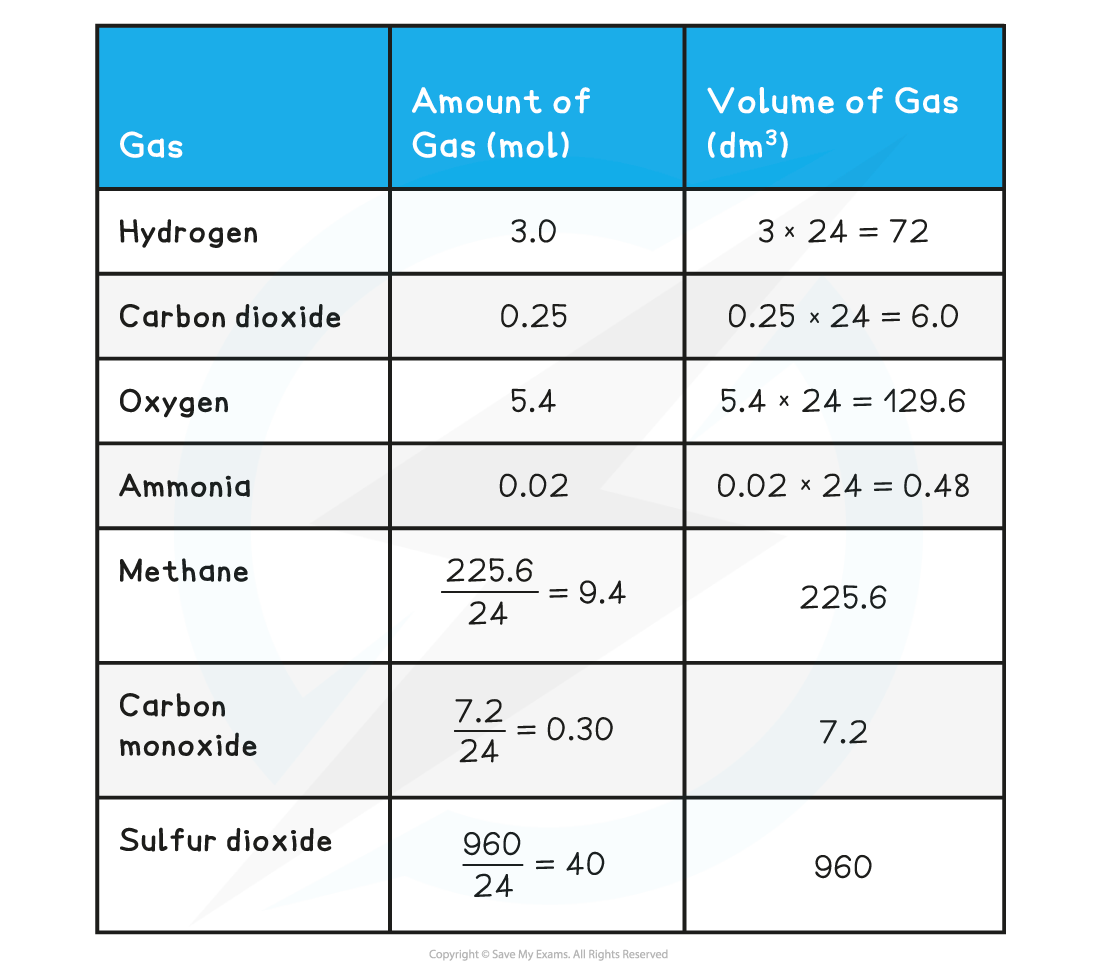
Calculate the volume the following gases occupy:
- Hydrogen (3 mol)
- Carbon dioxide (0.25 mol)
- Oxygen (5.4 mol)
- Ammonia (0.02 mol)
Calculate the moles in the following volumes of gases:
- Methane
- Carbon monoxide
- Sulfur dioxide
Answer
轉載自savemyexams
以上就是關于【AQA A Level Chemistry復習筆記1.3.3 Reacting Volumes】的解答,如需了解學校/賽事/課程動態,可至翰林教育官網獲取更多信息。
往期文章閱讀推薦:
2026 ALEVEL 夏考A率出爐!愛德思vs牛津AQA,哪些科目真的“好出分”?
2026 AMC10/12美國數學競賽新賽季!【翰林教育 × 清華大學出版社】獨家教材全面發售!


翰林AMC8視頻課重磅上線!

國際競賽真題資源免費領取






