Edexcel IGCSE Maths 復(fù)習(xí)筆記 2.15.1 Quadratic Simultaneous Equations

Edexcel IGCSE Maths 復(fù)習(xí)筆記 2.15.1 Quadratic Simultaneous Equations
What are quadratic simultaneous equations?
- When there are two unknowns (say x and y) in a problem, we need two equations to be able to find them both: these are called?Simultaneous Equations
- If there is an x2?or y2?in one of the equations then they are?Quadratic?(or?Non-Linear) Simultaneous Equations
(They can be represented by a straight line and a curve on a graph – the two pairs of answers are the points of intersection of the line and the curve)
How do you solve quadratic simultaneous equations?
- This is called the?Substitution Method:Label?the equations?A?and?B
- Rearrange the?linear?equation to?y = …?(or?x = …)
- Substitute?for?y?(or?x) in the?quadratic?equation
- Multiply out?brackets
- Rearrange?to “quadratic = 0”
- Solve?using appropriate method (Factorisation or Formula)
- Substitute?back into the linear equation to find the other variable
- Check?your answer by substituting into the equation you didn’t use in 6
Exam Tip
If the resulting quadratic has a?repeated root?then the line is a?tangent?to the curve.If the resulting quadratic has?no roots then the line does not intersect with the curve – or you have made a mistake!When giving your final answer, make sure you indicate which x and y values go together. If you don’t make this clear you can lose marks for an otherwise correct answer.
Worked Example
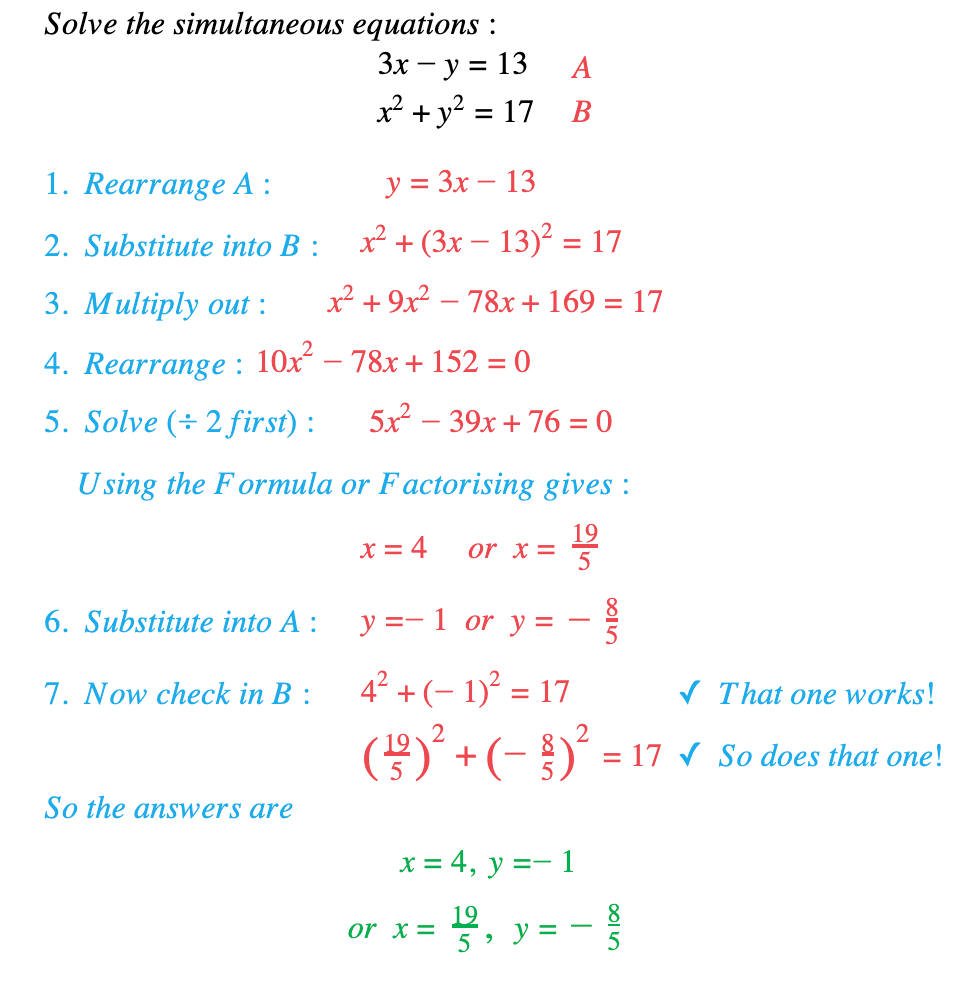
轉(zhuǎn)載自savemyexam
以上就是關(guān)于【Edexcel IGCSE Maths 復(fù)習(xí)筆記 2.15.1 Quadratic Simultaneous Equations】的解答,如需了解學(xué)校/賽事/課程動(dòng)態(tài),可至翰林教育官網(wǎng)獲取更多信息。
往期文章閱讀推薦:
IGCSE全A*,A-Level階段卻崩了?別忽視IGCSE選課的重要性!
2026 CAIE IGCSE 夏季大考放榜!A* 線全面揭曉,今年真的卷到新高度?


翰林AMC8視頻課重磅上線!

國(guó)際競(jìng)賽真題資源免費(fèi)領(lǐng)取






