2005 AMC12B 真題及答案詳細解析

2005 AMC 12 B 真題
真題解析
Problem 1
A scout troop buys? ?candy bars at a price of five for?
 ?dollars. They sell all the candy bars at the price of two for?
 ?dollar. What was their profit, in dollars?

Problem 2
A positive number? ?has the property that?
 ?of??is?
 . What is??

Problem 3
Brianna is using part of the money she earned on her weekend job to buy several equally-priced CDs. She used one ?fth of her money to buy one third of the CDs. What fraction of her money will she have left after she buys all the CDs?

Problem 4
At the beginning of the school year, Lisa's goal was to earn an A on at least? ?of her?
 ?quizzes for the year. She earned an A on?
 ?of the first?
 ?quizzes. If she is to achieve her goal, on at most how many of the remaining quizzes can she earn a grade lower than an A?

Problem 5
An? -foot by?
 -foot floor is tiled with square tiles of size??foot by??foot. Each tile has a pattern consisting of four white quarter circles of radius?
 ?foot centered at each corner of the tile. The remaining portion of the tile is shaded. How many square feet of the floor are shaded?
![[asy] unitsize(2cm); defaultpen(linewidth(.8pt)); fill(unitsquare,gray); filldraw(Arc((0,0),.5,0,90)--(0,0)--cycle,white,black); filldraw(Arc((1,0),.5,90,180)--(1,0)--cycle,white,black); filldraw(Arc((1,1),.5,180,270)--(1,1)--cycle,white,black); filldraw(Arc((0,1),.5,270,360)--(0,1)--cycle,white,black); [/asy]](https://latex.artofproblemsolving.com/c/b/e/cbe2bb4966beb1c1cbc889938c8e120b7d80639b.png)

Problem 6
In? , we have?
 ?and?
?and? . Suppose that?
 ?is a point on line?
 ?such that?
 ?lies between?
 ?and??and?
 . What is?
 ?
?

Problem 7
What is the area enclosed by the graph of? ?
?

Problem 8
For how many values of? ?is it true that the line?
 ?passes through the vertex of the parabola?
 ??
??

Problem 9
On a certain math exam,? ?of the students got?
 ?points,?
 ?got?
?got? ?points,?
 ?got?
?got? ?points,?
 ?got?
?got? ?points, and the rest got?
 points. What is the difference between the mean and the median score on this exam?

Problem 10
The first term of a sequence is? . Each succeeding term is the sum of the cubes of the digits of the previous terms. What is the?
 ?term of the sequence?

Problem 11
An envelope contains eight bills:??ones,??fives,??tens, and??twenties. Two bills are drawn at random without replacement. What is the probability that their sum is $ ?or more?

Problem 12
The?quadratic equation? ?has roots twice those of?
 , and none of?
 ?and?
?and? ?is zero. What is the value of?
 ?
?

Problem 13
Suppose that? ,?
,? ,?
,? , ... ,?
 . What is?
 ?
?

Problem 14
A circle having center? , with?
 ,is tangent to the lines?
 ,?
,? ?and?
?and? . What is the radius of this circle?

Problem 15
The sum of four two-digit numbers is? . None of the eight digits is?
 ?and no two of them are the same. Which of the following is?not?included among the eight digits?
Problem 16
Eight spheres of radius 1, one per octant, are each tangent to the coordinate planes. What is the radius of the smallest sphere, centered at the origin, that contains these eight spheres?

Problem 17
How many distinct four-tuples? ?of rational numbers are there with
 ?
?

Problem 18
Let? ?and?
?and? ?be points in the plane. Define?
 ?as?the region in the first quadrant consisting of those points?
 ?such that??is an acute triangle. What is the closest integer to the area of the region??

Problem 19
Let??and? ?be two-digit integers such that??is obtained by reversing the digits of?. The integers??and??satisfy?
 ?for some positive integer?
 . What is?
 ?
?

Problem 20
Let? ?and?
?and? ?be distinct elements in the set
![[{-7,-5,-3,-2,2,4,6,13}.]](https://latex.artofproblemsolving.com/1/a/8/1a8059229665bd96646ba8f4d93793d4a4d81896.png)
What is the minimum possible value of
![[(a+b+c+d)^{2}+(e+f+g+h)^{2}?]](https://latex.artofproblemsolving.com/5/f/3/5f38ca2651b3e7bbd3ffb5c9d50197d004f81059.png)

Problem 21
A positive integer? ?has?
?has? ?divisors and?
 ?has??divisors. What is the greatest integer?
 ?such that?
 ?divides??

Problem 22
A sequence of complex numbers? ?is defined by the rule
![[z_{n+1} = frac {iz_{n}}{overline {z_{n}}},]](https://latex.artofproblemsolving.com/5/6/1/5615d4f35b70105ed92f07cc305ec89d9a9cdd96.png)
where? ?is the?complex conjugate?of?
 ?and?
?and? . Suppose that?
 ?and?
?and? . How many possible values are there for?
 ?
?

Problem 23
Let? ?be the set of ordered triples?
 ?of real numbers for which
![[log_{10}(x+y) = z text{ and } log_{10}(x^{2}+y^{2}) = z+1.]](https://latex.artofproblemsolving.com/c/1/1/c117b87dca578c53d5694e7f783975909325a5bc.png) There are real numbers??and?
There are real numbers??and? ?such that for all ordered triples??in??we have?
 ?What is the value of?

Problem 24
All three vertices of an equilateral triangle are on the parabola? , and one of its sides has a slope of?. The?-coordinates of the three vertices have a sum of?
 , where??and??are relatively prime positive integers. What is the value of?
 ?
?

Problem 25
Six ants simultaneously stand on the six?vertices?of a regular?octahedron, with each ant at a different vertex. Simultaneously and independently, each ant moves from its vertex to one of the four adjacent vertices, each with equal?probability. What is the probability that no two ants arrive at the same vertex?


Since??means? , the statement "
 " can be rewritten?as?"
 ":
":
Let? Brianna's money. We have?
 . Thus, the money left over is?
 , so the answer is?
 . This was just a simple manipulation of the equation. No solving was needed!
Lisa's goal was to get an A on? ?quizzes. She already has A's on??quizzes, so she needs to get A's on?
 ?more. There are?
 ?quizzes left, so she can afford to get less than an A on?
 ?of them. Here, only the A's matter... No complicated stuff!
There are 80 tiles. Each tile has?![$[mbox{square} - 4 cdot (mbox{quarter circle})]$](https://latex.artofproblemsolving.com/6/1/7/617c9a81577193c333f0b80c64514805a1e55857.png) ?shaded. Thus:
?shaded. Thus:
4 quarters of a circle is a circle so that may save you 0.5 seconds???
In?, we have??and?. Suppose that??is a point on line??such that??lies between??and??and?. What is??
Solution
Draw height? ?(Perpendicular line from point C to line AD). We have that?
 . From the?Pythagorean Theorem,?
 . Since?,?
 , and?
 , so?
, so? .
.
Solution 1
If we get rid of the absolute values, we are left with the following 4 equations (using the logic that if? , then??is either??or?
 ):
):

We can then put these equations in slope-intercept form in order to graph them.

Now you can graph the lines to find the shape of the graph:
![[asy] Label f; f.p=fontsize(6); xaxis(-8,8,Ticks(f, 4.0)); yaxis(-6,6,Ticks(f, 3.0)); fill((0,-3)--(4,0)--(0,3)--(-4,0)--cycle,grey); draw((-4,-6)--(8,3), Arrows(4)); draw((4,-6)--(-8,3), Arrows(4)); draw((-4,6)--(8,-3), Arrows(4)); draw((4,6)--(-8,-3), Arrows(4));[/asy]](https://latex.artofproblemsolving.com/a/1/9/a19def037694543a1771b3897d68d519dd066fcf.png)
We can easily see that it is a rhombus with diagonals of? ?and?. The area is?
 , or?
, or?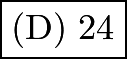
Solution 2
You can also assign??and??to be?. Then you can easily see that the diagonals are??and?. Multiply and divide by??to get D.
We see that the vertex of the quadratic function??is? . The y-intercept of the line??is?
 . We want to find the values (if any) such that?
 . Solving for?, the only values that satisfy this are??and?, so the answer is?
To begin, we see that the remaining? ?of the students got??points. Assume that there are??students; we see that??students got??points,?
 ?students got??points,??students got??points,?
 ?students got??points, and??students got??points. The median is?, since the?
 ?and?
?and? ?terms are both?. The mean is?
 . The difference between the mean and median, therefore, is?
 .
.
Performing this operation several times yields the results of? ?for the second term,?
 ?for the third term, and?
 ?for the fourth term. The sum of the cubes of the digits of??equal?, a complete cycle. The cycle is... excluding the first term, the?
 ,?
,? , and?
 ?terms will equal?,?, and?, following the fourth term. Any term number that is equivalent to?
 ?will produce a result of?. It just so happens that?
 , which leads us to the answer of?
 .
.
Solution 1
The only way to get a total of $?or more is if you pick a twenty and another bill, or if you pick both tens. There are a total of? ?ways to choose??bills out of?. There are?
 ?ways to choose a twenty and some other non-twenty bill. There is??way to choose both twenties, and also??way to choose both tens. Adding these up, we find that there are a total of?
 ?ways to attain a sum of??or greater, so there is a total probability of?
 .
.
Solution 2
Another way to do this problem is to use complementary counting, i.e. how many ways that the sum is less than 20. Now, you do not have to consider the 2 twenties, so you have 6 bills left.? ?ways. However, you counted the case when you have 2 tens, so you need to subtract 1, and you get 14. Finding the ways to get 20 or higher, you subtract 14 from 28 and get 14. So the answer is?
 .
.
Solution 1
Let? ?have roots??and?. Then
![[x^2 + px + m = (x-a)(x-b) = x^2 - (a+b)x + ab,]](https://latex.artofproblemsolving.com/d/6/3/d6347a5ee25d5b941694ca5cd21c35997e6d31f8.png)
so? ?and?
?and? . Also,?
 ?has roots?
 ?and?
?and? , so
, so
![[x^2 + mx + n = (x-2a)(x-2b) = x^2 - 2(a+b)x + 4ab,]](https://latex.artofproblemsolving.com/5/0/1/501f7835ffc0da1ceef39eaa3eebb8784db663d4.png)
and? ?and?
?and? . Thus?
 .
.
Indeed, consider the quadratics? .
.
Solution 2
If the roots of??are 2a and 2b and the roots of??are a and b, then using Vieta's equations,![[2a + 2b = -m]](https://latex.artofproblemsolving.com/0/8/e/08ecb4147711eacc9e46c3025ecf06f134ac14d1.png)
![[a + b = -p]](https://latex.artofproblemsolving.com/0/2/b/02b64c3d1b6523bbb51defb309c6d0549b692b29.png)
![[2a(2b) = n]](https://latex.artofproblemsolving.com/8/6/c/86c586dee72aa6367bb10d8204969336903bd179.png)
![[a(b) = m]](https://latex.artofproblemsolving.com/d/1/4/d14005e53d35d168169a64841d4ceef3b3b42600.png) Therefore, substituting the second equation into the first equation gives
Therefore, substituting the second equation into the first equation gives![[m = 2(p)]](https://latex.artofproblemsolving.com/b/1/e/b1ee6cc0acfd106f4f1d26965b77854e3878ea4f.png) and substituting the fourth equation into the third equation gives
and substituting the fourth equation into the third equation gives
We see that we can re-write?,?,?, ... ,??as? ?by using substitution. By using the properties of exponents, we know that?
 .
. Therefore, the answer is?
Alternate Solution
Changing??to logarithmic form, we get? . We can rewrite this?as?
 . Applying this to the rest, we get?
Let??be the radius of the circle. Draw the two radii that meet the points of tangency to the lines? . We can see that a square is formed by the origin, two tangency points, and the center of the circle. The side lengths of this square are??and the diagonal is?
 . The diagonal of a square is?
 ?times the side length. Therefore,?
 .
.
![[asy] real Xmin,Xmax,Ymin,Ymax; real R = 6+6*sqrt(2); Xmin = -16; Xmax = 16; Ymin = -4; Ymax = 40; xaxis(Xmin,Xmax,Arrows); yaxis(Ymin,Ymax,Arrows); label("$x$",(Xmax+0.25,0),S); label("$y$",(0,Ymax+0.25),E); draw((Xmin,-Xmin)--(-Ymin,Ymin)); draw((Xmax,Xmax)--(Ymin,Ymin)); draw((Xmin,6)--(Xmax,6)); dot((0,0)); dot((R/sqrt(2),R/sqrt(2))); dot((-R/sqrt(2),R/sqrt(2))); dot((0,R*sqrt(2))); draw((0,0)--(R/sqrt(2),R/sqrt(2))--(0,R*sqrt(2))--(-R/sqrt(2),R/sqrt(2))--(0,0)); draw(Circle((0,6+R),R)); label("$R$",(0,6+R/2),(0,0)); label("$R$",(-R/(2*sqrt(2)),3*R/(2*sqrt(2))),0.5*NW); label("$R$",(R/(2*sqrt(2)),3*R/(2*sqrt(2))),0.5*NE); label("$R$",(-R/(2*sqrt(2)),R/(2*sqrt(2))),0.5*SW); label("$R$",(R/(2*sqrt(2)),R/(2*sqrt(2))),0.5*SE); label("$6$",(0,3),(0,0)); [/asy]](https://latex.artofproblemsolving.com/9/2/1/9214d60dfddf137d3b4e216cf2abcdd4d76c8e90.png)
Solution 1
?can be written?as?the sum of four two-digit numbers, let's say? ,?
,? ,?
,? , and?
 . Then?
 . The last digit of??is?, and?
 ?won't affect the units digits, so?
 ?must end with?. The smallest value??can have is?
 , and the greatest value is?
 . Therefore,??must equal?
 ?or?
?or? .
.
Case 1:?
The only distinct positive integers that can add up to??is? . So,?,,
 , and?
 ?must include four of the five numbers?
 . We have?
 , or?
, or? . We can add all of?
 , and try subtracting one number to get to?, but to no avail. Therefore,??cannot add up to?.
Case 2:?
Checking all the values for? ,
, ,
, ,and??each individually may be time-consuming, instead of only having??solution like Case 1. We can try a different approach by looking at?
 ?first. If?,?
 , or?
, or? . That means?
 . We know?
 , so the missing digit is?
Solution 2
Alternatively, we know that a number is congruent to the sum of its digits mod 9, so? , where??is some digit. Clearly,?
 .
.
The eight spheres are formed by shifting spheres of radius??and center? ?
? ?in the?
 ?directions. Hence, the centers of the spheres are?
 . For a sphere centered at the origin to contain all eight spheres, its radius must be greater than or equal to the longest distance from the origin to one of these spheres. This length is the sum of the distance from??to the origin and the radius of the spheres, or?
 . To verify this is the longest length, we can see from the triangle inequality that the length from the origin to any other point on the spheres is strictly smaller. Thus, the answer is?
 .
.
Using the laws of?logarithms, the given equation becomes![[log_{10}2^{a}+log_{10}3^{b}+log_{10}5^{c}+log_{10}7^bpn8fgcvlp=2005]](https://latex.artofproblemsolving.com/9/b/3/9b367a566b912c5625212b4998ae7e4acb4a4918.png)
![[Rightarrow log_{10}{2^{a}cdot 3^{b}cdot 5^{c}cdot 7^bpn8fgcvlp}=2005]](https://latex.artofproblemsolving.com/3/4/b/34b1fdf053c6b026b0976f3f18c9a30db5ee001a.png)
![[Rightarrow 2^{a}cdot 3^{b}cdot 5^{c}cdot 7^bpn8fgcvlp = 10^{2005}]](https://latex.artofproblemsolving.com/8/5/9/859b1435302b7be43757fbe0695894a5fc73e38b.png) As?
As? ?must all be rational, and there are no powers of??or?
 ?in?
?in? ,?
,? . Then?
 .Only the four-tuple?
 ?satisfies the equation, so the answer is?
 .
.
For angle??and??to be acute,??must be between the two lines that are perpendicular to? ?and contain points??and?. For angle??to be acute, first draw a?
 ?triangle with??as?the hypotenuse. Note??cannot be inside this triangle's circumscribed circle or else?
 . Hence, the area of??is the area of the large triangle minus the area of the small triangle minus the area of the circle, which is?
 , which is approximately?
 . The answer is?
 .
.
let? , then?
 ?where??and??are nonzero digits.By difference of squares,
![[x^2-y^2=(x+y)(x-y)]](https://latex.artofproblemsolving.com/1/b/8/1b8088e58252db3fe978b651bf66d791f79fb190.png)
![[=(10a+b+10b+a)(10a+b-10b-a)]](https://latex.artofproblemsolving.com/f/7/5/f75db726bece8fe4b6cf1036ff0d80353d418f83.png)
![[=(11(a+b))(9(a-b))]](https://latex.artofproblemsolving.com/4/3/d/43d794211b54da0f1669ac78864b06348267c4fb.png) For this product to be a square, the factor of??must be repeated in either?
For this product to be a square, the factor of??must be repeated in either? ?or?
?or? , and given the constraints it has to be?
 . The factor of?
 ?is already a square and can be ignored. Now??must be another square, and since??cannot be??or greater then??must equal??or?. If?
 ?then?
 ,?
,? ,?
,? , which is not a digit. Hence the only possible value for?
 ?is?. Now we have?
 ,?
,? ,?
,? , then?
 ,?
,? ,?
,? ,?
,? , and?
The sum of the set is? , so if we could have the sum in each set of parenthesis be??then the minimum value would be?
 . Considering the set of four terms containing?
 , this sum could only be even if it had two or four odd terms. If it had all four odd terms then it would be?
 , and with two odd terms then its minimum value is?
 , so we cannot achieve two sums of?. The closest we could have to??and??is??and?, which can be achieved through?
 ?and?
?and? . So the minimum possible value is?
 .
.
We may let? , where??is not divisible by 7. Using the fact that the number of divisors function?
 ?is multiplicative, we have?
 . Also,?
 . These numbers are in the ratio 3:4, so?
 .
.
Solution 1
Since? , let?
 , where?
 ?is an?argument?of?
 . We will prove by induction that?
 , where?
 .
.
Base Case: trivial
Inductive Step: Suppose the formula is correct for? , then
![[z_{k+1}=frac{iz_k}{overline {z_k}}=i e^{itheta_k} e^{itheta_k}=e^{i(2theta_k+pi/2)}]](https://latex.artofproblemsolving.com/0/1/e/01e74ac69a249e45f90adf147c3ebb85f437278e.png) Since
Since![[2theta_k+frac{pi}{2}=2cdot 2^n(theta_0+frac{pi}{2})-pi+frac{pi}{2}=2^{n+1}(theta_0+frac{pi}{2})-frac{pi}{2}=theta_{n+1}]](https://latex.artofproblemsolving.com/4/5/7/457e3e14aad4f7928516575089f38a0e5ad927e6.png) the formula is proven
the formula is proven
 , where??is an integer. Therefore,
![[2^{2005}(theta_0+frac{pi}{2})=(2k+frac{1}{2})pi]](https://latex.artofproblemsolving.com/b/4/d/b4d614845645002f03bb5918558e8cb03b2e28fe.png)
![[theta_0=frac{k}{2^{2004}}pi+left(frac{1}{2^{2006}}-frac{1}{2}right)pi]](https://latex.artofproblemsolving.com/b/8/c/b8c7716ce947fab700ffffc659af41384da8058f.png) The value of??only matters?modulo?
The value of??only matters?modulo? . Since?
 , k can take values from 0 to?
 , so the answer is?
Solution 2
Let? .
.![[z_1 = frac {iz_{0}}{overline {z_{0}}} = frac{i(cos theta + isin theta)}{cos theta - isin theta} = i(cos theta + isin theta)^2 = i(cos 2theta + isin 2theta) = ie^{i2theta}]](https://latex.artofproblemsolving.com/6/4/f/64fb82c88de3f4cf3be269d8897e0ff7783dff54.png)
![[z_2 = frac {iz_{1}}{overline {z_{1}}} = frac{i(cos 2theta + isin 2theta)}{cos 2theta - isin 2theta} = i(cos 2theta + isin 2theta)^{2} = i(cos 2^2theta + isin 2^2theta) = ie^{i2^2theta}]](https://latex.artofproblemsolving.com/f/3/b/f3bbedd4ff0606468250bb3c505467ce03ba30fe.png) Repeating through this recursive process, we can quickly see that
Repeating through this recursive process, we can quickly see that![[z_{2005} = ie^{i2^{2005}theta} = i(cos 2^{2005}theta + isin 2^{2005}theta) = 1]](https://latex.artofproblemsolving.com/1/4/2/142c16aecb2b1139ba7294b780a11fc9ddade6ff.png) Thus,?
Thus,? . The solutions for?
 ?are?
?are? ?where?
 . Note that?
 ?for all?, so the answer is?. (Author: Patrick Yin)
Solution 3
Note that for any complex number? , we have?
 . Therefore, the magnitude of?
 ?is always?, meaning that all of the numbers in the sequence??are of magnitude?.
Another property of complex numbers is that? . For the numbers in our sequence, this means?
 , so?
, so? . Rewriting our recursive condition with these facts, we now have
![[z_{n+1}=frac{iz_n}{z_n^{-1}}=iz_n^2.]](https://latex.artofproblemsolving.com/0/d/8/0d8fbf2d5bdf5f2b1df010b1647bfe512d995671.png) Solving for?
Solving for? ?here, we obtain
![[z_n=frac{pmsqrt{z_{n+1}}}i=-icdot(pmsqrt{z_{n+1}}).]](https://latex.artofproblemsolving.com/6/2/5/6252ed8b42eb8b882d78931ffe62e1d4873d4638.png) It is seen that there are two values of??which correspond to one value of?
It is seen that there are two values of??which correspond to one value of? . That means that there are two possible values of?
 , four possible values of?
 , and so on. Therefore, there are?
 ?possible values of?, giving the answer?as?
 .
.
Solution 1
Let? ?and?
?and? . Then,?
 ?implies?
 ,so?
,so? . Therefore,?
 . Since?
 , we find that?
 . Thus,?
 ?
? ?
?
Solution 2
First, remember that? ?factors to?
 . By the givens,?
 ?and?
?and? . These can be used to find?
 :
:![[(x + y)^2 = 10^{2z}]](https://latex.artofproblemsolving.com/f/7/9/f7967b17ebc5f13cba6c3efe77596eb37bd2163e.png)
![[x^2 + 2xy + y^2 = 10^{2z}]](https://latex.artofproblemsolving.com/7/b/8/7b8e87035760ba6ffc9de644abcc1f99296344ec.png)
![[2xy = 10^{2z} - 10^{z + 1}]](https://latex.artofproblemsolving.com/5/1/a/51a82b542652c871a2a5bdd04616b8ad6eb73d00.png)
![[xy = frac{10^{2z} - 10^{z + 1}}{2}]](https://latex.artofproblemsolving.com/2/7/2/272577214ce8a9ae60d5acd64f3eca1781717951.png)
Therefore,![[x^3 + y^3 = a cdot 10^{3z} + b cdot 10^{2z} = 10^zleft(10^{z + 1} - frac{10^{2z} - 10^{z + 1}}{2}right)]](https://latex.artofproblemsolving.com/0/1/4/014d6c496227809e14206399e7b4a7185307f3c3.png)
![[= 10^zleft(10^{z + 1} - frac{10^{2z} - 10^{z + 1}}{2}right)]](https://latex.artofproblemsolving.com/6/d/4/6d4a9dc625258ca6a010da9c3600772b3bc69a01.png)
![[= 10^{2z + 1} - frac{10^{3z} - 10^{2z + 1}}{2}]](https://latex.artofproblemsolving.com/b/2/9/b2937aa95ed289010ec5a7282e4378f466baa509.png)
![[= -frac{1}{2} cdot 10^{3z} + frac{3}{2} cdot 10^{2z + 1}]](https://latex.artofproblemsolving.com/d/d/7/dd740210cb87719fa28a9592eadb74dc59d4f85f.png)
![[= -frac{1}{2} cdot 10^{3z} + 15 cdot 10^{2z}.]](https://latex.artofproblemsolving.com/0/3/5/035f86d29f3587edc966682ba6feed38226f692e.png)
It follows that? ?and?
?and? , thus?
Solution 3
We can rearrange? ?into?
 ?and?
?and? ?into?
We can then put? ?to the third power or?
 . Basic polynomial multiplication shows us that?
 ?Thus,?
 ?or?
?or? . We know that??so we have?
 .
.
Now we need to find out what??is equal to in terms of?. We will find??by squaring?. It is basic polynomial multiplication to figure out that? . We also given that?and?. Thus?
 ?or?
?or? . Rearranging the terms of this equation we obtain that?
 ?or?
?or? . Now plugging this equation into our original equation?, we obtain the equation?
 Simple rearranging of this equation yields the result that?
 . Combining like terms we obtain the equation?
 .
.
Now we know the coefficients of? ?and?
?and? ?which are?
 ?and?
?and? ?respectively. Adding the two coefficients we obtain an answer of?
 ???(Author: David Camacho)
![[asy] import graph; real f(real x) {return x^2;} unitsize(1 cm); pair A, B, C; real a, b, c; a = (-5*sqrt(3) + 11)/11; b = (5*sqrt(3) + 11)/11; c = -19/11; A = (a,f(a)); B = (b,f(b)); C = (c,f(c)); draw(graph(f,-2,2)); draw((-2,0)--(2,0),Arrows); draw((0,-0.5)--(0,4),Arrows); draw(A--B--C--cycle); label("$x$", (2,0), NE); label("$y$", (0,4), NE); dot("$A(a,a^2)$", A, S); dot("$B(b,b^2)$", B, E); dot("$C(c,c^2)$", C, W); [/asy]](https://latex.artofproblemsolving.com/1/6/1/16184f744e08f706cf208e04e55092dcd13671ad.png)
 ?= the slope of?,
 ?= the slope of?
 ,
, ?= the slope of?
 .So the value that we need to find is the sum of the slopes of the three sides of the triangle divided by?. Without loss of generality, let??be the side that has the smallest angle with the positive?-axis. Let?
 ?be an arbitrary point with the coordinates?
 . Translate the triangle so??is at the origin. Then?
 . Since the slope of a line is equal to the tangent of the angle formed by the line and the positive x- axis, the answer is?
 .Using?, and the tangent addition formula, this simplifies to?
 , so the answer is?
Solution 1
We approach this problem by counting the number of ways ants can do their desired migration, and then multiple this number by the probability that each case occurs.
Let the octahedron be? , with points?
 ?coplanar. Then the ant from??and the ant from?
 ?must move to plane?
 . Suppose, without loss of generality, that the ant from??moved to point?. Then, we must consider three cases.
Case 1: Ant from point??moved to point?
On the plane, points??and??are taken. The ant that moves to??can come from either? ?or?. The ant that moves to??can come from either??or?. Once these two ants are fixed, the other two ants must migrate to the "poles" of the octahedron, points??and?. Thus, there are two degrees of freedom in deciding which ant moves to?, two degrees of freedom in deciding which ant moves to?, and two degrees of freedom in deciding which ant moves to?. Hence, there are?
 ?ways the ants can move to different points.
Case 2: Ant from point??moved to point?
On the plane, points??and??are taken. The ant that moves to??must be from??or?, but the ant that moves to??must also be from??or?. The other two ants, originating from points??and?, must move to the poles. Therefore, there are two degrees of freedom in deciding which ant moves to??and two degrees of freedom in choosing which ant moves to?. Hence, there are? ?ways the ants can move to different points.
Case 3: Ant from point??moved to point?
By symmetry to Case 1, there are??ways the ants can move to different points.
Given a point?, there is a total of? ?ways the ants can move to different points. We oriented the square so that point??was defined as the point to which the ant from point??moved. Since the ant from point??can actually move to four different points, there is a total of?
 ?ways the ants can move to different points.
Each ant acts independently, having four different points to choose from. Hence, each ant has probability? ?of moving to the desired location. Since there are six ants, the probability of each case occuring is?
 . Thus, the desired answer is?
 .
.
Solution 2
Let? ?be the number of?cycles?of length??the can be walked among the vertices of an octahedron. For example,?
 ?would represent the number of ways in which an ant could navigate??vertices and then return back to the original spot. Since an ant cannot stay still,?
 . We also easily see that?
 .
.
Now consider any four vertices of the octahedron. All four vertices will be connected by edges except for one pair. Let’s think of this?as?a?squarewith one diagonal (from top left to bottom right).
![[asy] size(30); defaultpen(0.6); pair A = (0,0), B=(5,0), C=(5,5), D=(0,5); draw(A--B--C--D--cycle); draw(B--D); [/asy]](https://latex.artofproblemsolving.com/6/6/6/666e49bcbf25ed91b3eda62dae34cc3680159376.png)
 .
.
For? , consider an ant at the top of the octahedron. It has four choices. Afterwards, it can either travel directly to the bottom, and then it has?ways back up, or it can travel along the sides and then go to the bottom, of which simple counting gives us??ways back up. Hence, this totals?
 .
.
Now, the number of possible ways is given by the sum of all possible cycles,![[a cdot f(2) cdot f(2) cdot f(2) + b cdot f(2) cdot f(4) + c cdot f(3) cdot f(3) + d cdot f(6)]](https://latex.artofproblemsolving.com/e/6/5/e65fd0eb8dbb6a962bc099eecf3cb0d37647d6d6.png)
where the?coefficients?represent the number of ways we can configure these cycles. To find?, fix any face, there are??adjacent faces to select from to complete the cycle. From the four remaining faces there are only??ways to create cycles, hence? .
.
To find?, each cycle of??faces is distinguished by their common edge, and there are??edges, so? .
.
To find?, each three-cycle is distinguished by the vertex, and there are??edges. However, since the two three-cycles are indistinguishable,? .
.
Clearly? . Finally,
![[8(1)(1)(1) + 12(1)(2) + 4(2)(2) + (32) = 80]](https://latex.artofproblemsolving.com/3/3/a/33a8010162aa899b041b3e0073355ddd80212a39.png)
Each bug has??possibilities to choose from, so the probability is? .
.
以上解析方式僅供參考
學術活動報名掃碼了解!免費領取歷年真題!
以上就是關于【2005 AMC12B 真題及答案詳細解析】的解答,如需了解學校/賽事/課程動態,可至翰林教育官網獲取更多信息。
往期文章閱讀推薦:
AMC10/12數學新賽季報名!清華大學出版社x翰林教材正式上線!


翰林AMC8視頻課重磅上線!

國際競賽真題資源免費領取






