OCR A Level Biology:復習筆記2.4.1 The Role of Enzymes

Enzymes as Catalysts
- Enzymes are?biological catalysts
- ‘Biological’ because they function in?living systems
- ‘Catalysts’ because they?speed up the rate of chemical reactions?without being?used up?or undergoing?permanent change
- Enzymes are?globular proteins?with?complex tertiary structures
- Some are formed from a single polypeptide, whilst others are made up of two or more polypeptides and therefore have a?quaternary structure
- Metabolic pathways?are controlled by enzymes in a biochemical cascade of reactions
- Virtually every metabolic reaction within living organisms is catalysed by an enzyme
- Enzymes are therefore essential for life to exist
Site of action of enzymes
- All enzymes are?proteins?that are produced via the process of protein synthesis?inside cells
- Some enzymes?remain?inside?cells, whilst others are?secreted?to work?outside?of cells
- Enzymes can therefore be?intracellular?or?extracellular, referring to whether they are active?inside?or?outside?the cell respectively
- Intracellular?enzymes are?produced?and?function?inside the cell
- Extracellular?enzymes are?secreted?by cells and catalyse reactions?outside?cells (eg. digestive enzymes in the gut)
Intracellular and Extracellular Enzymes Table
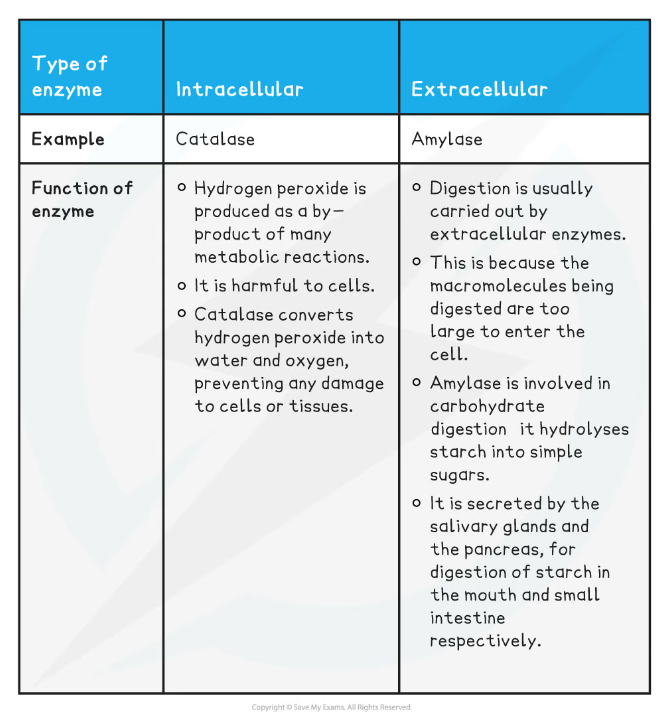
- As well as amylase (which hydrolyses starch into maltose), another example of an extracellular digestive enzyme that is secreted by the pancreas and enters the small intestine is?trypsin, which breaks?proteins?down into?peptides?and?amino acids
- In fact, some organisms can only feed using a form of?extracellular digestion?in which the digestive enzymes are actually secreted?outside?of their?bodies
- For example, the?hyphae?of?fungi?secrete the necessary enzymes?directly?onto the food?they are consuming (e.g. wood) so that the food is digested into smaller, simple molecules that the fungi can then?absorb?through the walls of the hyphae
Exam Tip
Don't forget that enzymes are proteins, meaning that anything that could denature a protein and make it non-operational (such as extremes of heat, temperature, pH etc.) would also denature an enzyme. This is one reason why homeostasis (the maintaining of internal body conditions) is so important: to ensure that enzymes within the body can function properly, as they are essential to the survival of organisms.
轉載自savemyexams
以上就是關于【OCR A Level Biology:復習筆記2.4.1 The Role of Enzymes】的解答,如需了解學校/賽事/課程動態,可至翰林教育官網獲取更多信息。
往期文章閱讀推薦:
MIT官方發布【2026年夏季推薦閱讀書單】!橫跨科學/人文/經濟...


翰林AMC8視頻課重磅上線!

國際競賽真題資源免費領取






