OCR A Level Biology:復(fù)習(xí)筆記2.3.1 Nucleotides & Phosphodiester Bonds

Nucleotides
- DNA and RNA are nucleic acids:?polymers?that are made up of?many repeating units?(monomers) called?nucleotides
- Each nucleotide is formed from:
- A?pentose sugar?(a sugar with 5 carbon atoms)
- A nitrogen-containing?organic base
- A?phosphate group
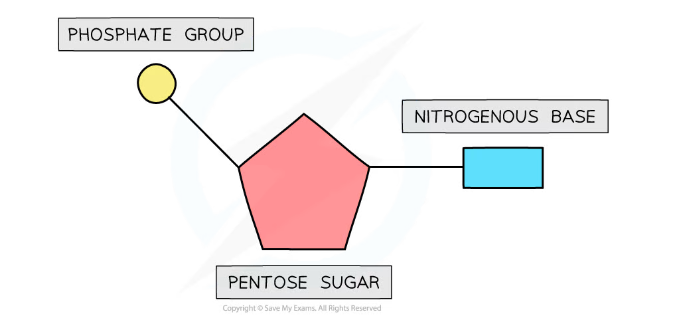
The basic structure of a nucleotide
DNA nucleotides
- The components of a DNA nucleotide are:
- A?deoxyribose?sugar with?hydrogen?at the 2' position
- A phosphate group
- One of four nitrogenous bases - adenine (A), cytosine(C), guanine(G) or thymine(T)
RNA nucleotides
- The components of an RNA nucleotide are:
- A?ribose?sugar with a?hydroxyl (OH) group?at the 2' position
- A phosphate group
- One of four nitrogenous bases - adenine (A), cytosine(C), guanine(G) or?uracil (U)
- The presence of the?2' hydroxyl group?makes?RNA more susceptible to hydrolysis
- This is why DNA is the storage molecule and RNA is the transport molecule with a shorter molecular lifespan
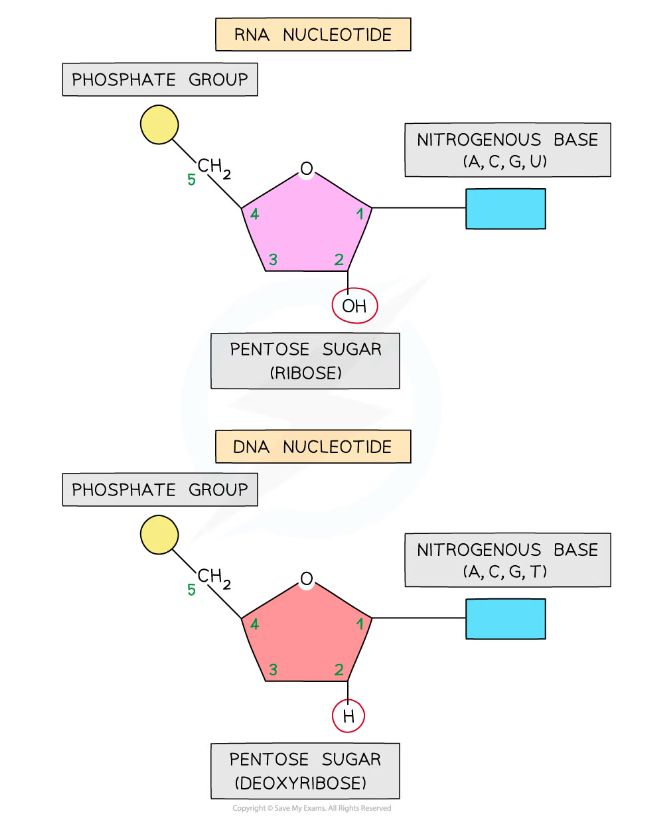
An RNA nucleotide (top) compared with a DNA nucleotide (bottom)
Purines & pyrimidines
- The?nitrogenous base?molecules that are found in the nucleotides of DNA (A, T, C, G) and RNA (A, U, C, G) occur in?two structural forms:?purines?and?pyrimidines
- The bases?adenine?and?guanine?are?purines?– they have a?double ring structure
- The bases?cytosine,?thymine?and?uracil?are?pyrimidines?– they have a?single ring structure
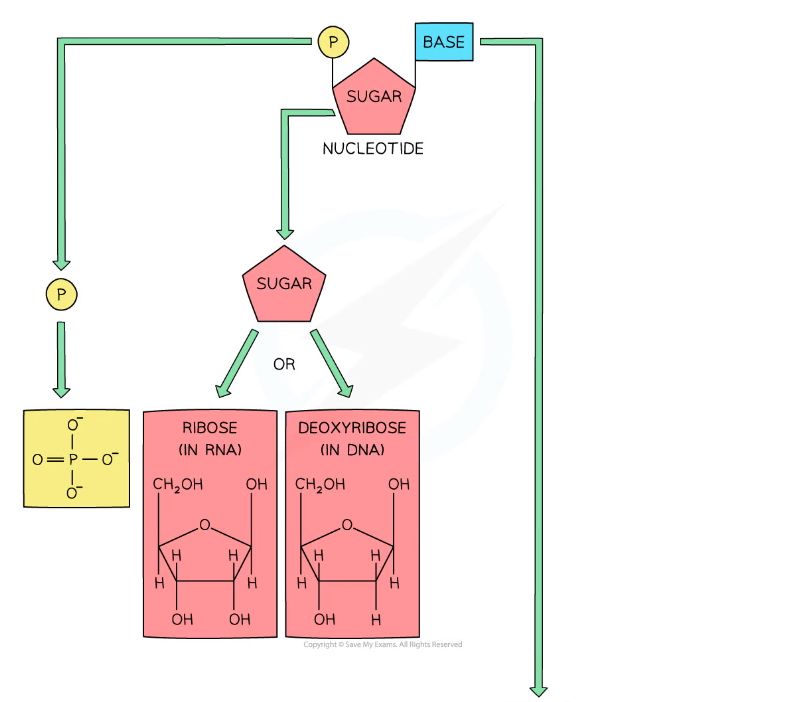
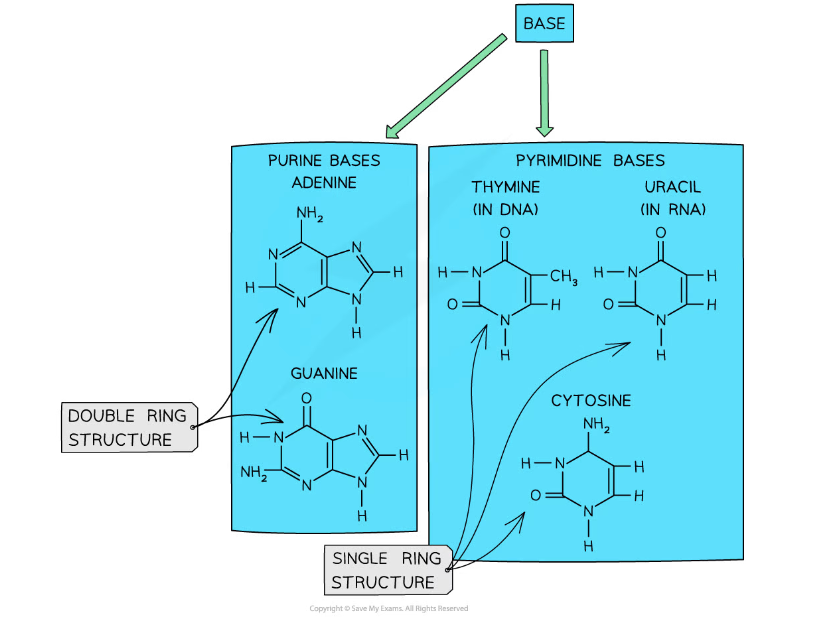
The molecular structures of purines and pyrimidines are slightly different
Nucleotide Structure Table

Exam Tip
Although DNA and RNA nucleotides are very similar, make sure you know the?key differences?between them: unlike DNA,?RNA nucleotides never contain the nitrogenous base thymine?(in place of this they contain the nitrogenous base?uracil) and unlike DNA, RNA nucleotides contain the pentose sugar?ribose?(instead of deoxyribose).You don’t need to know the structural formulae of the bases, just which are purines and which are pyrimidines.
Phosphodiester Bond
- DNA and RNA are polymers (polynucleotides), meaning that they are made up of many nucleotides joined together in long chains
- Separate?nucleotides are joined together?via?condensation reactions
- These condensation reactions occur between the?phosphate group?of one nucleotide and the?pentose sugar?of the next nucleotide
- A condensation reaction between two nucleotides forms a?phosphodiester bond
- It is called a phosphodiester bond because it consists of a phosphate group and?two?ester bonds
- The chain of alternating phosphate groups and pentose sugars produced as a result of many phosphodiester bonds is known as the?sugar-phosphate backbone?(of the DNA or RNA molecule)
- As the?synthesis?of?polynucleotides?requires the?formation?of?phosphodiester bonds, the same is true for the reverse process: the?breakdown?of polynucleotides requires the?breakage?of phosphodiester bonds
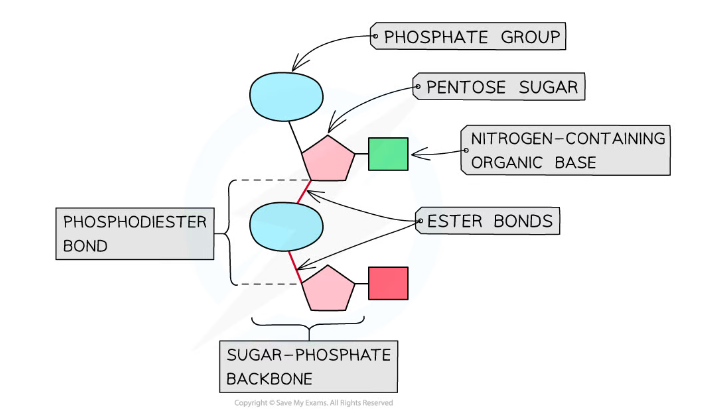
A section of a single polynucleotide strand showing a phosphodiester bond (and the positioning of the two ester bonds and the phosphate group that make up the phosphodiester bond)
Exam Tip
In condensation reactions, a molecule of water is released. In hydrolysis reactions, a molecule of water is added.
轉(zhuǎn)載自savemyexams
以上就是關(guān)于【OCR A Level Biology:復(fù)習(xí)筆記2.3.1 Nucleotides & Phosphodiester Bonds】的解答,如需了解學(xué)校/賽事/課程動態(tài),可至翰林教育官網(wǎng)獲取更多信息。
往期文章閱讀推薦:
斯坦福大學(xué)官方推薦書單!名校學(xué)霸們暑假都在讀什么?
MIT官方發(fā)布【2026年夏季推薦閱讀書單】!橫跨科學(xué)/人文/經(jīng)濟(jì)...


翰林AMC8視頻課重磅上線!

國際競賽真題資源免費(fèi)領(lǐng)取






