OCR A Level Biology:復習筆記2.2.17 Chromatography

Chromatography
- Chromatography is a technique that can be used to?separate a mixture?into its individual components
- Chromatography relies on?differences in the solubility?of the different chemicals (called?‘solutes’) within a mixture
- All chromatography techniques use?two phases:
- The?mobile?phase
- The?stationary?phase
- The components in the mixture?separate?as the mobile phase travels over the stationary phase
- Differences in the?solubility?of each component in the mobile phase affects?how far each component can travel
- Those components with?higher solubility?will travel?further?than the others
- This is because they spend more time in the mobile phase and are thus carried further up the paper than the less soluble components
Paper chromatography
- Paper chromatography?is one specific form of chromatography
- In paper chromatography:
- The mobile phase is the?solvent?in which the sample molecules can move, which in paper chromatography is a liquid e.g. water or ethanol
- The stationary phase in paper chromatography is the?chromatography paper
Paper chromatography method
- A spot of the mixture (that you want to separate) is placed on chromatography paper and left to dry
- The chromatography paper is then?suspended in a solvent
- As the solvent travels up through the chromatography paper, the different components within the mixture begin to move up the paper at different speeds
- Larger molecules move slower than smaller ones
- This causes the original mixture to separate out into different spots or bands on the chromatography paper
- This produces what is known as a?chromatogram
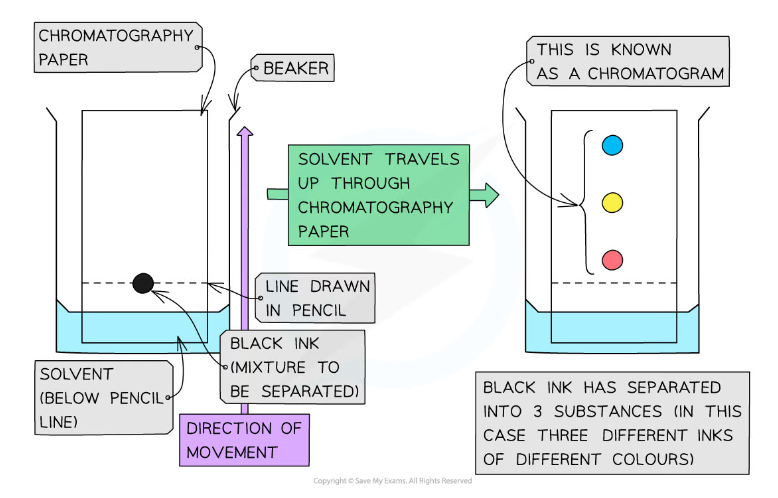
An example of a chromatogram that has been produced by using paper chromatography to separate a spot of ink
Using chromatography to separate a mixture of monosaccharides
- Paper chromatography can be used to?separate a mixture of monosaccharides
- Mixtures containing coloured molecules, such as ink or chlorophyll, do not have to be stained as they are already coloured
- Mixtures of colourless molecules, such as a mixture of monosaccharides,?have to be stained first
- A spot of the stained monosaccharide sample mixture is placed on a line at the bottom of the chromatography paper
- Spots of?known standard solutions?of different monosaccharides are then placed on the line beside the sample spot
- The chromatography paper is then?suspended in a solvent
- As the solvent travels up through the chromatography paper,?the different monosaccharides?within the mixture?separate out?at different distances from the line
- The unknown monosaccharides can then be identified by?comparing?and?matching?them with the chromatograms of the known standard solutions of different monosaccharides
- If a spot from the monosaccharide sample mixture is at the?same distance from the line?as a spot from one of the known standard solutions, then?the mixture must contain this monosaccharide
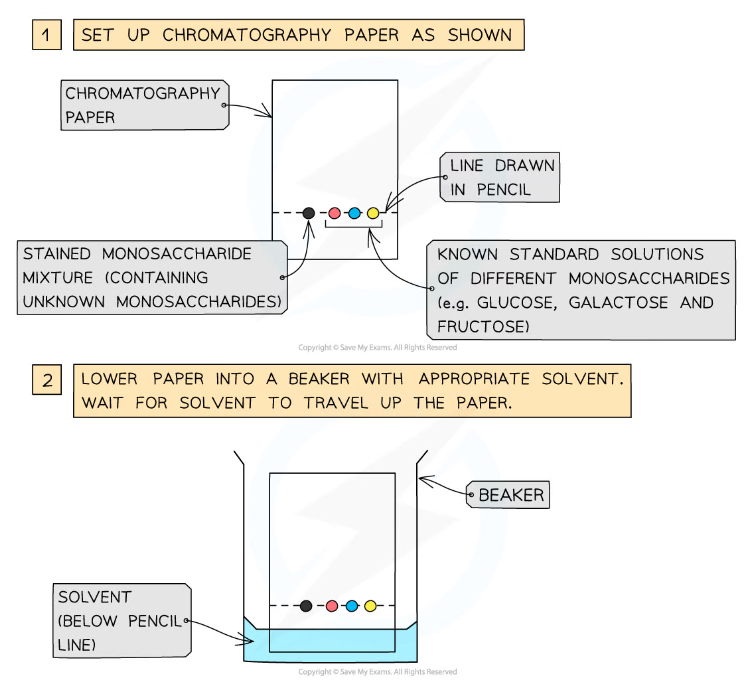
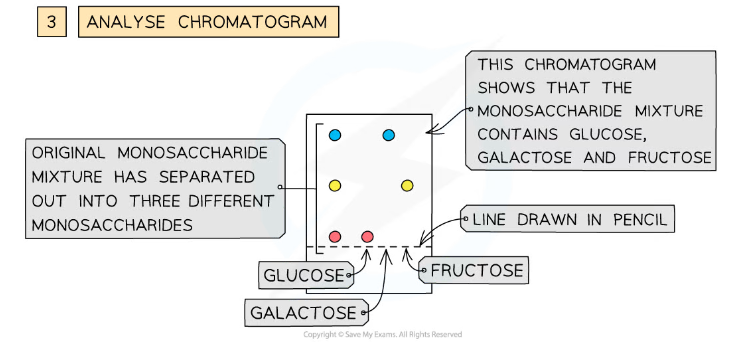
How chromatography can be used to separate a mixture of monosaccharides and identify the individual components
Using chromatography to separate a mixture of amino acids
- Paper chromatography can be used to?separate a mixture of amino acids
- A spot of the unknown amino acid sample mixture is placed on a line at the bottom of the chromatography paper
- Spots of?known standard solutions?of different amino acids are then placed on the line beside the unknown sample spot
- The chromatography paper is then?suspended in a solvent
- Each amino acid will be?more or less soluble?in the mobile phase than others and will therefore?separate out?of the mixture travelling with the solvent at?different times/distances?from the line, depending on their:
- Charge
- Size
- The unknown amino acid(s) can then be identified by?comparing?and?matching?them with the chromatograms of the?known standard solutions?of different amino acids
- If a spot from the amino acid sample mixture is at the?same distance from the line?as a spot from one the known standard solutions, then?the mixture must contain this amino acid
- In order to view the spots from the different amino acids, it may be necessary to first?dry?the chromatography paper and then?spray it?with?ninhydrin solution?(this chemical?reacts with amino acids, producing an?easily visible blue-violet colour)
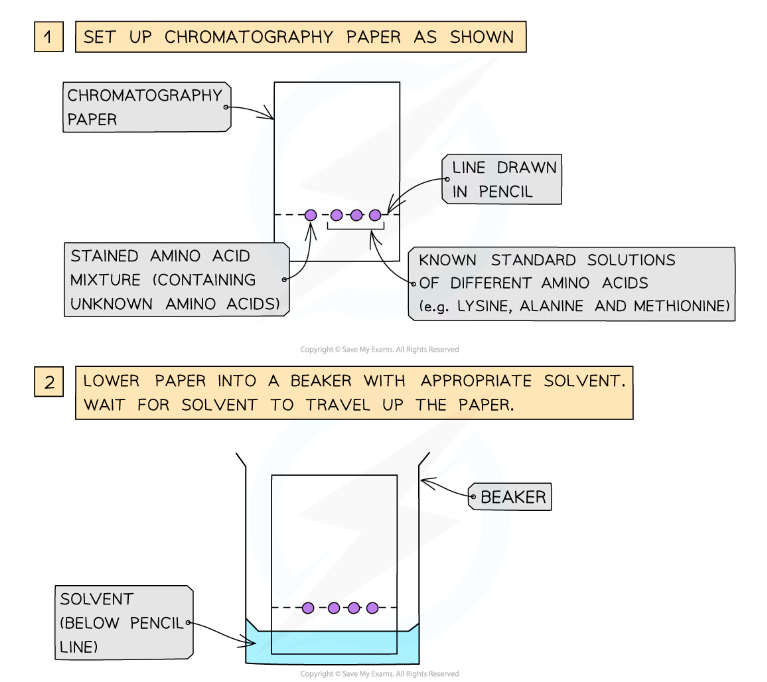
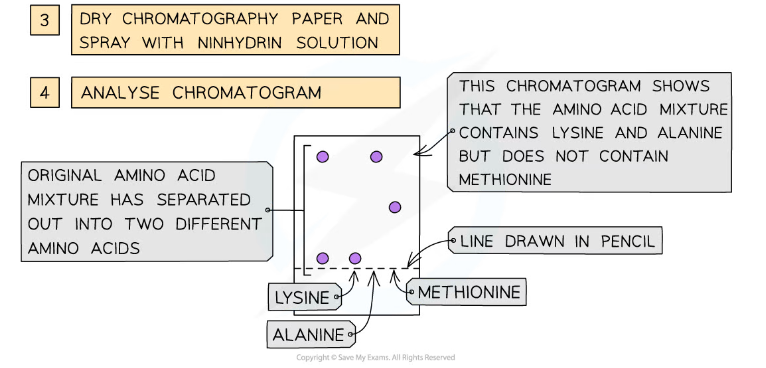
How chromatography can be used to separate a mixture of amino acids and identify the individual components
Calculating the?Rf?value
- After a chromatogram has been obtained the molecules present in the sample mixture can be identified by calculating their retardation factor (Rf)
- In order to calculate Rf values, a line must be drawn across the chromatogram to show how far the solvent travelled
- This line is known as the?solvent front
- The distance between the?origin line?and the solvent front is the distance moved by the solvent
- The origin line is the line at the?bottom?of the paper on which the samples were placed at the beginning of the experiment
- The Rf?value demonstrates how far a dissolved molecule travels during the mobile phase
- A?smaller Rf?value?indicates the molecule is?less soluble?and?larger?in size
- The Rf value of each solute (each spot on the chromatogram) is calculated and then compared to the Rf values of known molecules/substances
- The equation is:
Rf = distance moved by solute?÷?distance moved by solvent
- The Rf value is a ratio so it is?always lower than one
- It has?no units
Using Rf values to identify chloroplast pigments
- Chromatography can be used to separate and identify chloroplast pigments that have been extracted from a leaf as?each pigment will have a unique Rf value
- Although specific Rf values depend on the solvent that is being used, in general:
- Carotenoids?have the?highest Rf values?(usually close to 1)
- Chlorophyll B?has a?much lower Rf value
- Chlorophyll A?has an Rf value somewhere?between?those of carotenoids and chlorophyll B
- Small Rf values?indicate the pigment is?less soluble?and?larger?in size
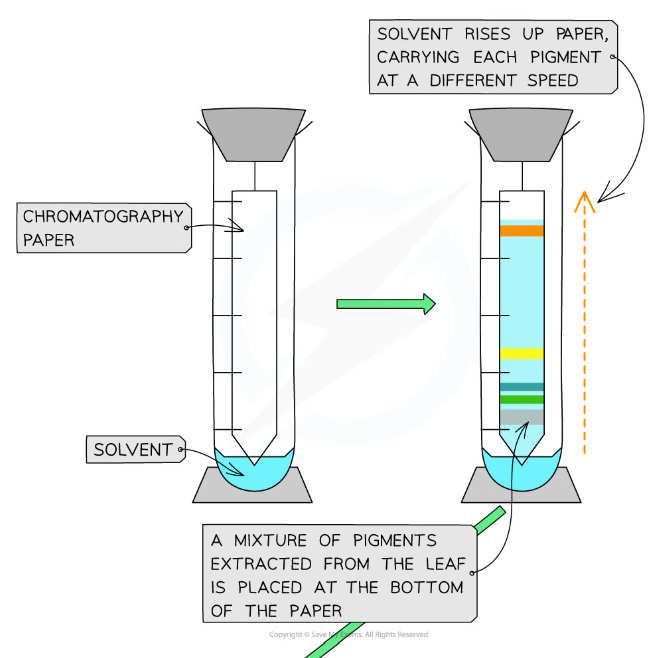
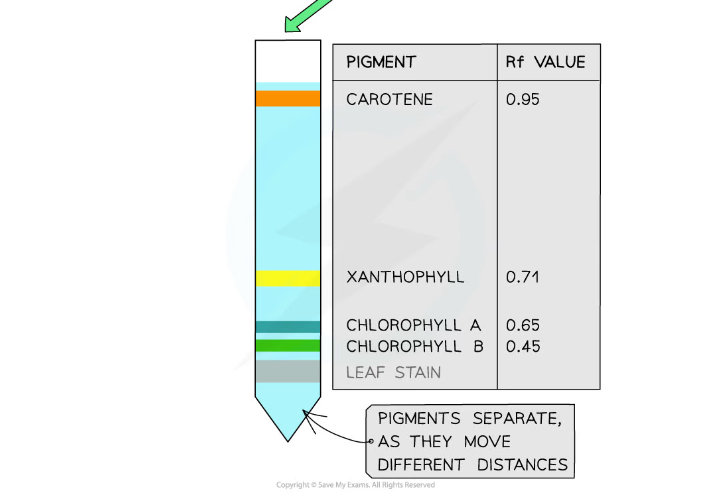
Paper chromatography can be used to separate the photosynthetic pigments found within chloroplasts. Rf values can then be calculated for each pigment and compared to known Rf values for the different pigments.
Exam Tip
It is always worth trying to understand?why?a certain practical technique is useful. An example of when chromatography would be used is if you have an unknown liquid and you have determined it contains protein using a Biuret test. Chromatography will then show you which amino acids are present so you can better understand the potential use or function of the sample. This could be useful in crime scene investigations or in detecting additives or spoilage in foods.
轉載自savemyexams
以上就是關于【OCR A Level Biology:復習筆記2.2.17 Chromatography】的解答,如需了解學校/賽事/課程動態,可至翰林教育官網獲取更多信息。
往期文章閱讀推薦:
MIT官方發布【2026年夏季推薦閱讀書單】!橫跨科學/人文/經濟...


翰林AMC8視頻課重磅上線!

國際競賽真題資源免費領取






