OCR A Level Biology:復習筆記2.2.2 Monomers & Polymers

Monomers & Polymers
- There is a massive variety of life within and between organisms however the biochemical basis of life is similar for all living things
- The key molecules that are required to build structures that enable organisms to function are:
- Carbohydrates
- Proteins
- Lipids
- Nucleic Acids
- Water
- Monomers?are the smaller units from which larger molecules are made
- Polymers?are molecules made from a large number of monomers joined together in a chain
- Carbon compounds can form small single subunits?(monomers)?that bond with many repeating subunits to form large molecules?(polymers)?by a process called?polymerisation
- Macromolecules?are very large molecules
- They contain 1000 or more atoms and so have a?high molecular mass
- Polymers can be macromolecules, however,?not?all?macromolecules are polymers as the subunits of polymers have to be the?same?repeating units
Covalent bonding
- A?covalent bond?is the sharing of two or more electrons between two atoms
- The electrons can be shared equally forming a?nonpolar?covalent bond or unequally (where an atom can be more?electronegative?δ-) to form a?polar?covalent bond
- Generally, each atom will form a certain number of covalent bonds due to the number of free electrons in the outer orbital e.g. H = 1 bond, C = 4 bonds
- Covalent bonds are very stable as high energies are required to break the bonds
- Multiple pairs of electrons can be shared forming?double?bonds (e.g. unsaturated fats C=C) or?triple?bonds
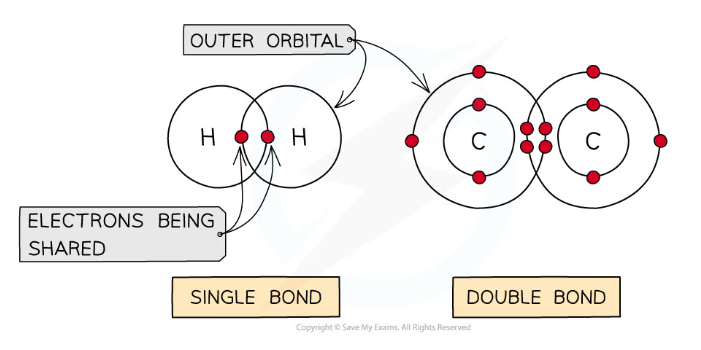
Different types of covalent bonds
- When two monomers are close enough that their outer orbitals overlap this results in their?electrons being shared?and a covalent bond forming. If more monomers are added then?polymerisation?occurs (and / or a macromolecule forms)
Condensation
- Also known as dehydration synthesis (‘to put together while losing water’)
- A?condensation reaction?occurs when?monomers?combine together by?covalent bonds?to form?polymers?(polymerisation) or macromolecules (lipids) and?water?is?removed
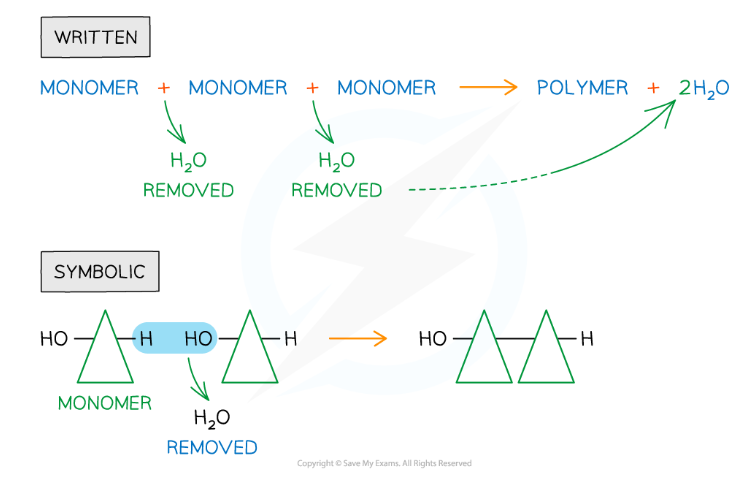
Written and symbolic illustrations of the removal of water to form a covalent bond between two or more monomers during a condensation reaction
Hydrolysis
- Hydrolysis means ‘lyse’ (to break) and ‘hydro’ (with water)
- In the hydrolysis of polymers,?covalent bonds?are?broken?when?water?is?added
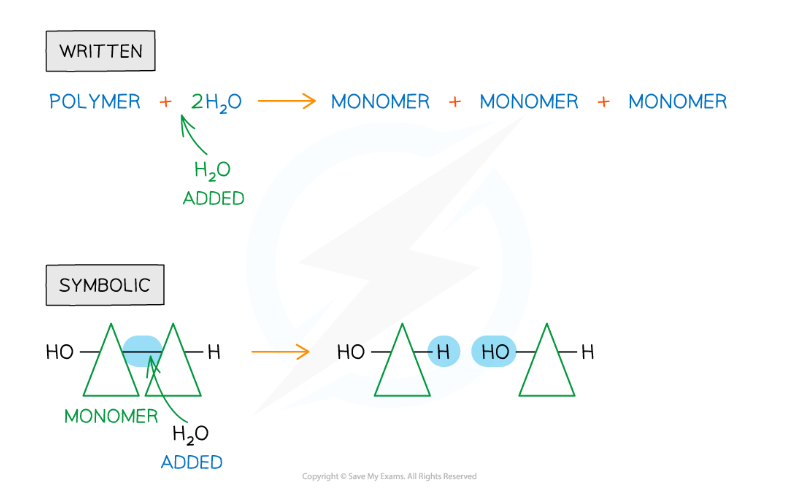
Written and symbolic illustrations of the addition of water to break down covalent bond/s during a hydrolysis reaction
Covalent Bonds in Organic Molecules Table
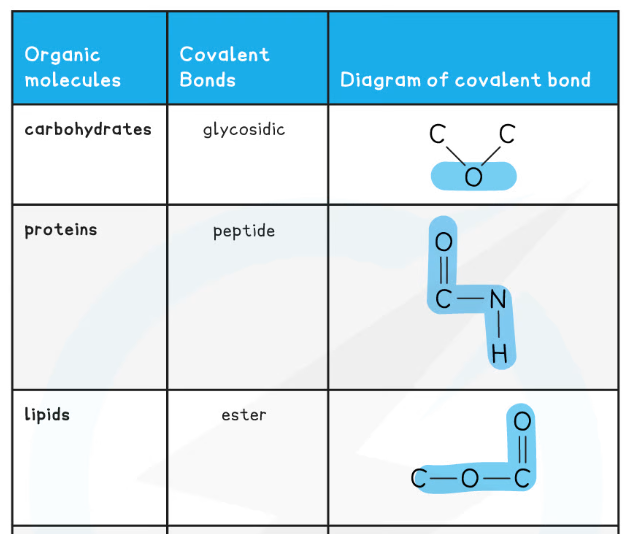
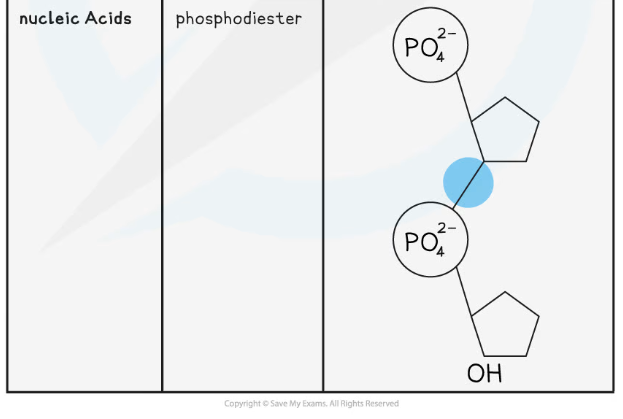
Exam Tip
When discussing monomers and polymers, give the definition but also name specific examples eg. a?nucleic acid?is a polymer, made of?nucleotide?monomers.Remember, lipid molecules are?not?made from monomers or polymers as each fatty acid joins to a glycerol molecule, rather than to each other. Separate lipid molecules, such as triglycerides, are?not?held together by?covalent bonds?and therefore lipids cannot be classed as polymers.
Chemical Elements in Biological Molecules
- Carbohydrates, lipids, proteins and nucleic acids contain the chemical elements?carbon?(C) and?hydrogen?(H) making them?organic compounds
- Carbon atoms?are key to organic compounds because:
- Each carbon atom can form?four?covalent bonds?– this makes the compounds very stable (as covalent bonds are so strong they require a large input of energy to break them)
- Carbon atoms can form covalent bonds with oxygen, nitrogen and sulfur
- Carbon atoms can form?straight chains,?branched?chains?or?rings
Carbohydrates
- All carbohydrates contain the chemical elements?C,?H?and?O
- As?H?and?O?atoms are always present in the?ratio?of?2:1?(eg. water H2O, which is where ‘hydrate’ comes from in 'carbohydrate') they can be represented by the formula?Cx?(H2O)y
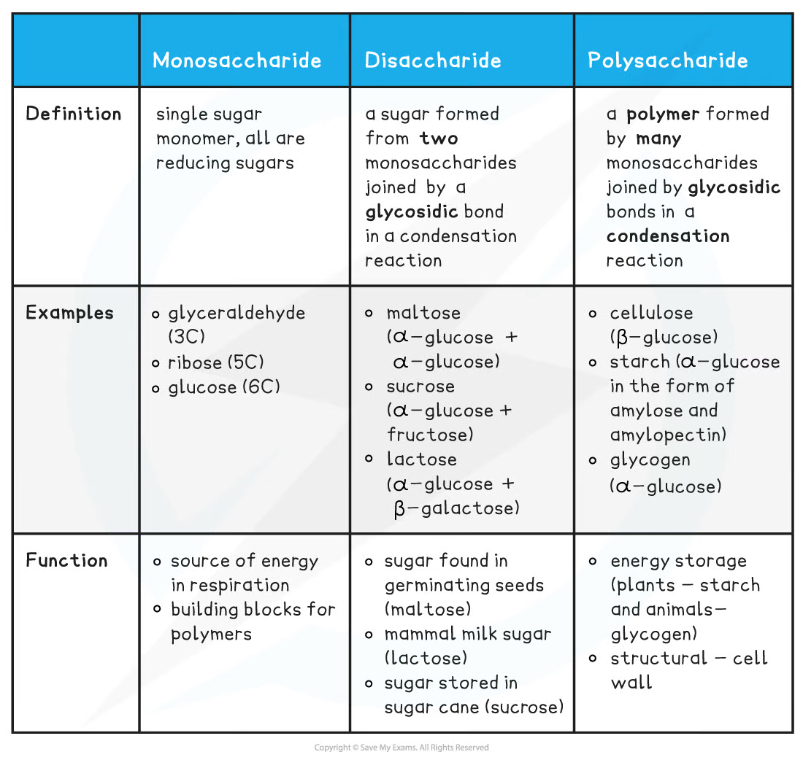
- The three types of carbohydrates are?monosaccharides,?disaccharides?and?polysaccharides
- Carbohydrates have many different functions:
- Source of energy?e.g. glucose is used for energy-release during cellular respiration
- Store of energy?e.g. glycogen is stored in the muscles and liver of animals
- Structurally important?e.g. cellulose in the cell walls of plants
Types of Carbohydrates Table
Lipids
- All lipids?contain the chemical elements?C,?H?and?O
- However, the proportion of?O?in lipids is?low?compared to carbohydrates
- There are many types of lipids, including triglycerides (fats and oils), phospholipids, waxes, and steroids (such as cholesterol)
- Lipids have many different functions:
- Source of energy?that can be respired (lipids have a high energy yield)
- Store of energy?e.g. lipids are stored in animals as fats in adipose tissue and in plants as lipid droplets
- Insulating layer?e.g.?thermal?insulation?under the skin of mammals and?electrical?insulation?around nerve cells
- An essential component of?biological membranes
Proteins
- Like carbohydrates and lipids, all proteins contain the chemical elements?C,?H?and?O
- However, all proteins also contain?N?(nitrogen) and some proteins contain?S?(sulphur)
- Proteins have many different functions:
- Required for cell?growth, cell?repair?and the replacement of biological materials
- Structurally important?e.g. in muscles, collagen and elastin in the skin, collagen in bone and keratin in hair
- Proteins can also act as?carrier molecules?in cell membranes,?antibodies,?enzymes?or?hormones
Nucleic Acids
- Like carbohydrates, lipids and proteins, all nucleic acids contain the chemical elements?C,?H?and?O
- However, all nucleic acids also contain?N?(nitrogen) in their?bases?and?P?(phosphorous) in the form of?phosphate groups
- Nucleic acids (DNA and RNA) have?one?function:
- Carrying the?genetic code?in all living organisms
- Nucleic acids are essential in the?control?of all cellular?processes?including?protein synthesis
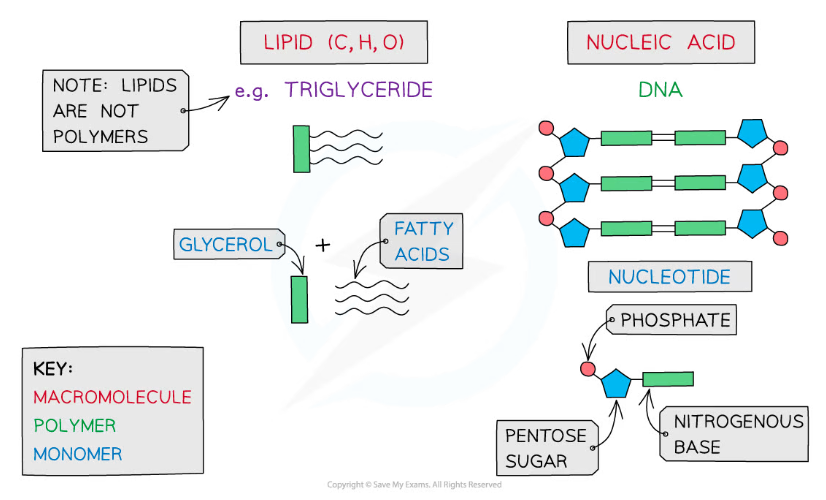
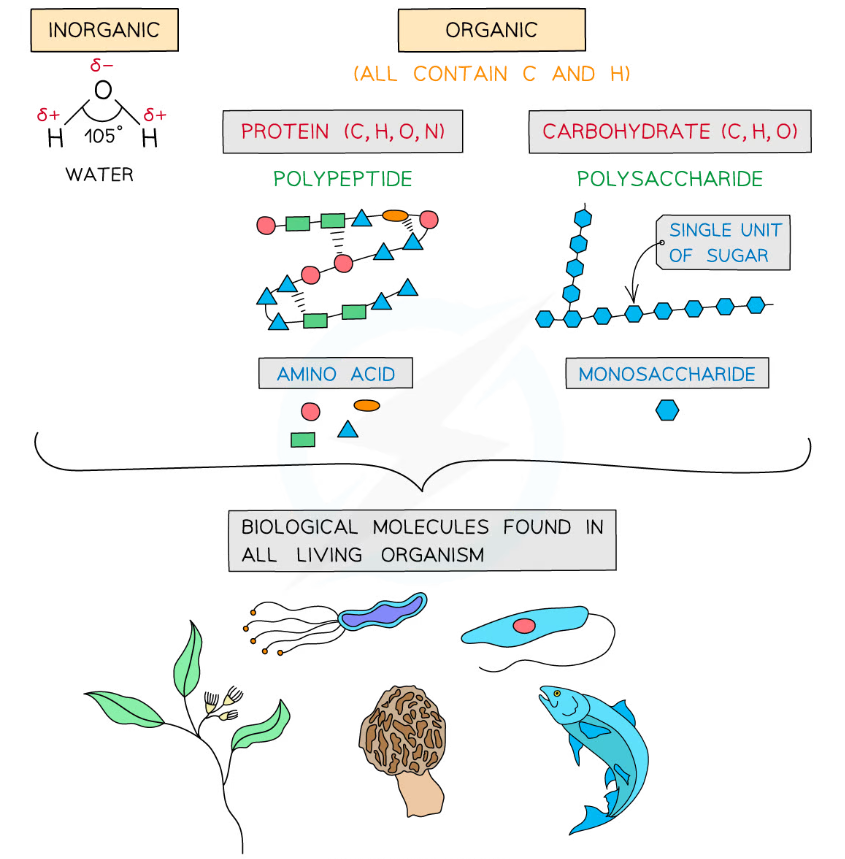
The key biological molecules for living organisms
轉載自savemyexams
以上就是關于【OCR A Level Biology:復習筆記2.2.2 Monomers & Polymers】的解答,如需了解學校/賽事/課程動態,可至翰林教育官網獲取更多信息。
往期文章閱讀推薦:
MIT官方發布【2026年夏季推薦閱讀書單】!橫跨科學/人文/經濟...


翰林AMC8視頻課重磅上線!

國際競賽真題資源免費領取






