Edexcel A (SNAB) A Level Biology:復(fù)習(xí)筆記8.1.1 Co-ordination of Response

Co-ordination of Response
- Organisms must?respond to changes?in their?external?and?internal?environments in order to survive
- Organisms need to
- Find favourable external conditions e.g. avoiding locations that are too hot or cold
- Find food
- Avoid harm e.g. from predators or high blood glucose
- Organisms need to
- Changes in the environment, or?stimuli?(singular?stimulus) are detected by specialised?receptor cells
- Receptor cells are located in the?sense organs?e.g. the nose and eyes
- Receptor cells can also be found inside the body e.g. pressure receptors in the blood vessels
- Receptor cells send?signals?via either the?nervous system?or the?hormonal system?to the body's co-ordination centres in the?brain?or?spinal cord
- Signals are then sent on to the parts of the body which respond, known as the?effectors
- Effectors can be either?muscles?or?glands?e.g.
- An arm muscle would respond to a hot surface by contracting to move the hand away
- The pancreas responds to high blood sugar by secreting insulin
- Effectors can be either?muscles?or?glands?e.g.
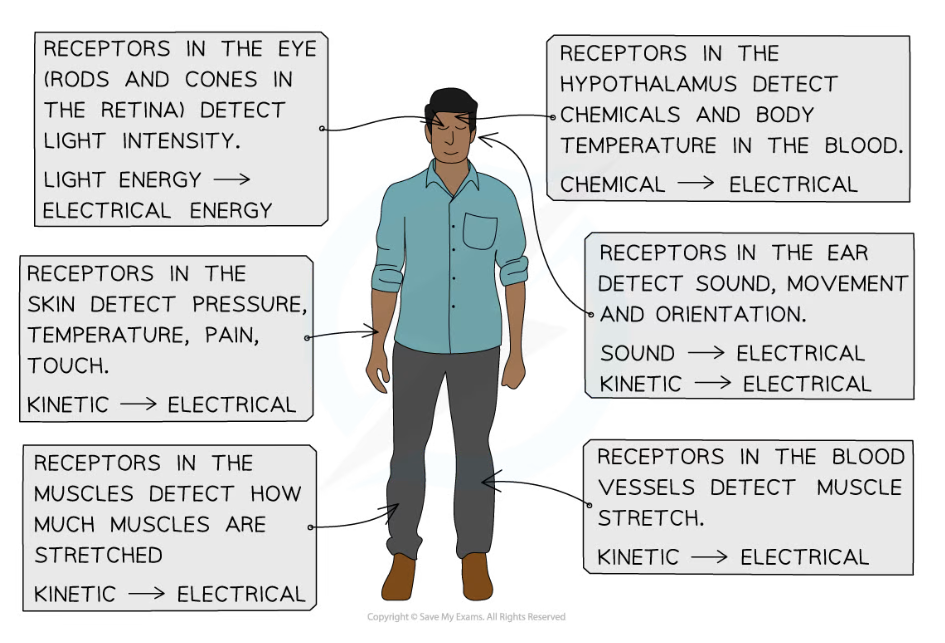
Receptors are cells that detect stimuli in the internal and external environment
The nervous system
- The human nervous system consists of
- Central nervous system?(CNS) – the?brain?and?spinal cord
- Peripheral nervous system?(PNS) – all of the?nerves?in the body
- The nervous system allows detection of stimuli in our surroundings and the?coordination?of the body's?responses?to the stimuli
- Information is sent through the nervous system in the form of?electrical impulses?that pass along?nerve cells?known as?neurones
- A?bundle of neurones?is known as a?nerve
- There are different types of neurones?including?sensory neurones, relay neurones,?and?motor neurones
- The nerves connect the receptors in the sense organs with the CNS, and connect the CNS with effectors
- The?CNS?acts as a?central coordinating centre?for the impulses that come in from, and are sent out to, any part of the body
- Nerve impulses pass through the nervous system along the following pathway
stimulus → receptor → sensory neurone → CNS →motor neurone →effector
- An example of this nerve pathway in action might be
hot surface → pain receptor in skin of hand → sensory neurone →CNS → motor neurone →?arm muscle
-
- The muscle in the arm responds by contracting to move the hand away from the hot surface
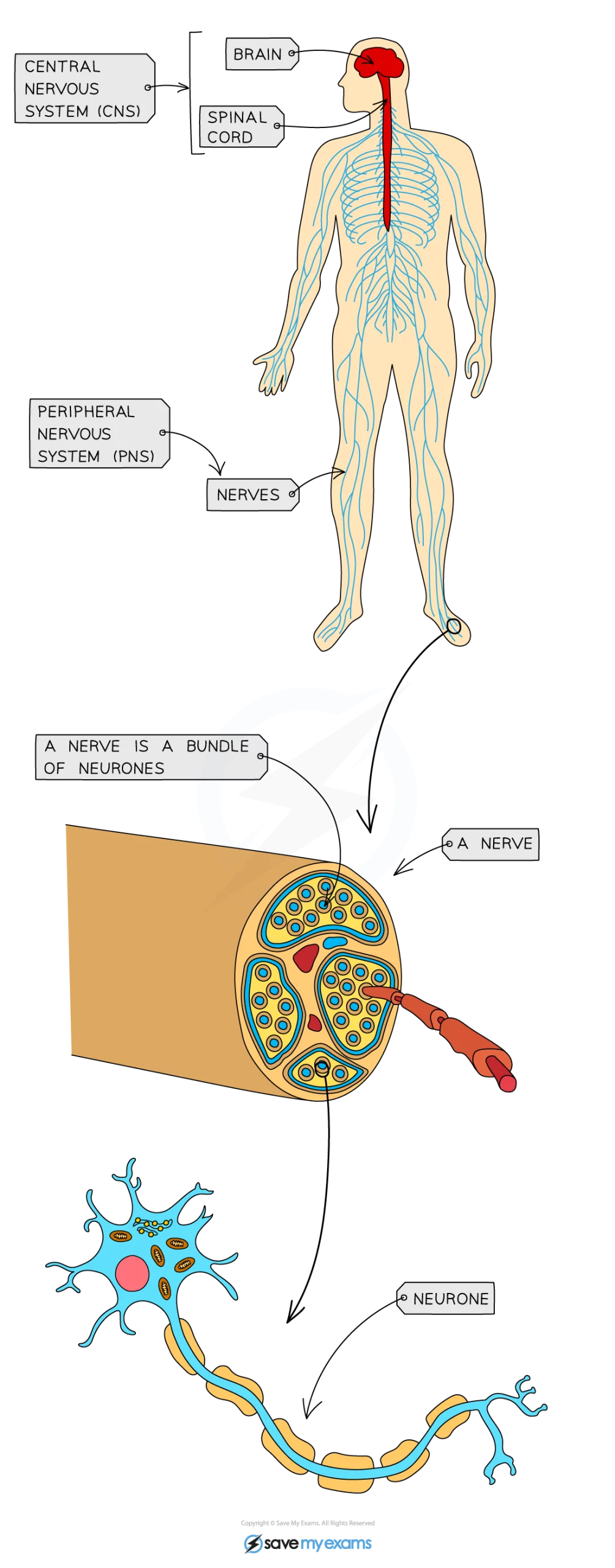
The nervous system allows the detection of stimuli and the co-ordination of appropriate responses
The hormonal system
- Hormones are?chemical substances?produced by?endocrine glands?and carried by the?blood
- Hormones are sometimes known as?chemical messengers
- Hormones?transmit information from one part of an organism to another?and bring about?change?by altering the?activity?of one or more?specific?target organs
- Hormones can leave the blood and bind to?specific receptors?on the cell surface membranes of target organs
- Hormones are slower in action than nerve impulses and are therefore used to control functions that?do not need instant responses
- Endocrine glands that produces hormones in animals are known collectively as the?endocrine system
- Endocrine glands secrete hormones directly into the?blood
- Endocrine glands can be stimulated to secrete hormones by the action of?another hormone?or by the arrival of a?nerve impulse
- The pathway of hormone action is as follows
stimulus → receptor → hormone →effector
- An example of this pathway in action might be
high blood sugar → cells in the pancreas → insulin →?liver cells
-
- The liver cells respond to insulin by converting glucose into glycogen
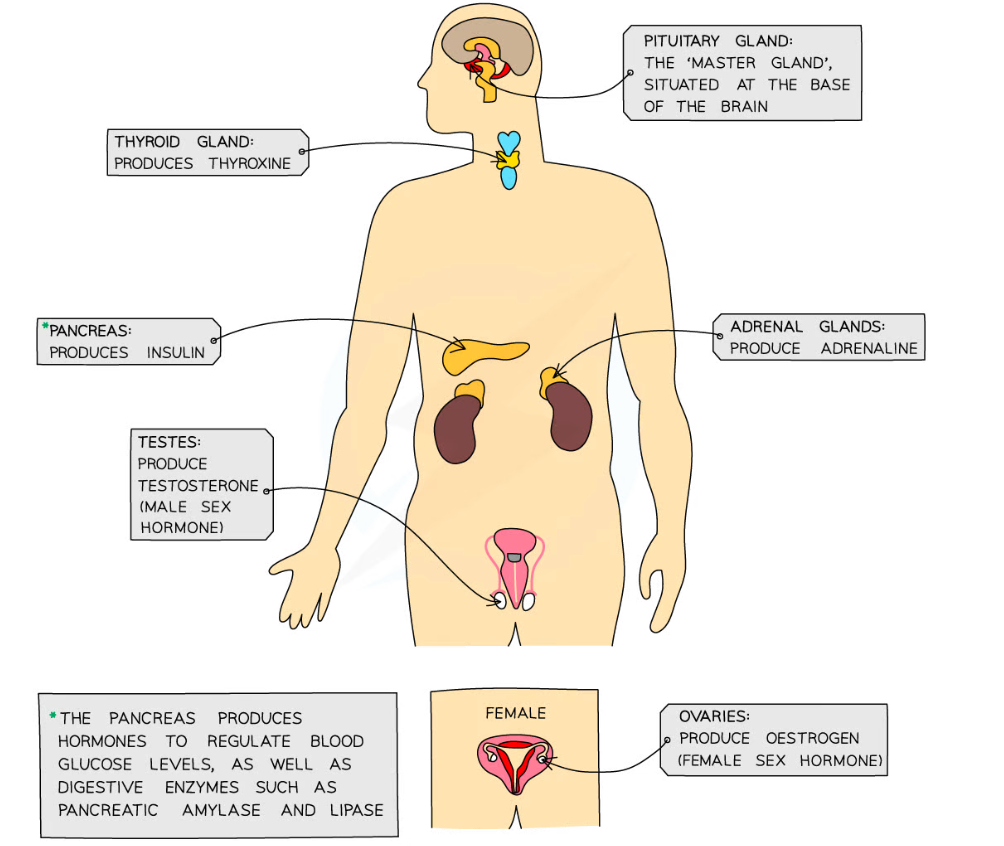

Hormones are secreted into the blood by the endocrine glands
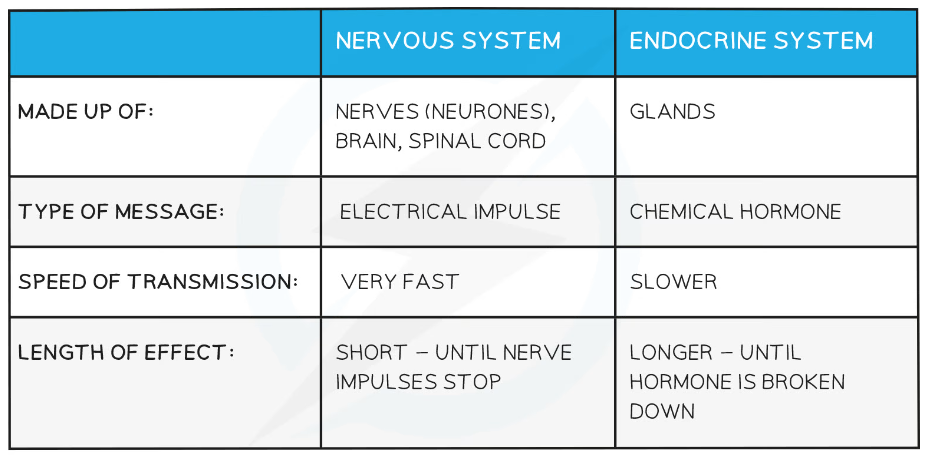
Comparison of Nervous and Hormonal control Table
轉(zhuǎn)載自savemyexams
以上就是關(guān)于【Edexcel A (SNAB) A Level Biology:復(fù)習(xí)筆記8.1.1 Co-ordination of Response】的解答,如需了解學(xué)校/賽事/課程動態(tài),可至翰林教育官網(wǎng)獲取更多信息。
往期文章閱讀推薦:
斯坦福大學(xué)官方推薦書單!名校學(xué)霸們暑假都在讀什么?
MIT官方發(fā)布【2026年夏季推薦閱讀書單】!橫跨科學(xué)/人文/經(jīng)濟(jì)...


翰林AMC8視頻課重磅上線!

國際競賽真題資源免費領(lǐng)取






