Edexcel A Level Physics:復習筆記8.8 Annihilation of Matter & Antimatter

Annihilation of Matter & Antimatter
Annihilation
- When a particle meets its antiparticle partner, the two will?annihilate
- Annihilation is:
When a particle meets its equivalent anti–particle they both are destroyed and their mass is converted into energy in the form of two gamma ray photons
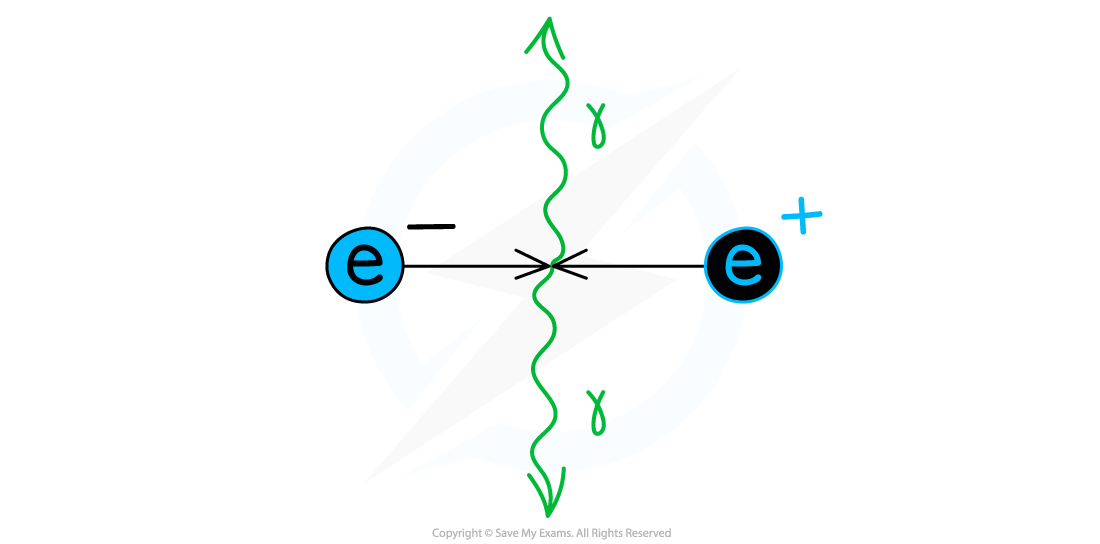
When an electron and positron collide, their mass is converted into energy in the form of two photons emitted in opposite directions
Pair Production
- Pair production is the opposite of annihilation
- Pair production is:
When a photon interacts with a nucleus or atom and the energy of the photon is used to create a particle–antiparticle pair
- The presence of a nearby neutron is essential in pair production so that the process conserves both?energy and momentum
- A single photon alone cannot produce a particle–anti-particle pair or the conservation laws would be broken
- Pair creation is a case of energy being converted into matter
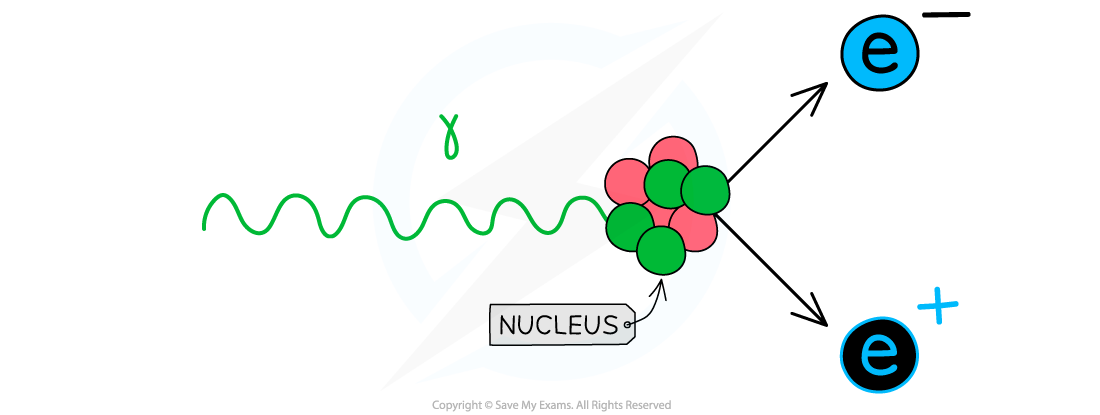
When a photon with enough energy interacts with a nucleus it can produce an electron-positron pair
- This means the energy of the photon must be above a certain value to provide the?total?rest?mass?energy?of the particle–antiparticle pair
- Einstein's famous mass-energy relation showed that?energy?can be converted into?mass, and vice versa
- It is given by:
ΔE?=?c2?Δm
- Where:
- Δm?= rest mass of the particle (kg)
- c?= speed of light (m s–1)
- ΔE?= rest mass energy of the particle (J)
- Therefore, in order to create a particle & anti-particle pair, the energy carried by a single photon must be?at least?twice the rest-mass energy required, i.e.
2ΔE?= 2(c2?Δm)
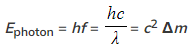
- This also means if a particle meets its anti-particle and annihilates, the energy carried away by?each?of the two photons?Ephoton?is given by:
Worked Example
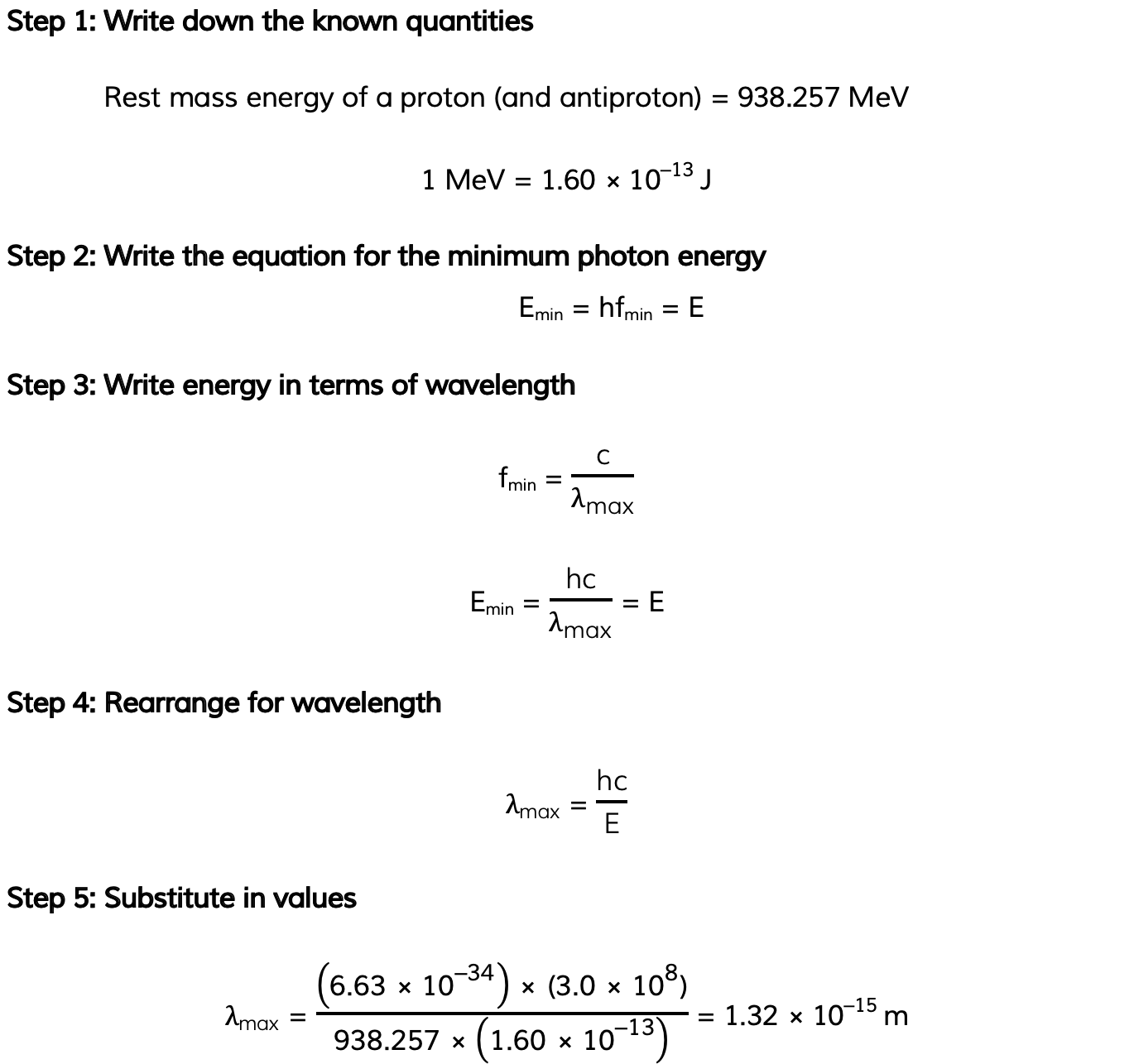
Calculate the maximum wavelength of one of the photons produced when a proton and antiproton annihilate each other.
Exam Tip
Since the Planck constant is in Joules (J?s) remember to always convert the rest mass-energy from MeV to J.
Remember that the equation?E?=?hf?is only relevant for?photons, not for all particles!
轉載自savemyexams
以上就是關于【Edexcel A Level Physics:復習筆記8.8 Annihilation of Matter & Antimatter】的解答,如需了解學校/賽事/課程動態,可至翰林教育官網獲取更多信息。
往期文章閱讀推薦:
2026 ALEVEL 夏考A率出爐!愛德思vs牛津AQA,哪些科目真的“好出分”?
2026 AMC10/12美國數學競賽新賽季!【翰林教育 × 清華大學出版社】獨家教材全面發售!


翰林AMC8視頻課重磅上線!

國際競賽真題資源免費領取






