Edexcel A Level Physics:復(fù)習(xí)筆記7.17 Induced E.M.F in a Moving Coil

Induced E.M.F in a Moving Coil
- Electromagnetic induction is a phenomenon which occurs when an?e.m.f?is induced when a conductor moves through a magnetic field
- If there is a change in?magnetic flux?Φ or magnetic flux linkage?NΦ
- Mechanical work?(from moving the conductor in the field) is transformed into?electrical energy
- Therefore, if attached to a complete circuit, a current will be induced in the conductor
- This is known as?electromagnetic induction?and is defined as:
The process in which an e.m.f is induced in a closed circuit due to changes in magnetic flux (linkage)
- This can occur either when:
- A conductor cuts through a?magnetic field
- The magnetic flux (linkage) through a coil changes, e.g. becomes more or less dense, or changes direction
- Electromagnetic induction is used in:
- Electrical?generators?which convert mechanical energy to electrical energy
- Transformers?which are used in electrical power transmission
- This phenomenon can easily be demonstrated with a magnet and a coil, or a wire and two magnets
Relative Motion between a Coil and a Magnet
- When a coil is connected to a sensitive voltmeter, a bar magnet can be moved in and out of the coil to induce an e.m.f in the coil
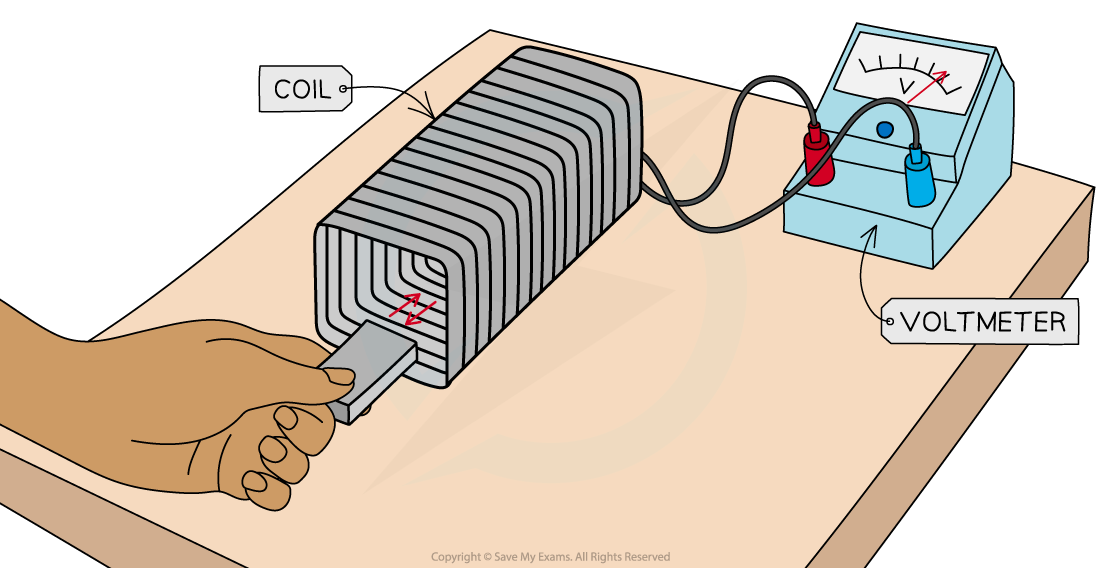
A bar magnet is moved through a coil connected to a voltmeter to induce an e.m.f
The observations are:
- When the bar magnet is?not moving, the voltmeter shows a?zero reading
- When the bar magnet is held still inside, or outside, the coil, the rate of change of flux is zero, so, there is?no e.m.f induced
- When the bar magnet begins to move inside the coil, there is a reading on the voltmeter
- As the bar magnet moves, its magnetic field lines ‘cut through’ the coil, generating a?change in magnetic flux?(ΔΦ)
- This induces an?e.m.f?within the coil, shown momentarily by the reading on the voltmeter
- When the bar magnet is taken back out of the coil, an e.m.f is induced in the?opposite direction
- As the magnet changes direction, the direction of the current changes
- The voltmeter will momentarily show a reading with the opposite sign
- Increasing the?speed?of the magnet induces an e.m.f with a?higher magnitude
- As the speed of the magnet increases, the rate of change of flux increases
- The direction of the electric current, and e.m.f, induced in the conductor is such that it?opposes?the change that produces it
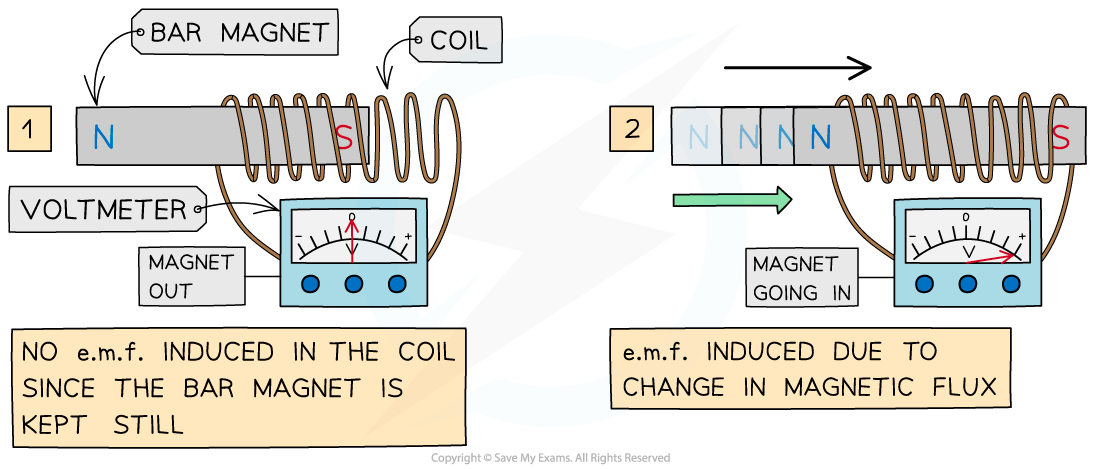
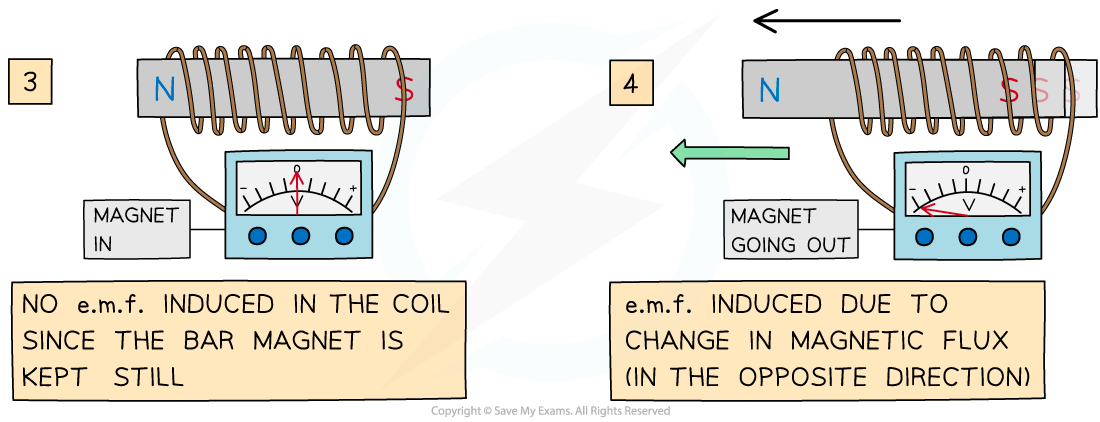
An e.m.f is induced only when the bar magnet is moving through the coil
- Factors that will increase the induced e.m.f are:
- Moving the magnet?faster?through the coil
- Adding more?turns?to the coil
- Increasing the?strength?of the bar magnet
Rotating Coils?
- When a coil rotates in a uniform magnetic field, the?magnetic?flux?through the coil will vary as it rotates
- Therefore, since the [popover id="QczwWzRh7Txmc1KJ" label ="flux linkage"] through the coil also varies, this will induce an e.m.f that also varies
- The maximum e.m.f is when the coil?cuts through?the most field lines
- The varying e.m.f induced is called an?alternating?voltage
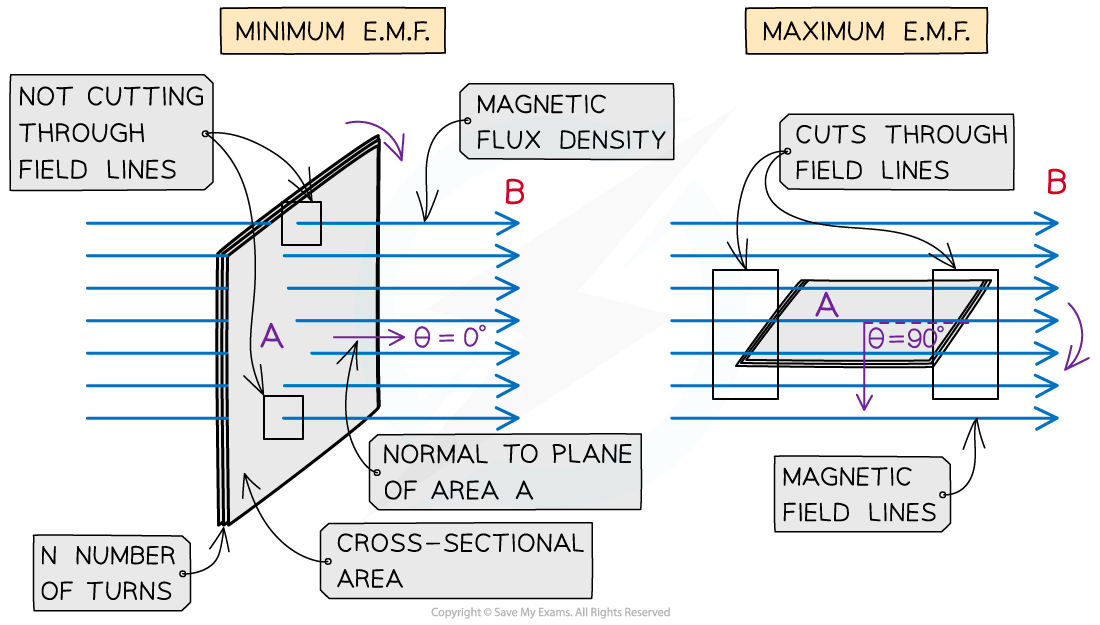
Even though the flux linkage through the coil is maximum when θ = 0°, the change in flux linkage is minimal as the coil rotates, so the induced e.m.f is a minimum. The opposite is true when?θ = 90°
- Increasing the coil's frequency of rotation increases:
- The?frequency?of the alternating voltage
- The?amplitude?of the alternating voltage
轉(zhuǎn)載自savemyexams
以上就是關(guān)于【Edexcel A Level Physics:復(fù)習(xí)筆記7.17 Induced E.M.F in a Moving Coil】的解答,如需了解學(xué)校/賽事/課程動(dòng)態(tài),可至翰林教育官網(wǎng)獲取更多信息。
往期文章閱讀推薦:
2026 ALEVEL 夏考A率出爐!愛德思vs牛津AQA,哪些科目真的“好出分”?
2026 AMC10/12美國(guó)數(shù)學(xué)競(jìng)賽新賽季!【翰林教育 × 清華大學(xué)出版社】獨(dú)家教材全面發(fā)售!


翰林AMC8視頻課重磅上線!

國(guó)際競(jìng)賽真題資源免費(fèi)領(lǐng)取






