Edexcel A Level Physics:復習筆記3.14 Potential Dividers & Variable Resistance

Potential Dividers & Variable Resistance
The Potentiometer
- A potentiometer is a single component which can act as a potential divider.
- It consists of a coil of wire with a sliding contact
- A variable output voltage can be varied by moving a slider along the component
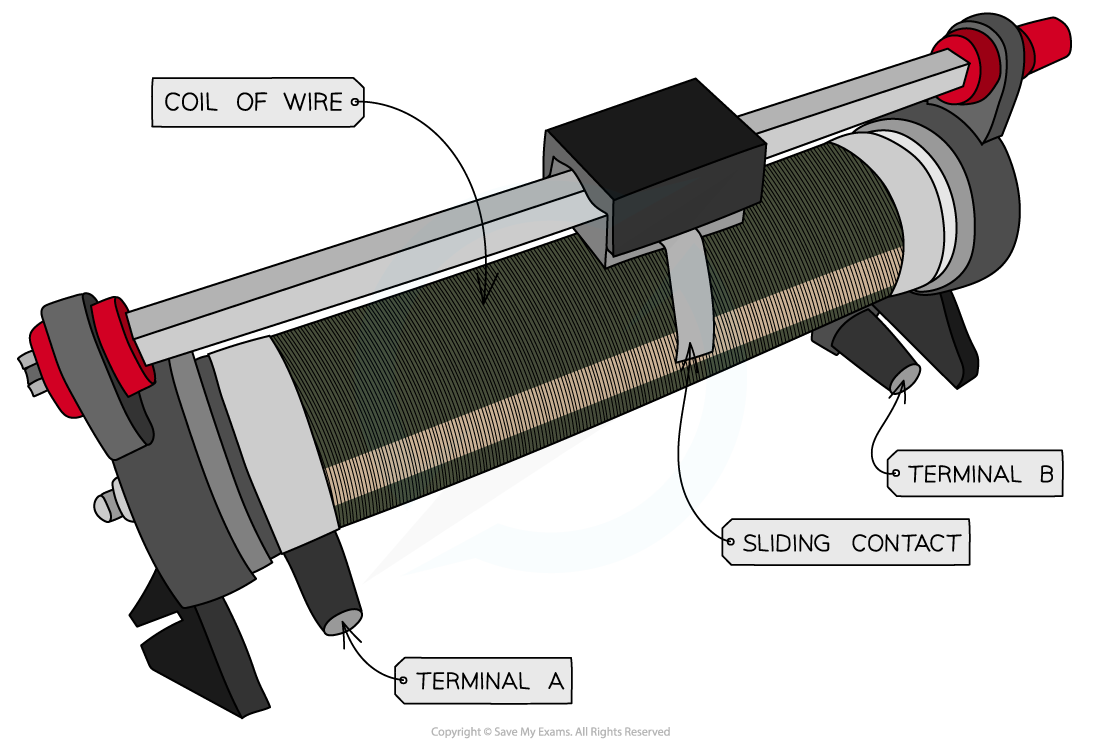
A potentiometer is a type of variable resistor
- The circuit symbol is drawn as an arrow next to the resistor, to represent the sliding contact

- The sliding contact has the effect of separating the potentiometer into two parts
- Each part will have different resistances
- Therefore output voltage will change
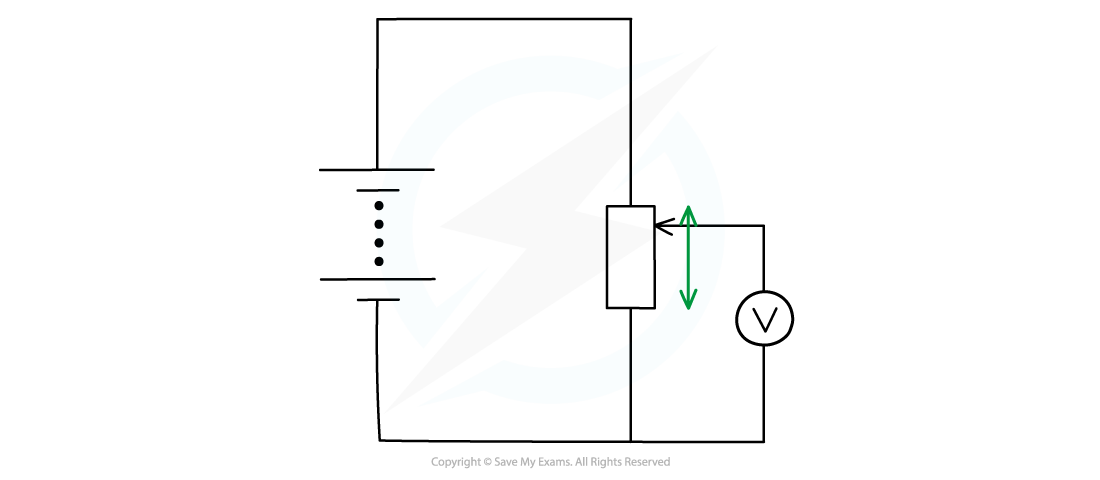
Moving the slider (the arrow in the diagram) changes the resistance (and hence potential difference) of the two parts of the potentiometer
- If the slider in the above diagram is moved upwards, the resistance of the lower part will increase and so the potential difference across it will also increase
- Therefore, the variable resistor obtains a maximum or minimum value for the output voltage
- If the resistance is 3 Ω:
- Maximum voltage is when the resistance is 3 Ω
- Minimum voltage is when the resistance is 0 Ω
Thermistors and Light Dependent Resistors (LDRs) in Potential Divider Circuits
- Sensory resistors are used in potential dividers to vary the output voltage
- This could cause an external component to switch on or off
- For example, a heater switching off automatically when its surroundings are at room temperature
- Examples of the variable sensory resistors used are?thermistors?and?light dependent resistors (LDRs)
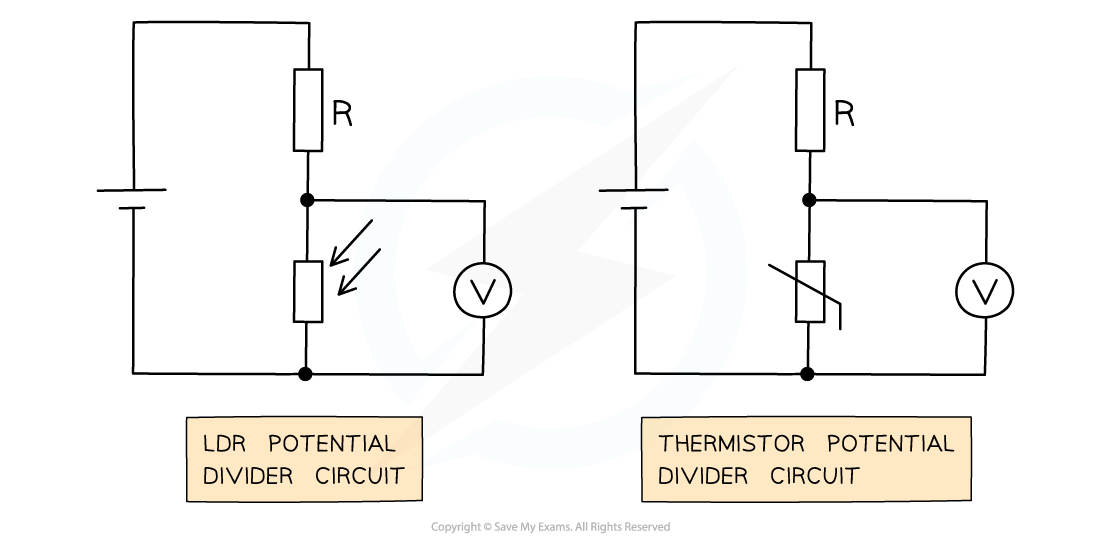
LDR and thermistor in a potential divider circuit with a fixed resistor R
- The voltmeter in both circuits is measuring Vout
- From Ohm’s law?V = IR, the potential difference Vout?from a sensory resistor in a potential divider circuit is?proportional?to its resistance
- If an LDR or thermistor's resistance?decreases, the potential difference through it also?decreases
- If an LDR or thermistor's resistance?increases, the potential difference through it also?increases
- The resistance of an?LDR?varies with?light intensity
- The higher the light intensity, the lower the resistance
- The lower the light intensity, the higher the resistance
- Therefore:
- If light intensity increases, Vout?across the LDR will?decrease?because resistance has decreased
- If light intensity decreases, Vout?across the LDR will increase?because resistance has decreased
- An LDR circuit is often used for street and security lights
- When light intensity falls, Vout?increases and so this can provide the voltage required to turn on a lamp
- The resistance of a?thermistor?varies with?temperature
- The hotter the thermistor, the lower the resistance
- The cooler the thermistor, the higher the resistance
- Therefore:
- If temperature increases, Vout?across the thermistor will?decrease?because resistance has decreased
- If temperature decreases, Vout?across the thermistor will increase?because resistance has decreased
- A thermistor circuit is used in fire alarms, ovens and digital thermometers
- When temperature falls, Vout?increases and so this can provide the voltage required to turn on a heater
- Since the total potential difference of the components must be equal to Vin:
- If the potential difference of the sensory resistor?decreases?then the potential difference across the other resistor in the circuit must?increase
- If the potential difference of the sensory resistor increases?then the potential difference across the other resistor in the circuit must?decrease
Worked Example
A potential divider consists of a fixed resistor R and a thermistor connected in series.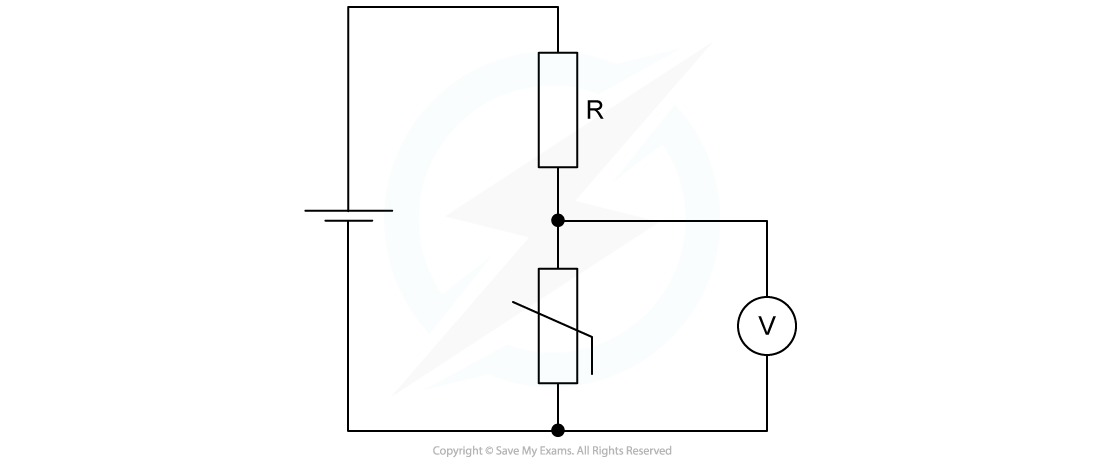 Which row of the table describes what happens to the potential difference across resistor R and the thermistor when the temperature of the thermistor decreases?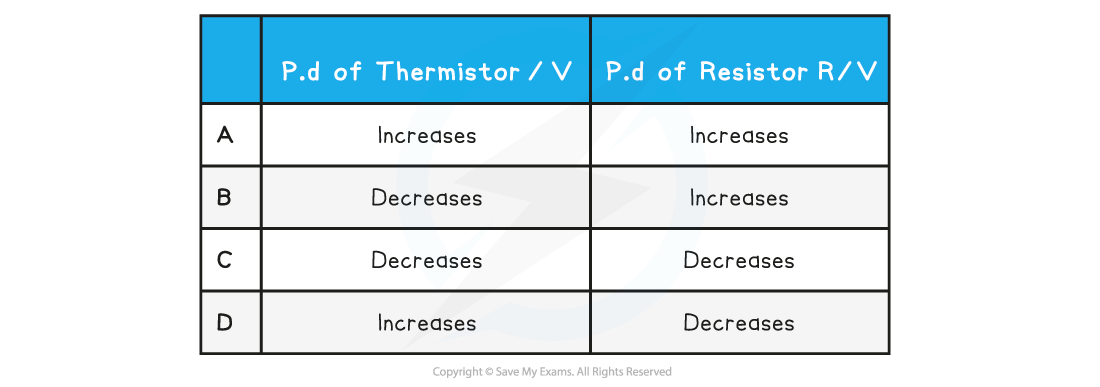
ANSWER:??D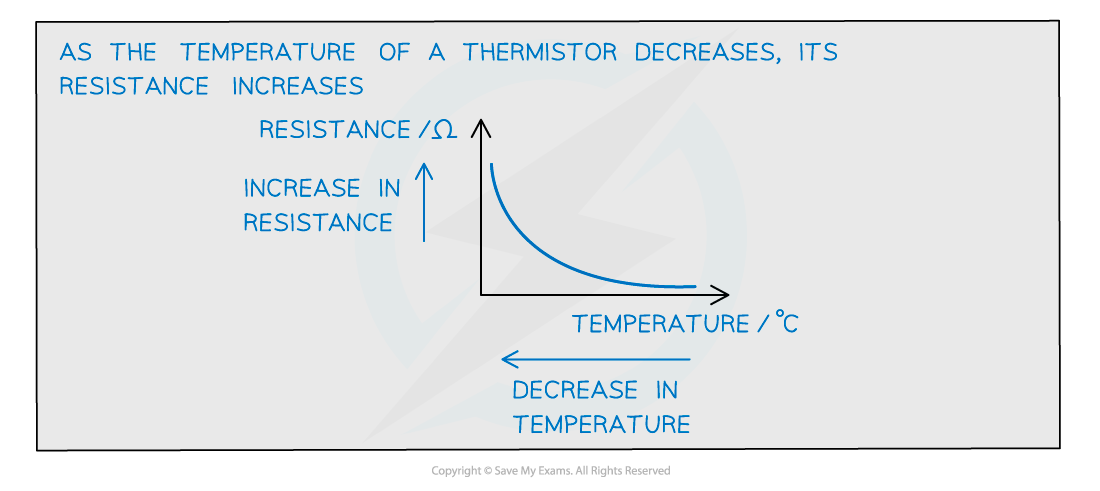
Step 1: Consider Ohm's Law
-
- Due to Ohm’s Law (V = IR), both the resistor and thermistor are connected in series and have the same current I
- If resistance?R?increases, the potential difference across the thermistor also?increases
- Due to Ohm’s Law (V = IR), both the resistor and thermistor are connected in series and have the same current I
Step 2: Consider the electrical voltages rule
-
- In series, the input potential difference is shared equally amongst the components due to the electrical voltages rule
- Therefore, since the potential difference across the thermistor?increases, the potential difference across the resistance R must?decrease
- In series, the input potential difference is shared equally amongst the components due to the electrical voltages rule
???Step 3: State the answer
-
- This is row?D
Exam Tip
A potentiometer can also be used as a variable resistor if only two of the three possible terminals are used.
轉載自savemyexams
以上就是關于【Edexcel A Level Physics:復習筆記3.14 Potential Dividers & Variable Resistance】的解答,如需了解學校/賽事/課程動態,可至翰林教育官網獲取更多信息。
往期文章閱讀推薦:
2026 ALEVEL 夏考A率出爐!愛德思vs牛津AQA,哪些科目真的“好出分”?
2026 AMC10/12美國數學競賽新賽季!【翰林教育 × 清華大學出版社】獨家教材全面發售!


翰林AMC8視頻課重磅上線!

國際競賽真題資源免費領取






