Edexcel A Level Economics A:復習筆記4.1.1 Globalisation

Characteristics of Globalisation
- Globalisation?is the economic integration of different countries through increasing freedoms in the cross-border movement of people, goods/services, technology & finance
- This?integration?of global economies has impacted?national cultures, spread ideas, speeded up?industrialisation?in developing nations & led to?de-industrialisation?in developed nations
- Globalisation has been increasing for thousands of years - it is not a new phenomenon
- Improvements in technology & the?speed of global connections?have exponentially increased the?level of interdependence?between nations in the past 50 years
- Consumers now?source products globally?recognising?global brands?wherever they travel
The Four Main Characteristics of Globalisation
| Increasing foreign ownership of companies | Increasing movement of labour & technology across borders |
| Free trade in goods/services | Easy flows of capital (finance) across borders |
Factors Contributing to Globalisation
- In 2000 the value of global trade was approximately?$6.45 trillion.?By 2020 this figure was at?$19 trillion
- Numerous factors have contributed to the?rapid increase in the pace of globalisation?but perhaps two of the most significant are the improvements in?containerised shipping?& the?innovation in communication technology
Factors Contributing to Globalisation in the Last 50 Years
| Economies of scale?generated?by?containerisation?in the shipping industry | The improved ability for firms to?easily connect and to promote themselves internationally?as a result of the internet &?improvements to communications technology?e.g Skype, WhatsApp, WeChat etc | The Increased effectiveness of the?World Trade Organisation (WTO)?in negotiating new trade agreements & in helping countries to open up to free trade (trade liberalisation), thus increasing international specialisation & the volume of trade |
| A rapid growth in the number & influence of?transnational corporations | The?end of the cold war?between Russia & the West in 1990?opened up former communist countries?around the world?enlarging the global supply of labour?e.g. more than 800,000 people migrated from East Germany to West Germany between 1990 and 1991 | In the 1990's there was?deregulation?of many financial markets which resulted in the?expansion of global financial services?& provided more access to capital |
Impact of Globalisation on Stakeholders
- Many of the?impacts of globalisation?have been positive, however there have been some very negative ones too
- When considering the impacts, it is useful to?acknowledge?all of the?stakeholders?including individual countries, governments, firms, consumers, workers & the environment
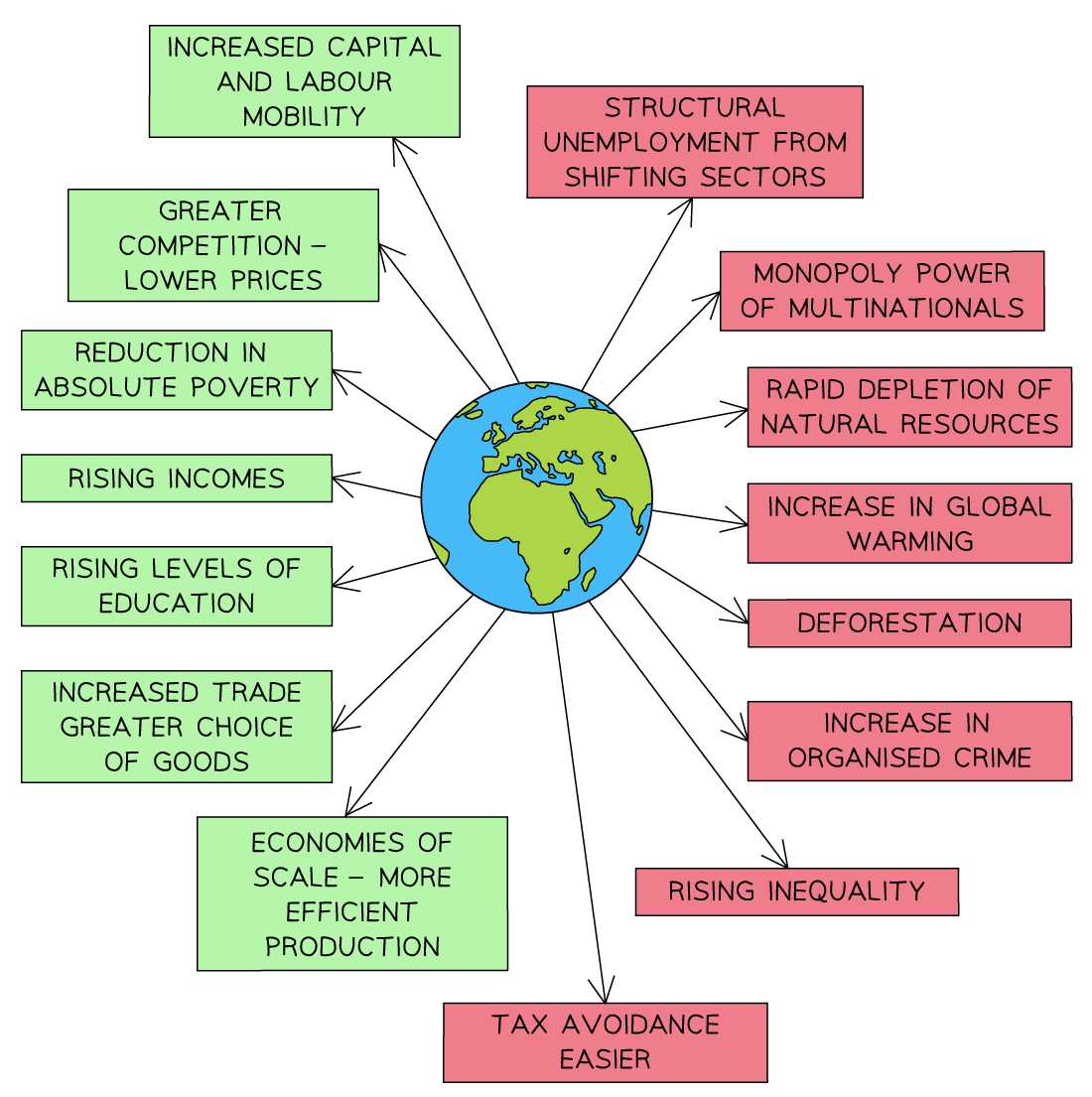
The impacts of Globalisation on Stakeholders
- Two of the more recent?criticisms of globalisation?include
- The lack of action by some governments to help workers unable to find new jobs as a result of?structural unemployment
- The use of?legal mechanisms (e.g. transfer pricing)?& corruption by transnational corporations is stripping developing countries of their assets & has been called 'new colonialism'
轉載自savemyexams
以上就是關于【Edexcel A Level Economics A:復習筆記4.1.1 Globalisation】的解答,如需了解學校/賽事/課程動態,可至翰林教育官網獲取更多信息。
往期文章閱讀推薦:
MIT官方發布【2026年夏季推薦閱讀書單】!橫跨科學/人文/經濟...


翰林AMC8視頻課重磅上線!

國際競賽真題資源免費領取






