Edexcel A Level Economics A:復習筆記2.3.3 Long-run AS

Keynesian Versus Classical Long-run AS
- Long run aggregate supply (LRAS)?is influenced by a change in the?productive capacity?of the economy
- Productive capacity is changed by changes to the?quantity or quality?of the?factors of production
- Economists have?two opposing views?on how?LRAS?works in an economy
- The?original view?is called the?classical view
- The insights developed by?John Meynard Keynes?in 1936 are called the?Keynesian view
?The Classical LRAS View
- The classical view believes that the?LRAS is perfectly inelastic?(vertical) at a point of?full employment?of all available?resources
- This point corresponds to the maximum possible output on a?production possibilities frontier (PPF)
- The classical view believes that?in the long-run?an economy will always return to this?full employment level of output
- There may be?short-run output gaps?in the economy
- During extreme periods of?economic growth?there can be an?inflationary gap?that develops
- In the?long run?this will?self-correct?and return to the long-run level of output, but at a?higher average price level
- During slowdowns or?recessions?there can be a?recessionary gap?that develops
- In the?long-run?this will?self-correct?and return to the long-run level of output, but at a lower average price level
- During extreme periods of?economic growth?there can be an?inflationary gap?that develops
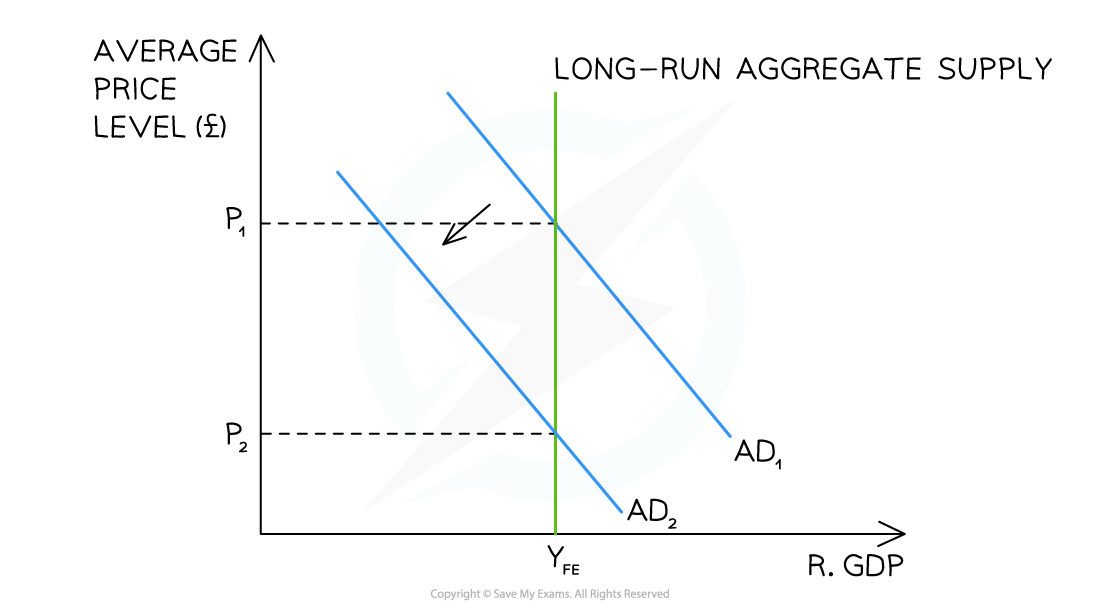
A diagram that shows the Classical View of long-run aggregate supply (LRAS) with a vertical aggregate supply curve at the full employment level of output (YFE)
Diagram Analysis
- Using?all available?factors of production, the long-term output of this economy?(LRAS) occurs at YFE
- The economy is initially in?equilibrium?at the intersection of?AD1?and LRAS (P1, YFE)
- A?slowdown?reduces output from?AD1→AD2?and creates a short term?recessionary gap
- This?self corrects?in the?long term?and returns the economy to the?long-run equilibrium?at the intersection of?AD2?and LRAS (P2, YFE)
?The Keynesian LRAS View
- Keynes believed that the?long-run aggregate supply curve (LRAS)?was more?L shaped
- Supply is elastic?at lower levels of output as there is a lot of?spare production capacity?in the economy
- Struggling firms?will increase output?without raising prices
- Supply?is perfectly inelastic?(vertical) at a point of?full employment (YFE)?of all available?resources
- The closer the economy gets to this point the more?price inflation?will occur as?firms compete for scarce resources
- Supply is elastic?at lower levels of output as there is a lot of?spare production capacity?in the economy
- The?Keynesian view?believes that an economy?will not?always self-correct and?return to the full employment level of output (YFE)
- It can?get stuck?at an equilibrium well?below the full employment level?of output e.g. Great Depression
- The?Keynesian view?believes that there is?role for the government?to increase its expenditure?so as to?shift aggregate demand?and change the negative?'animal spirits'?in the economy
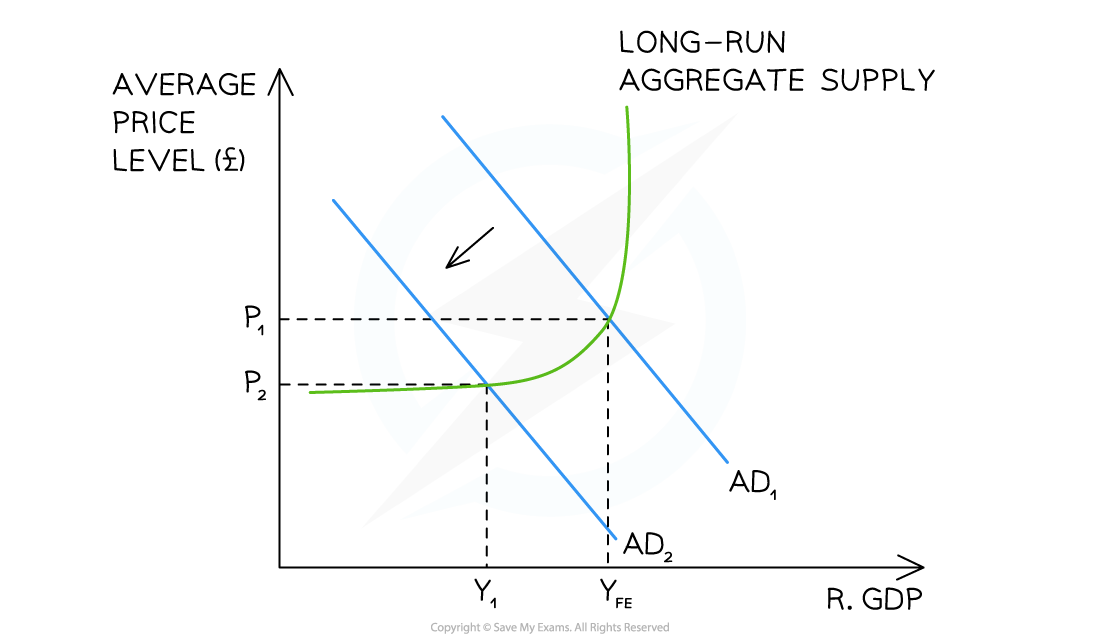
A diagram that shows the Keynesian View of long-run aggregate supply (LRAS) with a vertical aggregate supply curve at the full employment level of output (YFE) becoming more elastic at lower levels of output
Diagram Analysis
- Using?all available?factors of production, the long-term output of this economy?(LRAS) occurs at YFE
- The economy is initially in?equilibrium?at the intersection of?AD1?and LRAS (P1, YFE)
- A?slowdown?reduces output from?AD1→AD2?and creates a?recessionary gap?Y1-YFE
- The economy may reach a point where?average?prices stop falling (P2), but output continues to fall
- This economy?may not self-correct to YFE?for years
- The?low output?leads to?high unemployment?and?low confidence?in the economy
- This stops further?investment?and further?reduces consumption
- Keynes argued that this was where?governments needed to intervene?with significant?expenditure?e.g. Roosevelt's New Deal; response to financial crisis of 2008
Factors Influencing Long-run AS
- Any factor that changes the quantity or quality of a?factor of production?will impact the?long-run aggregate supply (LRAS)?of an economy:
- This corresponds to an?outward or inward shift?of the potential output of an economy on the?production possibilities frontier
- The following factors will shift the entire LRAS curve outwards and increase the potential output of the economy:
- Technological advances: these often improve the quality of the factors of production e.g. development of metal alloys
- Changes in relative?productivity: process innovation often results in?productivity improvement?e.g. moving from labour intensive car production to automated car production
- Changes in education and skills:?over time this increases the?quality of labour in an economy
- Changes in government regulations:?these can improve the?quantity of the factors of production. e.g. deregulation of fracking (extracting oil from shale deposits) increased oil reserves
- Demographic changes and migration:?a positive?net birth rate?or positive?net migration rate?will increase the quantity of labour available
- Competition policy:?regulating industries so as to?prevent monopoly power?results in more firms supplying goods/services in an economy and this?increases the potential output?of an economy
Exam Tip
You will frequently be examined on your understanding of factors that shift the?short-run aggregate supply (SRAS)?curve and?long-run aggregate supply (LRAS)?curve.
Make sure you know the difference and remember that?LRAS factors will shift the entire LRAS curve to the right,?representing an increase in the potential output of the economy. Changes to SRAS do not change the potential output of the economy.
This is the impact a long-run shift will have:
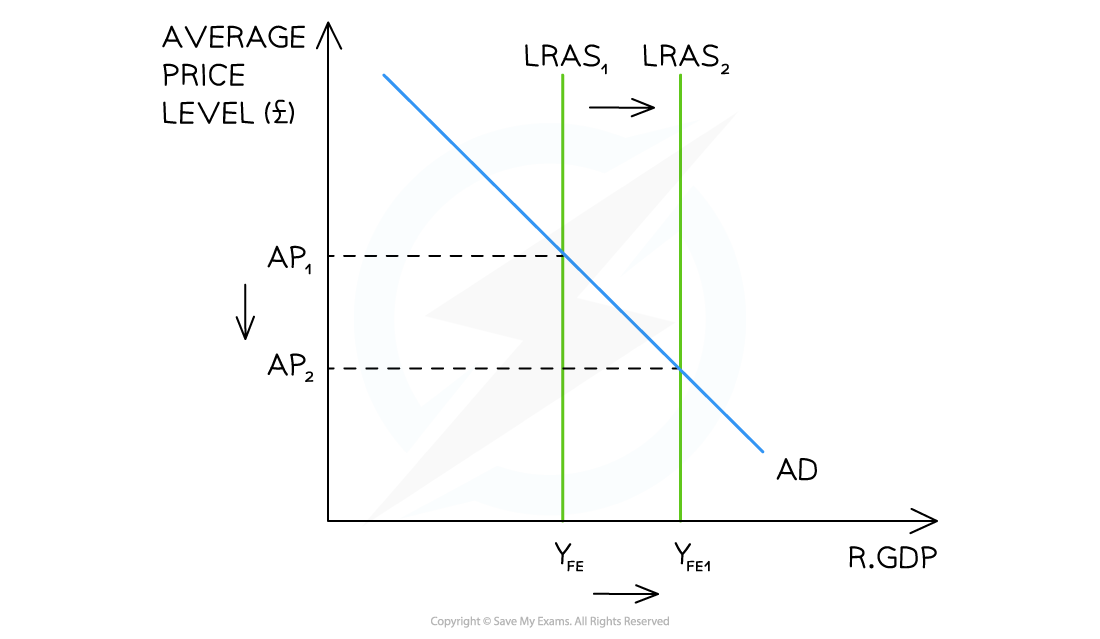 A diagram illustrating long-run economic growth through a change in one of the factors that shift the long-run aggregate supply (LRAS) of the economy
轉載自savemyexams
以上就是關于【Edexcel A Level Economics A:復習筆記2.3.3 Long-run AS】的解答,如需了解學校/賽事/課程動態,可至翰林教育官網獲取更多信息。
往期文章閱讀推薦:
MIT官方發布【2026年夏季推薦閱讀書單】!橫跨科學/人文/經濟...


翰林AMC8視頻課重磅上線!

國際競賽真題資源免費領取






