Edexcel A Level Economics A:復(fù)習(xí)筆記1.2.7 Price Mechanism

Functions of The Price Mechanism
- The price mechanism is the interaction of demand and supply in a free market
- This interaction?determines prices?which are the means by which?scarce resources are allocated?between competing wants/needs
- The price mechanism fulfils?three functions?in the relationship between buyers and sellers
- Rationing:?prices allocate (ration) scarce resources. When resources become?scarcer?the price will?rise?further. Only those who can afford to pay for them will receive them. If there is a?surplus?then?prices fall?and more consumers can afford them
- Signalling:??prices?provide information to producers & consumers where resources are required (in markets where prices increase) & where they are not (in markets where prices fall)
- Incentive:?when prices for a good/service rise, it?incentivises producers?to reallocate resources from a less profitable market to this market in order to?maximise their profits.?Falling prices?incentivise reallocation?of resources to new markets
- Adam Smith?referred to the?functions?of the?price mechanism?as the?'mystery of the invisible hand'
Price Mechanism at Work in Different Markets
- The price mechanism operates in all markets including?local,?national?and?global
Price Mechanism in a Local Market
- Long Island, USA has a rich history of agriculture and many producers set up farm shops selling directly to the public. In recent years, honey consumption has increased
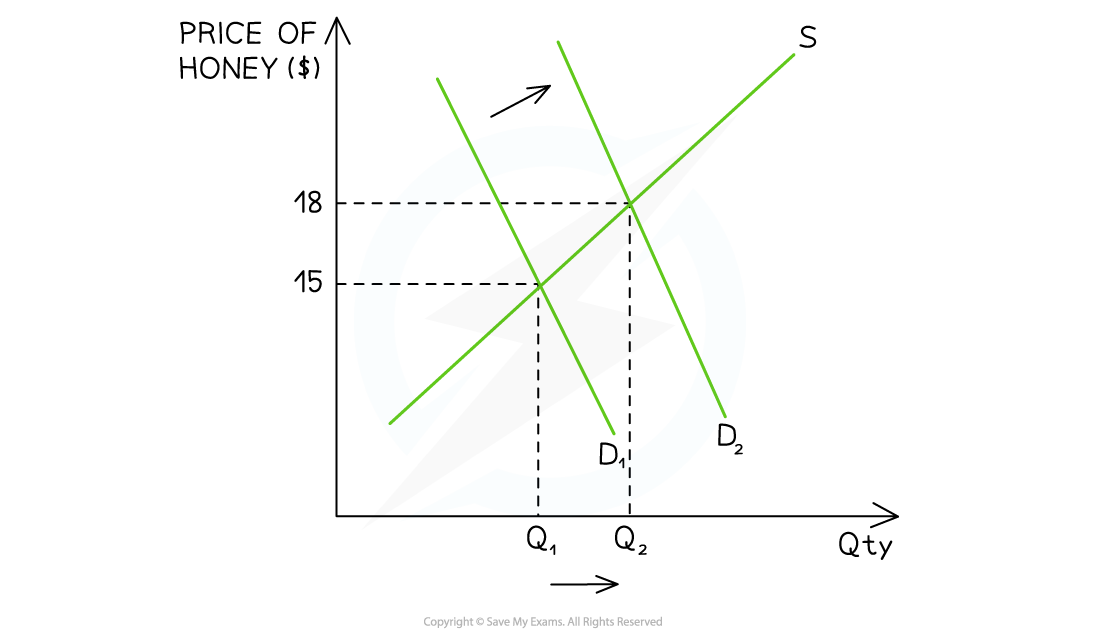
A diagram showing the increase in demand for honey in a local market, Long Island
- Due to a change in one of the?conditions of demand?(most likely change in tastes), the demand for honey in the local market has?increased from D1→D2?and the?price has increased?from $15 to $18
- The higher price serves to?ration?a valuable product. Those consumers who can afford to purchase it at $18, receive it
- The higher price?incentivises?producers to allocate more?factors of production?to producing honey and this is evident from the?extension in supply?from Q1?to Q2
- The shift in demand?signals?to other producers that?demand for honey is strong?and they should consider?entering?the market
Exam Tip
It can get confusing explaining some of the differences between the three functions. Thinking about it in the following way helps to simplify the process. If there is shift in demand/supply the market is sending a?signal?to consumers and producers. If there is a?movement?along one of the curves, this is as a result of the?incentive function.
Price Mechanism in a National Market
- The T-Shirt market in the UK is highly competitive. In 2018 the price of cotton fell
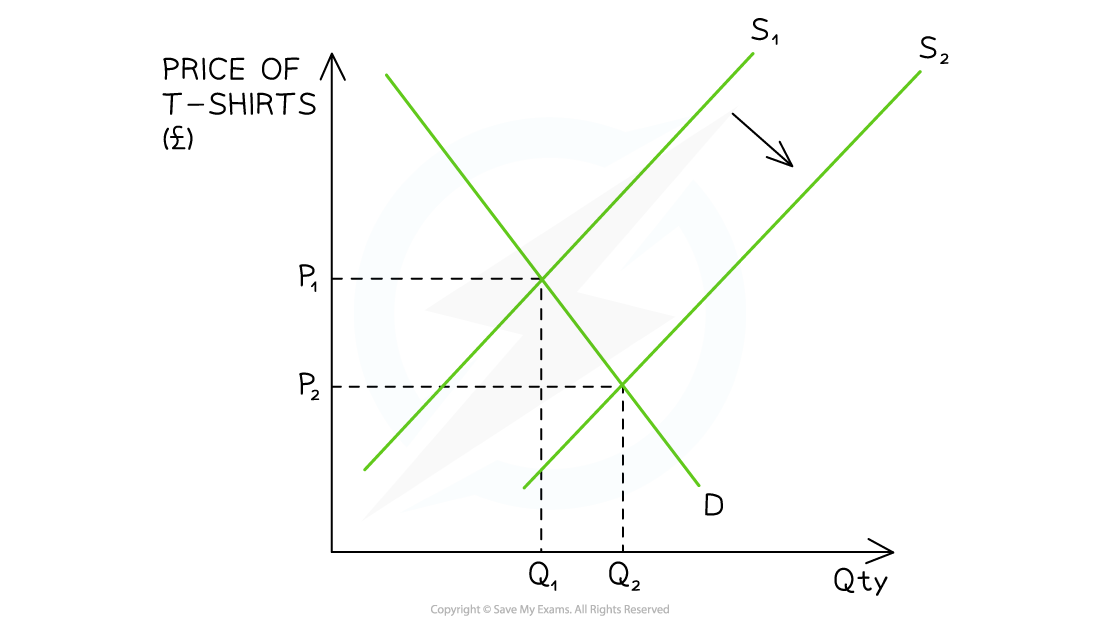
A diagram showing an increase in the supply of T-shirts in the UK market
- Due to a change in one of the?conditions of supply?(a decrease in costs of production), the?supply?of T-shirts in the UK has?increased?from S1→S2?and the?price has fallen?from P1?to P2
- The?lower price?increases the number of consumers who can access this product. It is?rationed more widely?as there is an?excess in supply
- The lower price?incentivises?consumers to purchase more T-shirts and this is evident from the?increase in demand?from Q1?to Q2
- The shift in supply?signals?to other producers that?there is excess supply?and they should consider?leaving?the market
Price Mechanism in a Global Market
- Cash crops?such as wheat, oats, barley, soy, corn, sunflowers etc. can be grown using the same?factors of production
- Many countries?export?excess crops into the?world market
- Producers?use world prices to guide their?production decisions
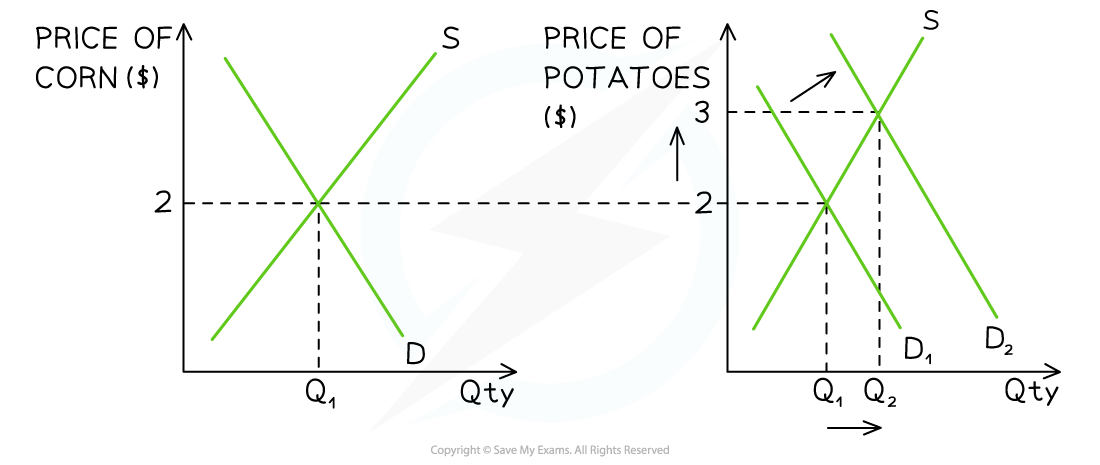
A diagram showing the price mechanism at work in two related global markets, corn and potatoes
- Farmers in France have been?producing corn?for many years and the market price is $2/kg. The?price?of potatoes in?global markets?has until recently been steady at $2/kg
- Due to a change in one of the?conditions of demand?(possibly an increase in global population), the demand for potatoes has?increased?from D1→D2?and the?price has increased?from $2/kg to $3/kg
- The higher price serves to?ration?the potatoes. Those consumers who?can afford?to purchase it for $3, receive it
- The higher price?incentivises?producers to?allocate more factors of production?to producing potatoes and this is evident from the?extension in supply?from Q1?to Q2
- The shift in global demand?signals?to producers in France that?demand for potatoes is strong?and they should consider?switching some of their production?from corn to potatoes
Exam Tip
Whenever you are faced with questions on the?functions of the price mechanism, remember that all three functions are built on the principle of?self-interest. This will help you to explain each function.
For example,?lower prices incentivises consumers?to purchase?more?of the product with the same income. Conversely, the?incentive for producers?is the opposite encouraging them to?reallocate their factors of production?to producing more profitable products.
Each party acts in their self interest
轉(zhuǎn)載自savemyexams
以上就是關(guān)于【Edexcel A Level Economics A:復(fù)習(xí)筆記1.2.7 Price Mechanism】的解答,如需了解學(xué)校/賽事/課程動(dòng)態(tài),可至翰林教育官網(wǎng)獲取更多信息。
往期文章閱讀推薦:
2026 AMC10/12美國數(shù)學(xué)競(jìng)賽新賽季!【翰林教育 × 清華大學(xué)出版社】獨(dú)家教材全面發(fā)售!
CAIE A-Level分?jǐn)?shù)線新鮮出爐!三大考試局查分攻略+出分急救指南速覽!


翰林AMC8視頻課重磅上線!

國際競(jìng)賽真題資源免費(fèi)領(lǐng)取






