Edexcel A Level Chemistry:復習筆記8.1.1 Finding Ka Values

Core Practical 9: Finding Ka for a Weak Acid
- The?Ka?of a weak acid may be determined by finding the pH at the half equivalence point
- At the half equivalence point?Ka?= [H+]

Key steps in the procedure
- A pH probe or meter is calibrated before use
- 25 cm3?of 0.1 mol dm-3?ethanoic acid is pipetted into a conical flask and a few drops of phenolphthalein indicator are added
- A burette is filled with?0.1 mol dm-3?sodium hydroxide solution
- The contents of the conical flask are titrated against the sodium hydroxide until the indicator just turns pink
- A further pipette containing 25 cm3?of the acid is then added to the flask and the pH is measured
Specimen Results
- pH at half equivalence point = 4.75
Analysis
- After the addition of the second portion of acid, the solution is effectively a half-neutralised sample of acid
- This is the half-equivalence point at which the?Ka?= [H+]
- By measuring the pH at that point you can convert it to [H+] and hence find the?Ka?of the acid
pH = 4.75
[H+] = 10-pH?= 1.8 x 10⁻⁵?mol dm-3
∴ ?Ka?= 1.8 x 10⁻⁵?mol dm-3
- You can also say that the pKa?= pH at the half-equivalence point
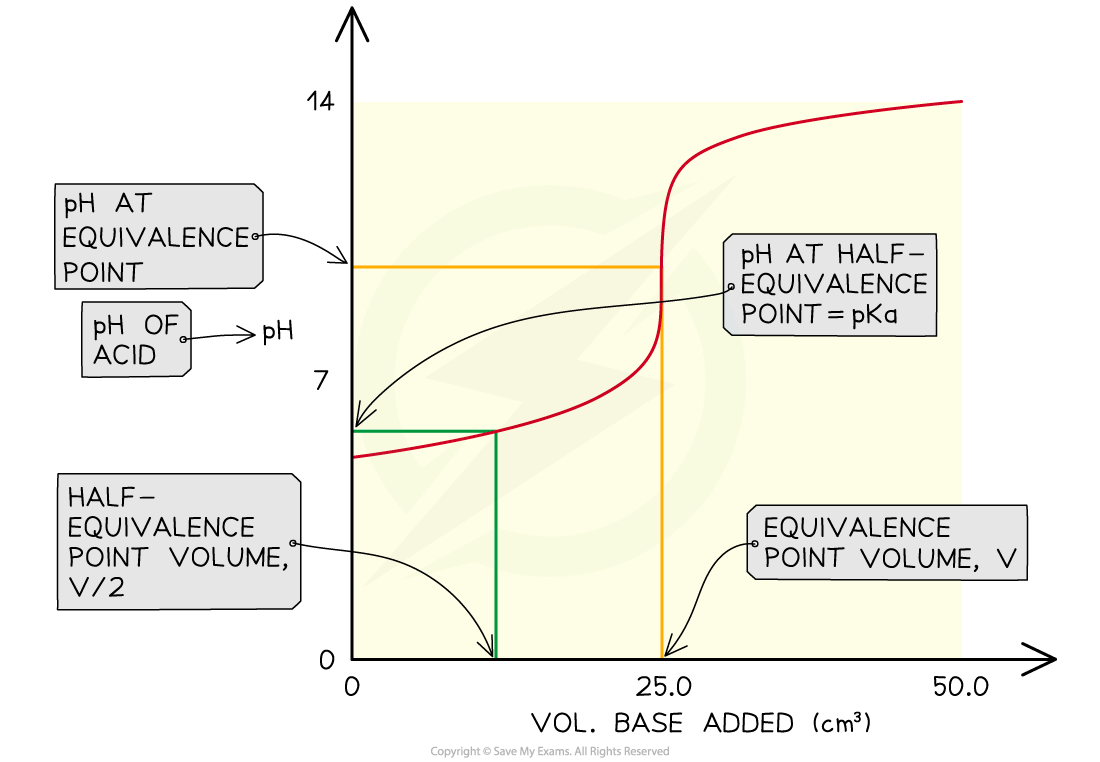
The pH at the half-equivalence point in a weak acid titration gives the pKa of the weak acid
Exam Tip
The sources of uncertainty in this experiment include the measurements made by the pipette and burette, and the judgement of the end-point of the titration.Be careful, there is a single uncertainty in the pipette measurements as one reading was taken but there is double the uncertainty for the burette reading as there was the initial and final readings.
轉載自savemyexams
以上就是關于【Edexcel A Level Chemistry:復習筆記8.1.1 Finding Ka Values】的解答,如需了解學校/賽事/課程動態,可至翰林教育官網獲取更多信息。
往期文章閱讀推薦:
2026 ALEVEL 夏考A率出爐!愛德思vs牛津AQA,哪些科目真的“好出分”?
2026 AMC10/12美國數學競賽新賽季!【翰林教育 × 清華大學出版社】獨家教材全面發售!


翰林AMC8視頻課重磅上線!

國際競賽真題資源免費領取






