Edexcel A Level Chemistry:復習筆記7.3.4 Acyl Chlorides & Esters

Hydrolysis of Esters
Hydrolysis of Esters - Acid
- The reverse of the esterification reaction is called?hydrolysis
- Ester hydrolysis is a useful reaction for creating biodegradable plastics
- Esters can be?hydrolysed?to reform the carboxylic acid and alcohol or salts of carboxylic acids by using either?dilute?acid?(e.g. sulfuric acid) or?alkali?(e.g. sodium hydroxide) and?heat
- When an ester is?heated under reflux?with?acid?an equilibrium mixture is established, meaning that the hydrolysis reaction is not complete
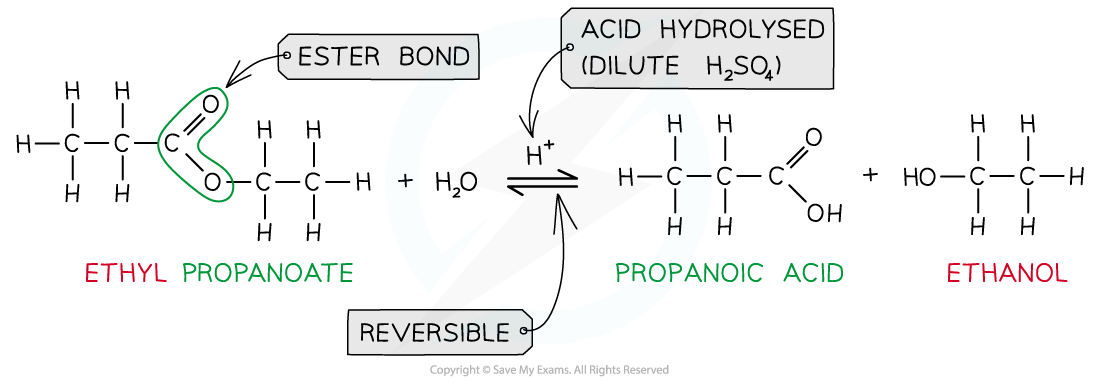
Ester hydrolysis by dilute acid is a reversible reaction forming carboxylic acid and alcohol
Hydrolysis of Esters - Alkaline
- However,?heating?the ester?under reflux?with?dilute alkali?(e.g. sodium hydroxide) is an?irreversible?reaction as the ester is fully hydrolysed and the reaction goes to completion
- The carboxylic acid produced reacts with excess alkali to form a?carboxylate salt?and?alcohol
- The?sodium?carboxylate?salt requires further?acidification?to turn into a?carboxylic?acid
- The sodium carboxylate (-COO-) ion needs to get protonated by an acid (such as HCl) to form the carboxylic acid (-COOH)
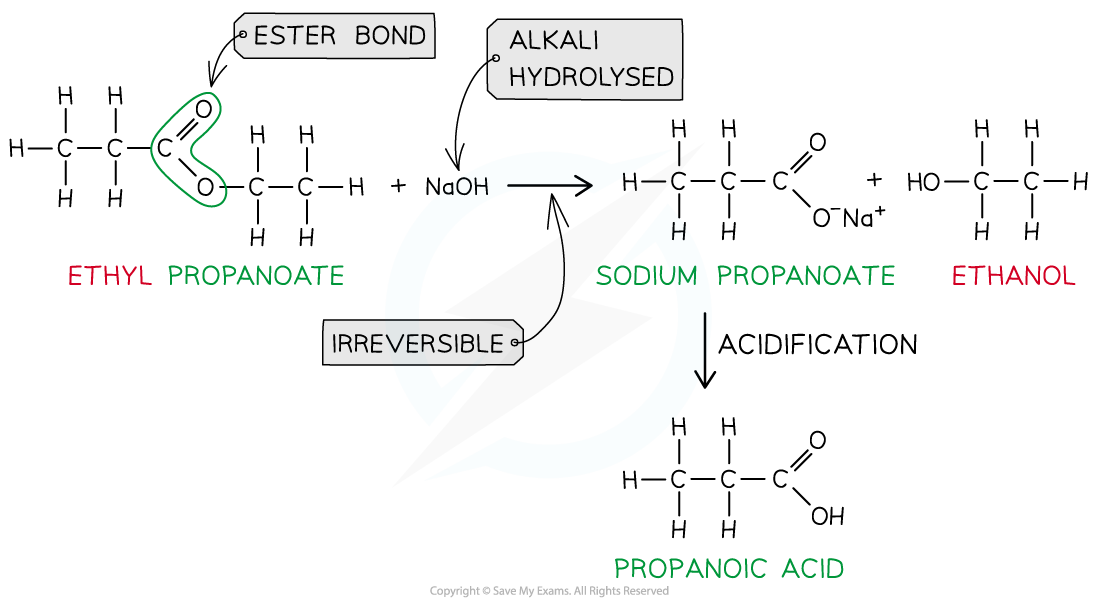
Ester hydrolysis by dilute alkali is an irreversible reaction forming a sodium carboxylate salt and alcohol
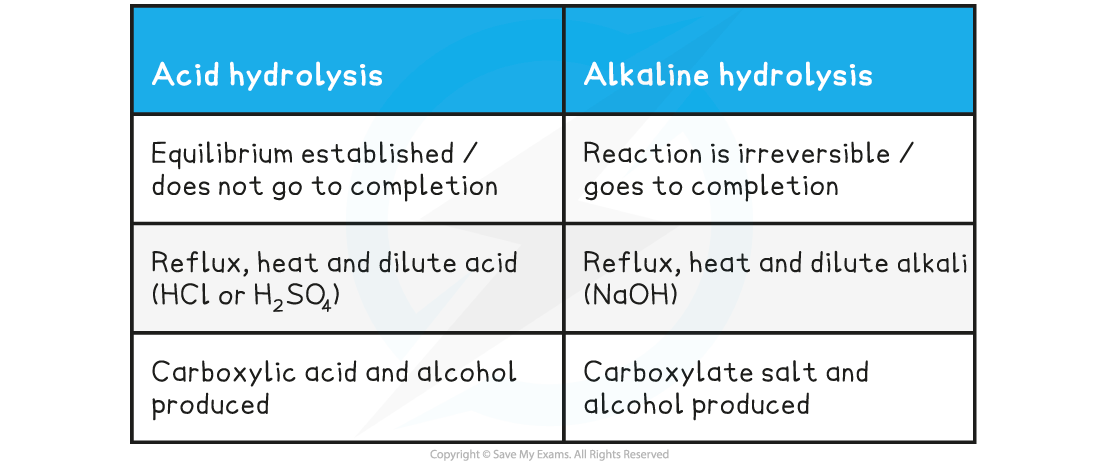
Table showing Differences in Hydrolysis of Esters
Worked Example
Name the products and write equations for the following hydrolysis reaction:
- Ethyl ethanoate with hot dilute sulfuric acid solution
- Methyl propanoate by hot sodium hydroxide solution
Answer:
Answer 1:?Ethanoic acid and ethanol
CH3COOCH2CH3?+ H2O ? CH3COOH + CH3CH2OH
Answer 2:?Sodium propanoate and methanol
CH3CH2COOCH3?+ NaOH → CH3CH2COONa + CH3OH
Acyl Chlorides & Esters
Acyl groups
- Acyl groups can be built into many molecules using acyl chlorides or acid anhydrides (known as acylating agents)
- Acyl chlorides are?derivatives of carboxylic acids?by substitution of the -OH group by a chlorine atom
- Acyl chlorides are named by identifying the parent hydrocarbon chain and adding the suffix -oyl chloride
- They can also be named by removing the -oic acid from the carboxylic acid and adding?-oyl chloride
- Acid anhydrides are also?derivatives of carboxylic acids?formed by substitution of the -OH group by an alkanoate
- Acid anhydrides are named by identifying the parent hydrocarbon chain and adding the suffix -oic anhydride
- They can also be named by removing the -oic acid from the carboxylic acid and adding?-oic anyhydride
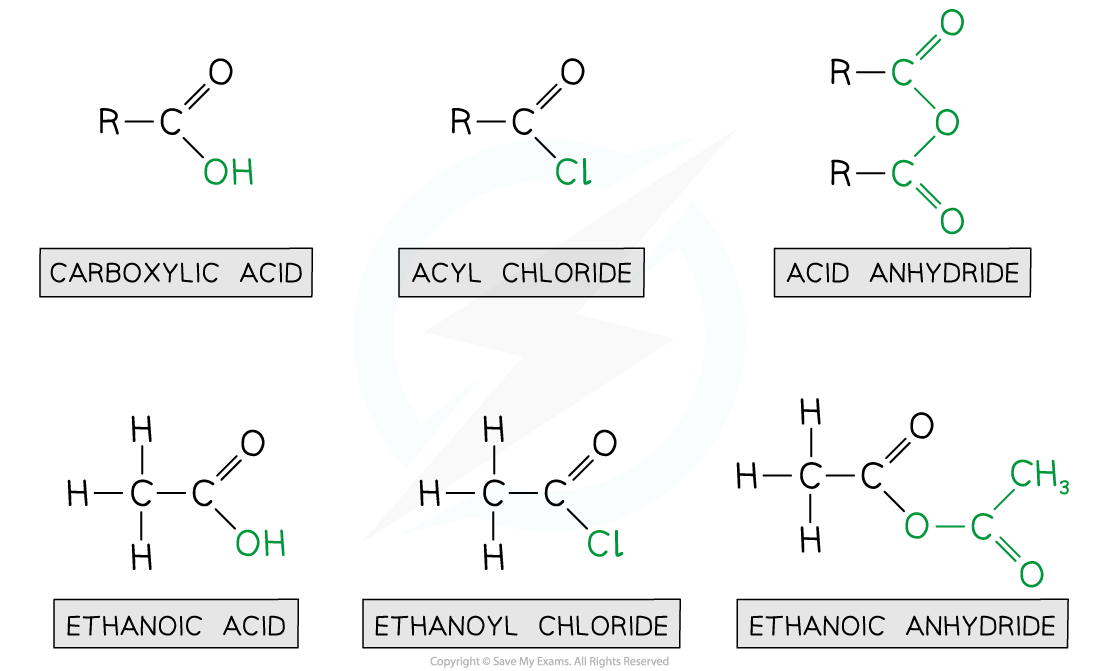
Ethanoic acid derivatives
Worked Example
Draw the displayed formula for the following:
A. Butanoyl chloride
B. Butanoic anhydride
Answer:
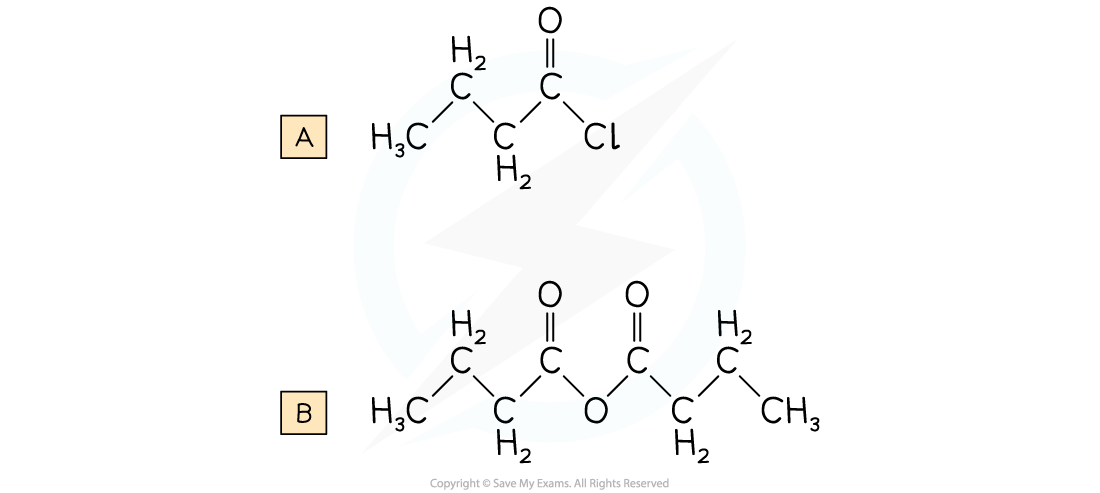
- Acyl chlorides?are?reactive?organic compounds that undergo many reactions such as?nucleophilic addition-elimination?reactions
- In nucleophilic addition-elimination reactions, the?nucleophilic?addition?of a small molecule across the C=O bond takes place followed by?elimination?of a small molecule
- Examples of these nucleophilic addition-elimination reactions include:
- Hydrolysis
- Reaction with alcohols to form?esters
- Reaction with ammonia and primary amines to form?amides
Hydrolysis
- The?hydrolysis?of acyl chlorides results in the formation of a?carboxylic acid?and?HCl?molecule
- This is a?nucleophilic?addition-elimination?reaction
- A?water molecule?adds across the C=O bond
- A hydrochloric acid (HCl) molecule is?eliminated
- An example is the hydrolysis of propanoyl chloride to form propanoic acid and HCl
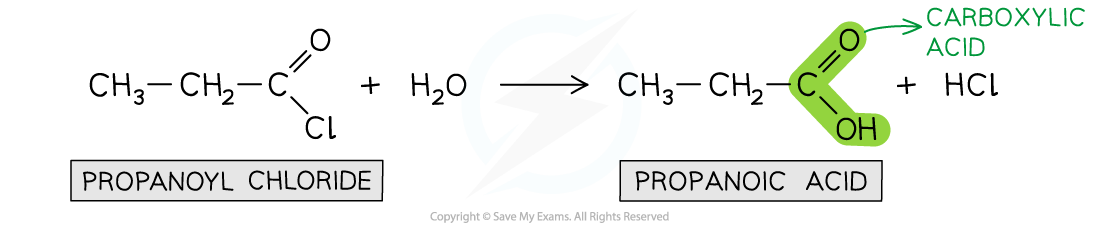
Acyl chlorides are hydrolysed to carboxylic acids
Formation of esters
- Acyl chlorides can react with?alcohols?to form esters
- The esterification of acyl chlorides is also a?nucleophilic?addition-elimination?reaction
- The alcohol adds across the C=O bond
- A HCl molecule is eliminated
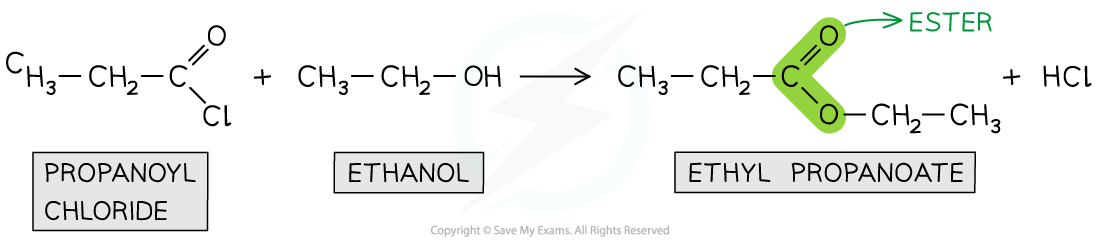
Acyl chlorides undergo esterification with alcohols to form esters
Formation of amides
- Acyl chlorides can form?amides?with?primary?amines?and?concentrated?ammonia
- The nitrogen atom in ammonia and primary amine has a lone pair of electrons which can be used to attack the carbonyl carbon atom in the acyl chlorides
- The product is an?amide (when reacted with ammonia) or?N-substituted?amide (when reacted with primary amines)
- This is also an example of a?nucleophilic?addition-elimination?reaction as
- The amine or ammonia molecule adds across the C=O bond
- A HCl molecule is eliminated
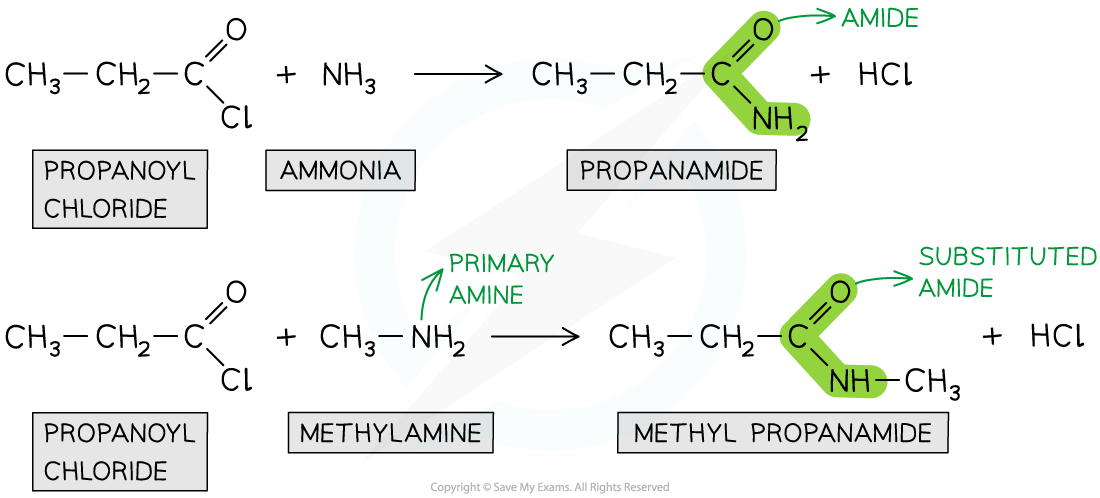
Acyl chlorides undergo reactions with ammonia and primary amines to form amides
Condensation Polymerisation
- Addition polymerisation has been covered in reactions of alkenes
- They are made using monomers that have C=C double bonds joined together to form polymers such as polyethene
- Condensation polymerisation is another type of reaction whereby a polymer is produced by repeated condensation reactions between monomers
- Natural condensation polymers are all formed by?elimination of water
- Although the process of?condensation?polymerisation involves the?elimination of a?small molecule
- Condensation polymers?can be identified because the monomers are linked by?ester?or?amide bonds
Polyester
- Is formed by the reaction between?dicarboxylic acid monomers?and?diol monomers
- Polyester is produced by linking these monomers with?ester bonds / links

This polymer structure shows an ester functional group linking monomers together
Formation of polyesters
- A diol and a dicarboxylic acid are required to form a polyester
- A diol contains 2 -OH groups
- A dicarboxylic acid contains 2 -COOH groups
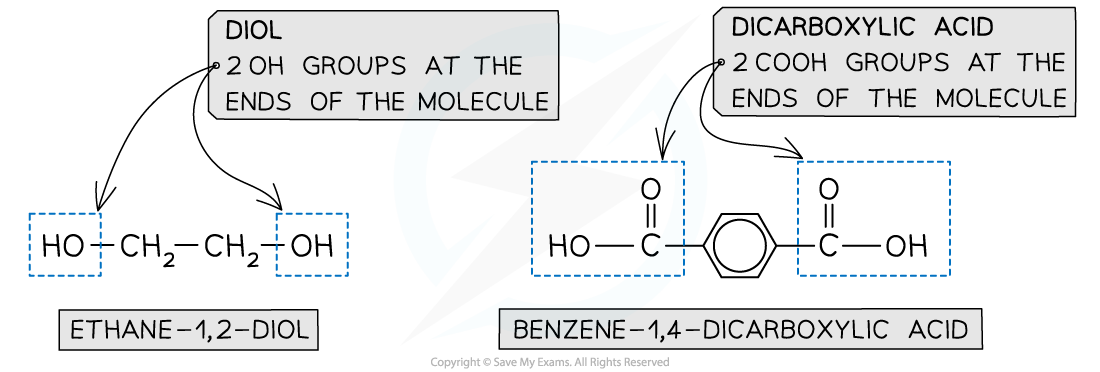
The position of the functional groups on both of these molecules allows condensation polymerisation to take place effectively
- When the polyester is formed, one of the -OH groups on the diol and the hydrogen atom of the -COOH are expelled as a water molecule (H2O)
- The resulting polymer is a polyester
- In this example, the polyester is?poly(ethylene terephthalate)?or PET, which is sometimes known by its brand names of Terylene or Dacron
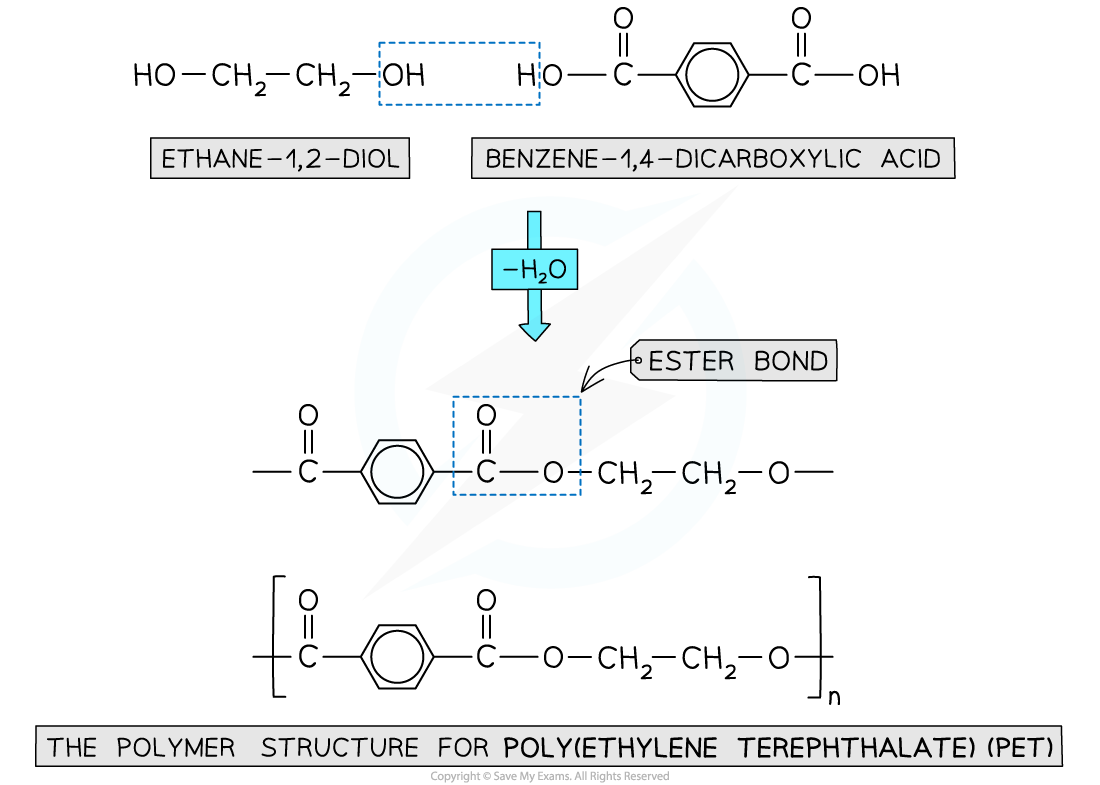
Expulsion of a water molecule in this condensation polymerisation forms the polyester called (ethylene terephthalate) (PET)
Formation of polyesters - hydroxycarboxylic acids
- So far the examples of making polyesters have focused on using 2 separate monomers for the polymerisation
- There is another route to making polyesters
- A single monomer containing both of the key functional groups can also be used
- These monomers are called hydroxycarboxylic acids
- They contain an alcohol group (-OH) at one end of the molecule while the other end is capped by a carboxylic acid group (-COOH)
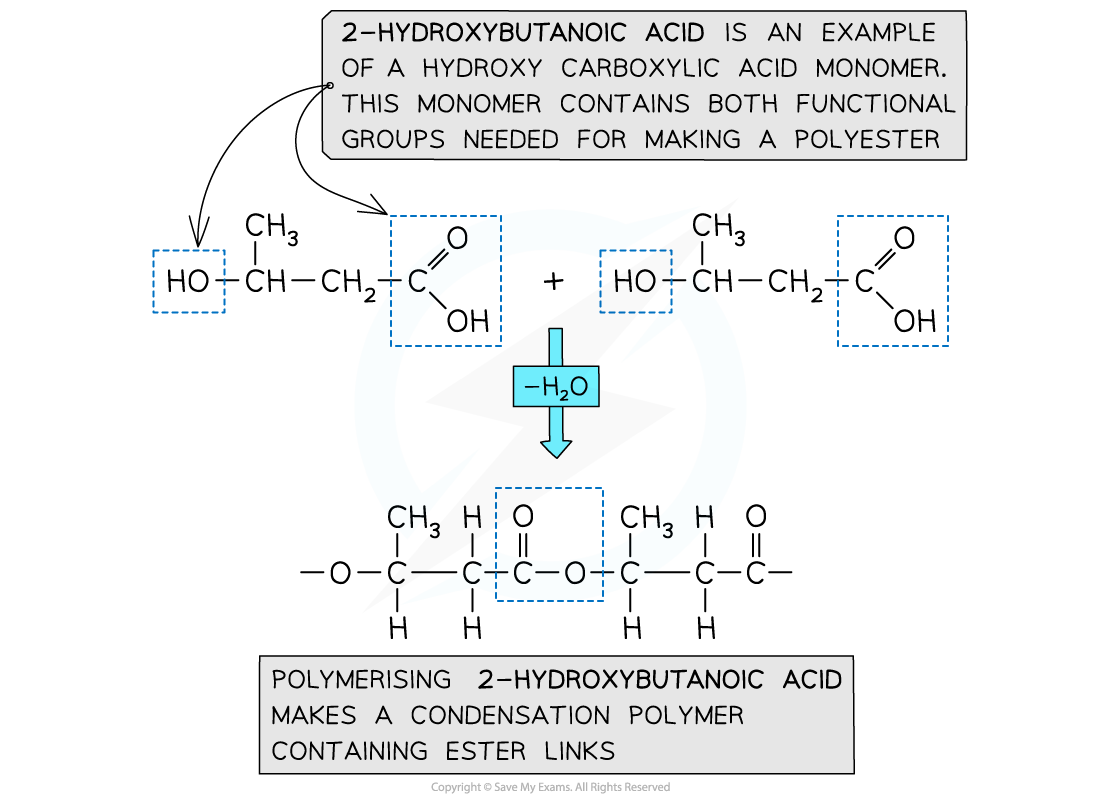
Both functional groups that are needed to make the polyester come from the same monomer
轉載自savemyexams
以上就是關于【Edexcel A Level Chemistry:復習筆記7.3.4 Acyl Chlorides & Esters】的解答,如需了解學校/賽事/課程動態,可至翰林教育官網獲取更多信息。
往期文章閱讀推薦:
2026 ALEVEL 夏考A率出爐!愛德思vs牛津AQA,哪些科目真的“好出分”?
2026 AMC10/12美國數學競賽新賽季!【翰林教育 × 清華大學出版社】獨家教材全面發售!


翰林AMC8視頻課重磅上線!

國際競賽真題資源免費領取






