CIE A Level Physics復習筆記19.2.1 Capacitor Discharge Graphs

Capacitor Discharge Graphs
- So far, only capacitors charged by a battery have been considered
- This is when the electrons flow from the positive to negative plate
- At the start, when the capacitor is charging, the current is large and then gradually falls to zero
- Capacitors are?discharged?through a resistor
- The electrons now flow back from the negative plate to the positive plate until there are equal numbers on each plate
- At the start of discharge, the current is large (but in the opposite direction to when it was charging) and gradually falls to zero
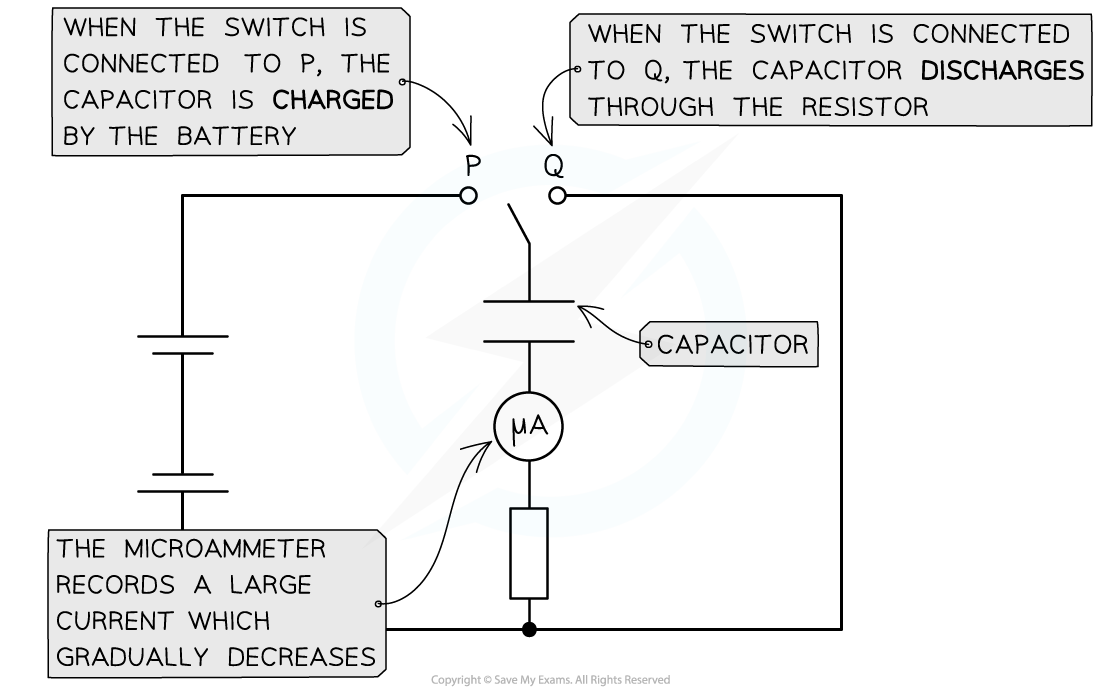
The capacitor charges when connected to terminal P and discharges when connected to terminal Q
- As a capacitor discharges, the current, p.d and charge all decrease?exponentially
- The means the rate at which the current, p.d or charge decreases is proportional to the amount of current, p.d or charge it has left
- The graphs of the variation with time of current, p.d and charge are all identical and represent an?exponential decay
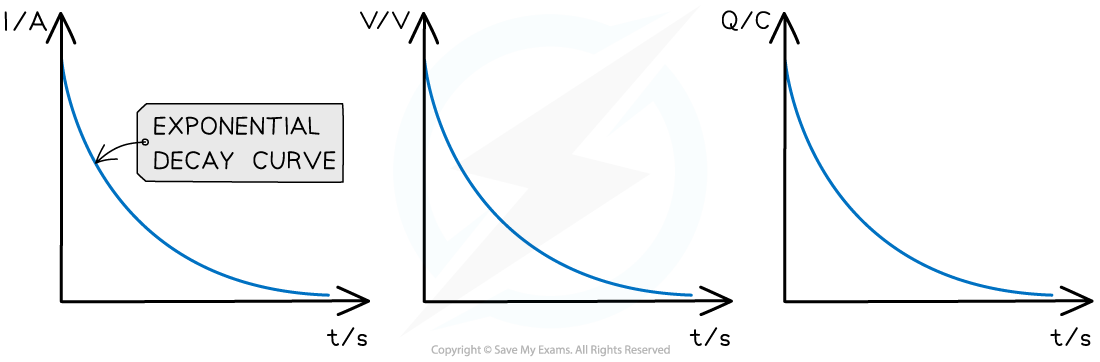
Graphs of variation of current, p.d and charge with time for a capacitor discharging through a resistor
- The key features of the discharge graphs are:
- The shape of the current, p.d. and charge against time graphs are identical
- Each graph shows exponential decay curves with decreasing gradient
- The initial value starts on the y axis and decreases exponentially
- The rate at which a capacitor discharges depends on the?resistance?of the circuit
- If the resistance is?high, the current will decrease and charge will flow from the capacitor plates more slowly, meaning the capacitor will take longer to discharge
- If the resistance is?low, the current will increase and charge will flow from the capacitor plates quickly, meaning the capacitor will discharge faster
轉載自savemyexams
以上就是關于【CIE A Level Physics復習筆記19.2.1 Capacitor Discharge Graphs】的解答,如需了解學校/賽事/課程動態,可至翰林教育官網獲取更多信息。
往期文章閱讀推薦:
2026 ALEVEL 夏考A率出爐!愛德思vs牛津AQA,哪些科目真的“好出分”?
2026 AMC10/12美國數學競賽新賽季!【翰林教育 × 清華大學出版社】獨家教材全面發售!


翰林AMC8視頻課重磅上線!

國際競賽真題資源免費領取






