CIE A Level Physics復習筆記17.2.2 Resonance

Resonance
- In order to sustain oscillations in a simple harmonic system, a periodic force must be applied to replace the energy lost in?damping
- This periodic force?does work?on the resistive force decreasing the oscillations
- These are known as?forced oscillations, and are defined as:
Periodic forces which are applied in order to sustain oscillations
- For example, when a child is on a swing, they will be pushed at one end after each cycle in order to keep swinging and prevent air resistance from damping the oscillations
- These extra pushes are the forced oscillations, without them, the child will eventually come to a stop
- The frequency of forced oscillations is referred to as the?driving frequency?(f)
- All oscillating systems have a?natural frequency (f0), this is defined as:
The frequency of an oscillation when the oscillating system is allowed to oscillate freely
- Oscillating systems can exhibit a property known as?resonance
- When resonance is achieved, a maximum amplitude of oscillations can be observed
- Resonance is defined as:
When the driving frequency applied to an oscillating system is equal to its natural frequency, the amplitude of the resulting oscillations increases significantly
- For example, when a child is pushed on a swing:
- The swing plus the child has a fixed natural frequency
- A small push after each cycle increases the amplitude of the oscillations to swing the child higher
- If the driving frequency does not quite match the natural frequency, the amplitude will increase but not to the same extent at when resonance is achieved
- This is because at resonance, energy is transferred from the driver to the oscillating system?most efficiently
- Therefore, at resonance, the system will be transferring the maximum kinetic energy possible
- A graph of driving frequency?f?against amplitude?a?of oscillations is called a?resonance curve. It has the following key features:
- When f < f0, the amplitude of oscillations increases
- At the peak where f = f0, the amplitude is at its maximum. This is?resonance
- When f > f0, the amplitude of oscillations starts to decrease
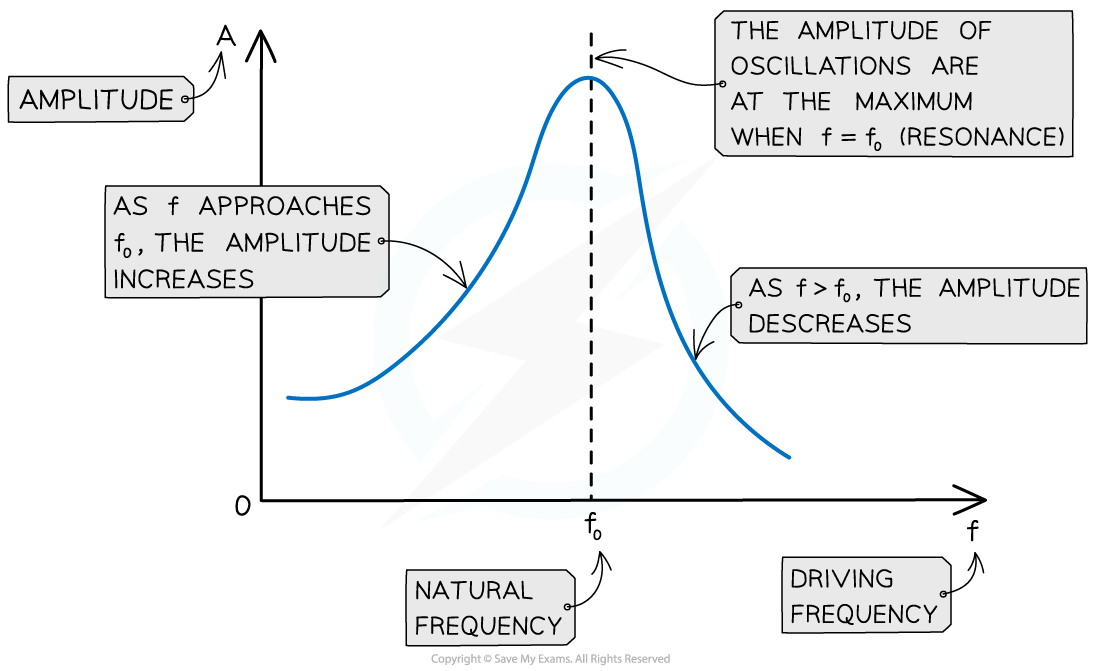
The maximum amplitude of the oscillations occurs when the driving frequency is equal to the natural frequency of the oscillator
- Damping reduces the amplitude of resonance vibrations
- The height and shape of the resonance curve will therefore change slightly depending on the degree of damping
- Note:?the natural frequency?f0?will remain the same
- As the degree of damping is increased, the resonance graph is altered in the following ways:
- The amplitude of resonance vibrations decrease, meaning the peak of the curve lowers
- The resonance peak broadens
- The resonance peak moves slightly to the left of the natural frequency when heavily damped
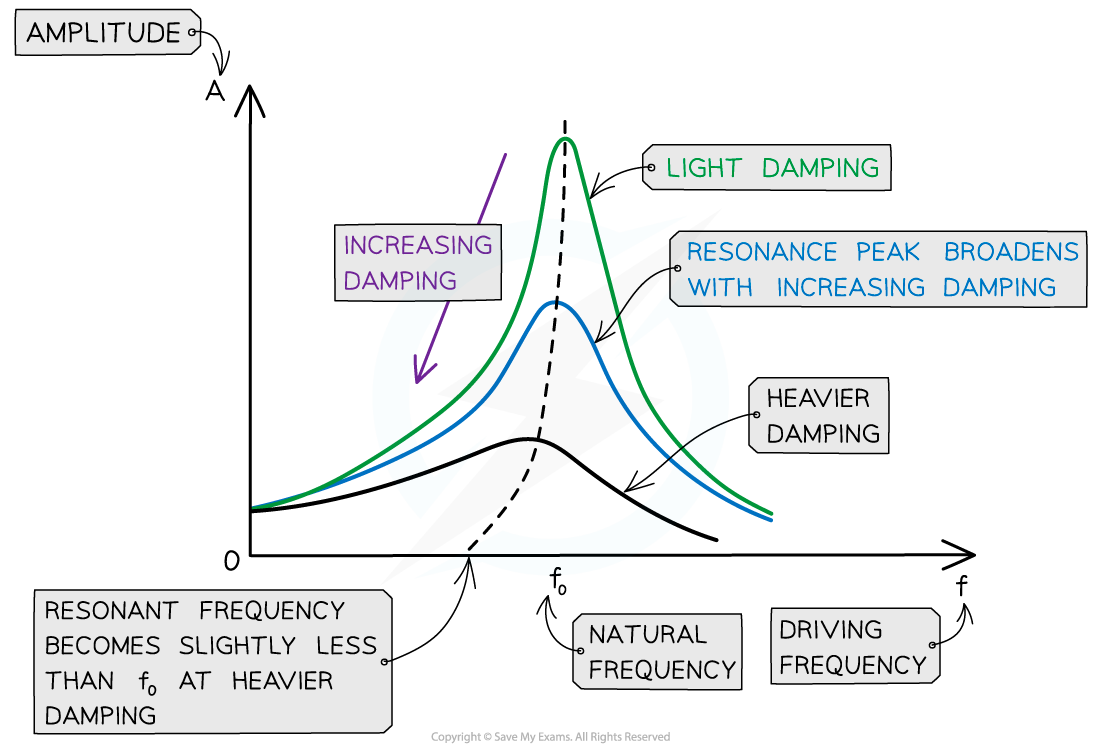
As damping is increased, resonance peak lowers, the curve broadens and moves slightly to the left
轉載自savemyexams
以上就是關于【CIE A Level Physics復習筆記17.2.2 Resonance】的解答,如需了解學校/賽事/課程動態,可至翰林教育官網獲取更多信息。
往期文章閱讀推薦:
2026 ALEVEL 夏考A率出爐!愛德思vs牛津AQA,哪些科目真的“好出分”?
2026 AMC10/12美國數學競賽新賽季!【翰林教育 × 清華大學出版社】獨家教材全面發售!


翰林AMC8視頻課重磅上線!

國際競賽真題資源免費領取






