CIE A Level Physics復習筆記15.2.2 Derivation of the Kinetic Theory of Gases Equation

Derivation of the Kinetic Theory of Gases Equation
- When molecules rebound from a wall in a container, the change in momentum gives rise to a force exerted by the particle on the wall
- Many molecules moving in random motion exert forces on the walls which create an average overall?pressure, since pressure is the force per unit area
- Picture a single molecule in a cube-shaped box with sides of equal length?l
- The molecule has a mass?m?and moves with speed?c,?parallel to one side of the box
- It collides at regular intervals with the ends of the box, exerting a force and contributing to the pressure of the gas
- By calculating the pressure this one molecule exerts on one end of the box, the total pressure produced by all the molecules can be deduced
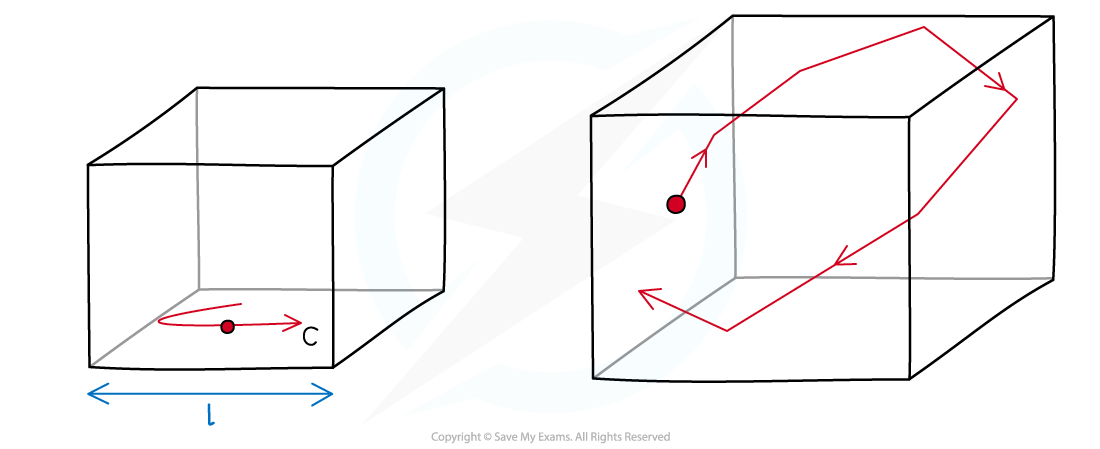
A single molecule in a box collides with the walls and exerts a pressure
5 Step Derivation
? ? ?1. Find the change in momentum as a single molecule hits a wall perpendicularly
- One assumption of the kinetic theory is that molecules?rebound elastically
- This means there is no kinetic energy lost in the collision
- If they rebound in the opposite direction to their initial velocity, their final velocity is -c
- The change in momentum is therefore:
Δp = ?mc ? (+mc) = ?mc ? mc = ?2mc
? ? ?2. Calculate the number of collisions per second by the molecule on a wall
- The time between collisions of the molecule travelling to one wall and back is calculated by travelling a distance of 2l?with speed c:

- Note:?c is?not?taken as the speed of light in this scenario
? ? ?3. Find the change in momentum per second
- The force the molecule exerts on one wall is found using Newton’s second law of motion:

- The change in momentum is +2mc since the force on the molecule from the wall is in the opposite direction to its change in momentum
? ? ?4. Calculate the total pressure from N molecules
- The area of one wall is?l2
- The pressure is defined using the force and area:

- This is the pressure?exerted from one molecule
- To account for the large number of?N?molecules, the pressure can now be written as:

- Each molecule has a different velocity and they all contribute to the pressure
- The mean squared speed of c2?is written with left and right-angled brackets <c2>
- The pressure is now defined as:

? ? ?5. Consider the effect of the molecule moving in 3D space
- The pressure equation still assumes all the molecules are travelling in the same direction and colliding with the same pair of opposite faces of the cube
- In reality, all molecules will be moving in three dimensions equally
- Splitting the velocity into its components cx, cy?and cz?to denote the amount in the x, y and z directions, c2?can be defined using pythagoras’ theorem in 3D:
c2?= cx2?+ cy2?+ cz2
- Since there is nothing special about any particular direction, it can be determined that:
<cx2> = <cy2> = <cz2>
- Therefore, <cx2> can be defined as:

- The box is a cube and all the sides are of length?l
- This means?l3?is equal to the volume of the cube,?V
- Substituting the new values for <c2> and?l3?back into the pressure equation obtains the final equation:

- This is known as the?Kinetic Theory of Gases equation
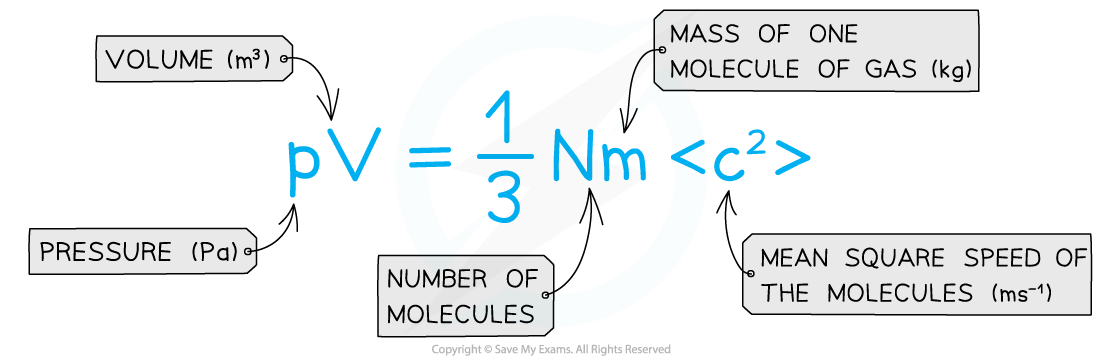
- This can also be written using the density?ρ?of the gas:

- Rearranging the pressure equation for p and substituting the density ρ:

Exam Tip
Make sure to revise and understand each step for the whole of the derivation, as you may be asked to derive all, or part, of the equation in an exam question.
轉載自savemyexams
以上就是關于【CIE A Level Physics復習筆記15.2.2 Derivation of the Kinetic Theory of Gases Equation】的解答,如需了解學校/賽事/課程動態,可至翰林教育官網獲取更多信息。
往期文章閱讀推薦:
2026 ALEVEL 夏考A率出爐!愛德思vs牛津AQA,哪些科目真的“好出分”?
2026 AMC10/12美國數學競賽新賽季!【翰林教育 × 清華大學出版社】獨家教材全面發售!


翰林AMC8視頻課重磅上線!

國際競賽真題資源免費領取






