CIE A Level Chemistry復(fù)習(xí)筆記5.6.7 Homogeneous & Heterogeneous Catalysts

Homogeneous & Heterogeneous Catalysis
- Catalysts?increase the rate of reaction by providing an alternative pathway which has a lower?activation energy
- Catalysts can be either?homogeneous?or?heterogeneous
- Homogeneous catalysts are those that are in the same phase as the reaction mixture
- For example, in the esterification of ethanoic acid (CH3COOH) with ethanol (CH3CH2OH) to form ethyl ethanoate (CH3COOCH2CH3) under acidic conditions

- The H+?is a homogeneous catalyst as like the reactants and product it is in the?aqueous?phase
- Heterogeneous catalysts are those that are in a different phase to the rest of the reaction mixture
- For example, in the Born-Haber process to form ammonia (NH3) from nitrogen (N2) and hydrogen (H2) an iron (Fe) catalyst is used

- The Fe catalyst is a heterogeneous catalyst as it is in?the?solid phase whereas the reactants and products are all in the?gas?phase
Heterogeneous Catalysis
- In?heterogeneous catalysis,?the molecules react at the surface of a solid catalyst
- The mode of action of a heterogeneous catalyst consists of the following steps:
- Adsorption?(or?chemisorption) of the reactants on the catalyst surface
- The reactants diffuse to the surface of the catalyst
- The reactant is?physically?adsorbed?onto the surface by?weak?forces
- The reactant is?chemically?adsorbed?onto the surface by?stronger?bonds
- Chemisorption causes?bond?weakening?between the atoms of the reactants
- Desorption?of the products
- The bonds between the products and catalyst weaken so much that the products break away from the surface
- For example, the adsorption of hydrogen molecules onto a palladium (Pd) surface
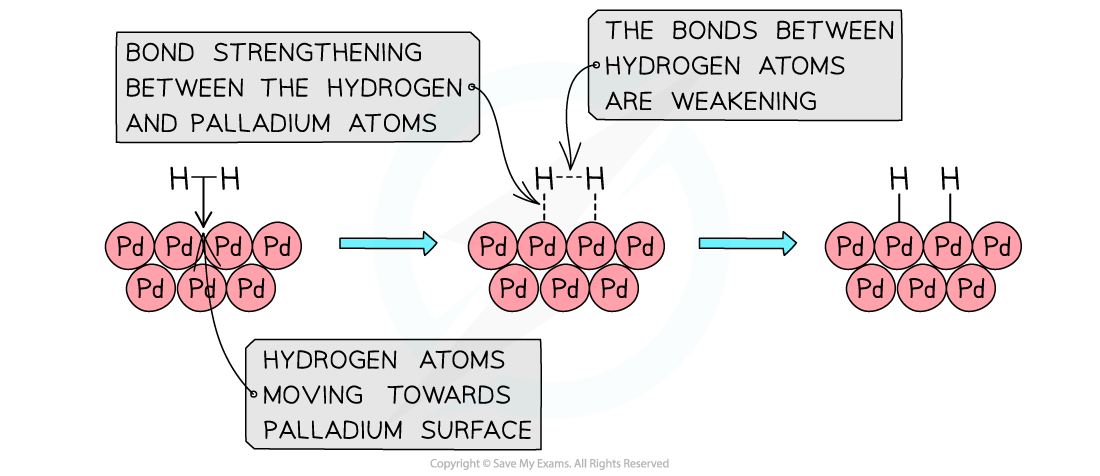
The reactants are adsorbed on the catalyst surface causing bond weakening and eventually desorption of the products
Iron in the Haber process
- In the?Haber?process?ammonia (NH3) is produced from nitrogen (N2) and hydrogen (H2)
- An?iron?catalyst?is used which speeds up the reaction by bringing the reactants close together on the metal surface
- This increases their likelihood to react with each other
- The mode of action of the iron catalyst is as follows:
- Diffusion?of the nitrogen and hydrogen gas to the iron surface
- Adsorption?of the reactant molecules onto the iron surface by forming bonds between the iron and reactant atoms
- These bonds are so strong that they weaken the covalent bonds between the nitrogen atoms in N2?and hydrogen atoms in H2
- But they are weak enough to break when the catalysis has been completed
- The reaction?takes place between the adsorbed nitrogen and hydrogen atoms which react with each other on the iron surface to form NH3
- Desorption?occurs when the bonds between the NH3?and iron surface are weakened and eventually broken
- The formed NH3?diffuses?away from the iron surface
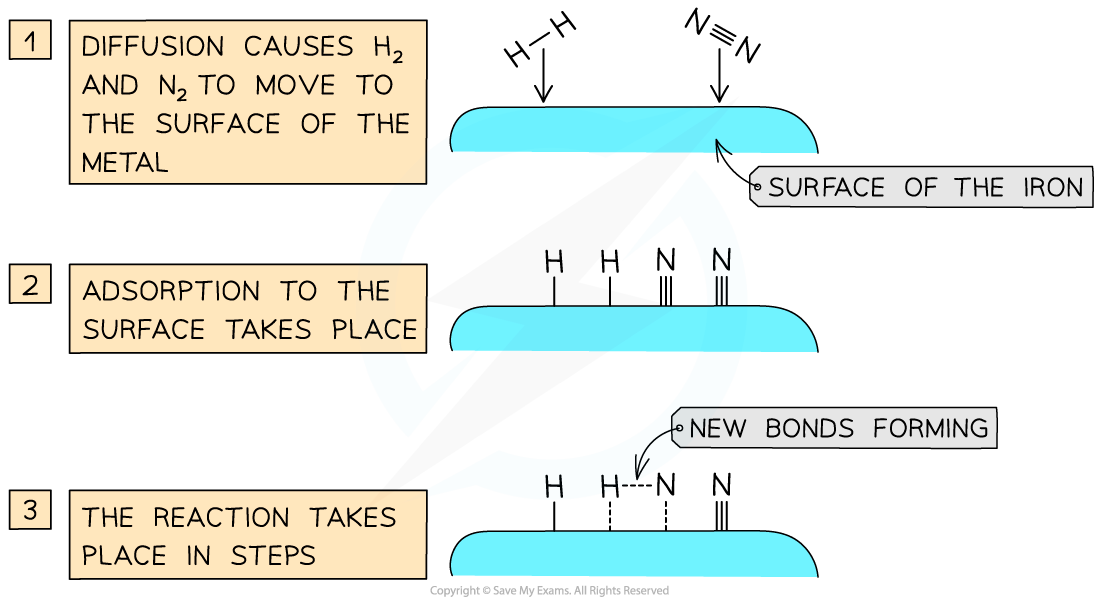
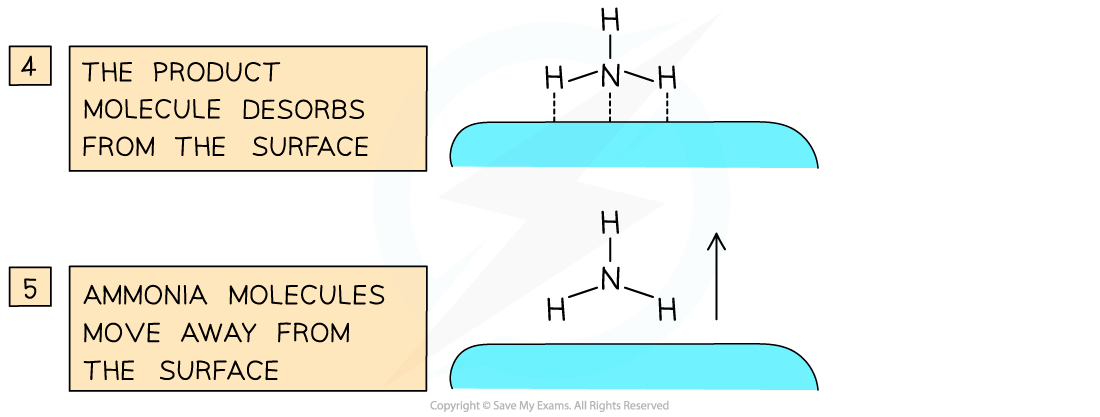
Iron brings the nitrogen and hydrogen closer together so that they can react and hence increases the rate of reaction
Heterogeneous catalyst in catalytic converters
- Heterogeneous catalysts are also used in the?catalytic?removal?of oxides of nitrogen from the exhaust gases of car engines
- The catalysts speed up the conversion of:
- Nitrogen oxides (NOy) into?harmless nitrogen gas?(N2)
- Carbon monoxide (CO) into carbon dioxide (CO2)
- The catalytic converter has a?honeycomb?structure containing small beads coated with?platinum, palladium,?or?rhodium metals?which act as?heterogeneous catalysts
- The mode of action of the catalysts is as following:
- Adsorption?of the nitrogen oxides and CO onto the catalyst surface
- The weakening?of the covalent bonds within nitrogen oxides and CO
- Formation of new bonds between:
- Adjacent nitrogen atoms to form N2?molecules
- CO and oxygen atoms to form CO2?molecules
- Desorption?of N2?and CO2?molecules which eventually?diffuse?away from the metal surface
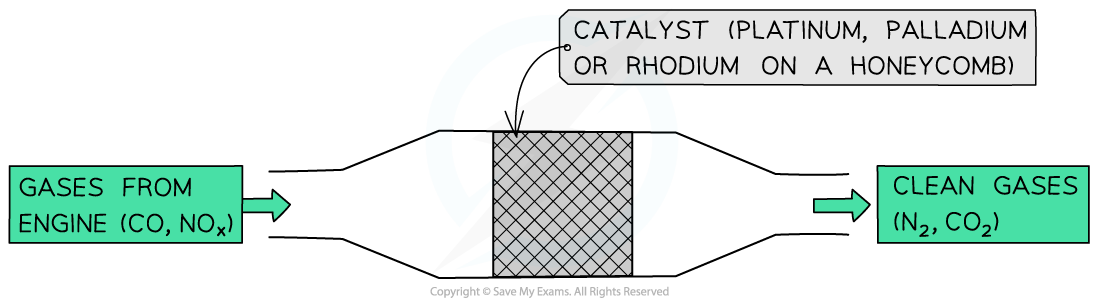
The metals in catalytic converters speed up the conversion of nitrogen oxides and CO into N2?and CO2?respectively
Homogeneous Catalysis
- Homogeneous catalysis?often involves?redox reactions?in which the ions involved in catalysis undergo changes in their?oxidation number
- As ions of transition metals can change oxidation number they are often good catalysts
- Homogeneous catalysts are used in one step and are reformed in a later step
The iodine-peroxydisulfate reaction
- This is a very?slow?reaction in which the peroxydisulfate (S2,O82-?) ions?oxidise?the?iodide?to?iodine
S2O82-?(aq) + 2I-?(aq) → 2SO42-?(aq) + I2?(aq)
- Since both the S2O82-?and I-?ions have a negative charge, it will require a lot of energy for the ions to overcome the?repulsive?forces?and collide with each other
- Therefore, Fe3+?(aq) ions are used as a?homogeneous catalyst
- The catalysis involves two?redox reactions:
- First, Fe3+?ions are?reduced?to Fe2+?by? I-
2Fe3+?(aq) + 2I-?(aq) → 2Fe2+?(aq) + I2?(aq)
-
- Then, Fe2+?is?oxidized?back to Fe3+?by S2O82-
2Fe2+?(aq) + S2O82-?(aq) → 2Fe3+?(aq) + 2SO42-? (aq)
- By reacting the reactants with a positively charged Fe ion, there are no repulsive forces, and the activation energy is significantly lowered
- The order of the two reactions does not matter
- So, Fe2+?can be first oxidised to Fe3+?followed by the reduction of Fe3+?to Fe2+
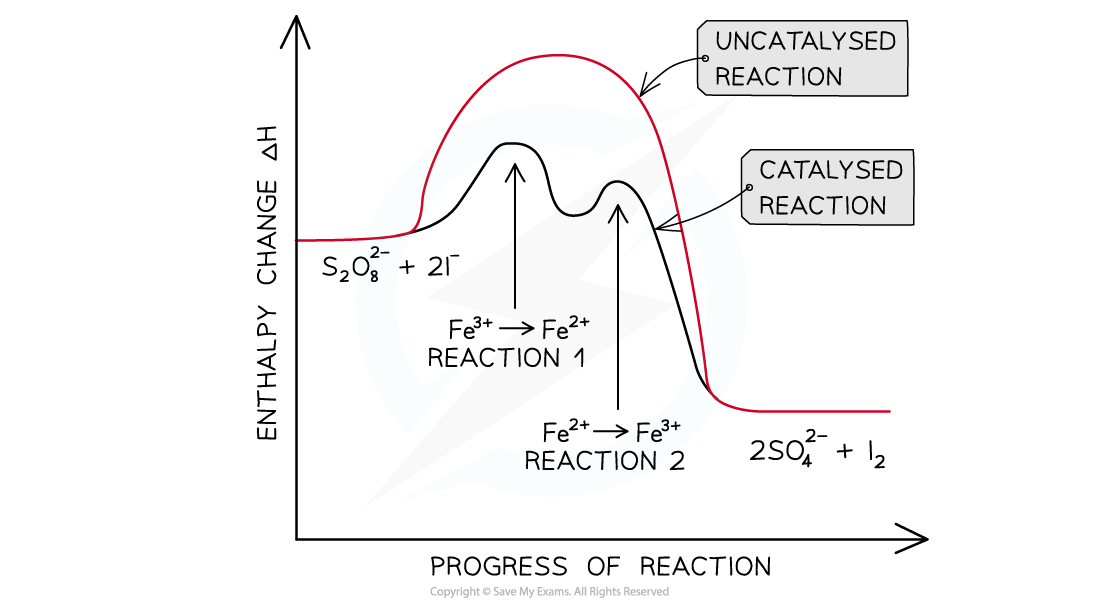
The catalysed reaction has two energy ‘humps’ because it is a two-stage reaction
Nitrogen oxides & acid rain
- As fossil fuels contain sulfur, burning the fuels will release sulfur dioxide which oxidises in air to sulfur trioxide, and then?dilute sulfuric acid?(H2SO4) is formed by reaction with water. The result is acidification of rain:
SO3(g) + H2O(l) → H2SO4(aq)
- Nitrogen oxides can act as?catalysts?in the formation of acid rain by catalysing the oxidation of SO2?to SO3
NO2(g) + SO2(g) → SO3(g) + NO(g)
- The formed NO gets oxidised to regenerate NO2
NO(g) + ? O2(g) → NO2(g)
- The regenerated NO2?molecule can again oxidise another SO2?molecule to SO3?which will react with rainwater to form H2SO4?and so on
轉(zhuǎn)載自savemyexams
以上就是關(guān)于【CIE A Level Chemistry復(fù)習(xí)筆記5.6.7 Homogeneous & Heterogeneous Catalysts】的解答,如需了解學(xué)校/賽事/課程動態(tài),可至翰林教育官網(wǎng)獲取更多信息。
往期文章閱讀推薦:
斯坦福大學(xué)官方推薦書單!名校學(xué)霸們暑假都在讀什么?
MIT官方發(fā)布【2026年夏季推薦閱讀書單】!橫跨科學(xué)/人文/經(jīng)濟...


翰林AMC8視頻課重磅上線!

國際競賽真題資源免費領(lǐng)取






