CIE A Level Chemistry復習筆記1.1.12 Ionisation Energies & Electronic Configurations

Ionisation Energies: Explained
- Energy?is required to remove an outer shell electron as this involves breaking the?attractive?forces?between the electron and the?positively?charged?nucleus
- There are several factors which affect the magnitude of the ionisation energy:
- Nuclear charge
- Positive nuclear charge increases with increasing number of protons
- The greater the positive charge, the greater the attractive forces between the outer electron(s) and the nucleus
- More energy is required to overcome these forces so ionisation energy?increases?with increasing nuclear charge
- Shielding
- Electrons?repel?each other and electrons occupying the inner shells repel electrons located in shells further outside the nucleus and prevent them from feeling the?full?effect?of the nuclear charge
- The greater the shielding effect is, the weaker the attractive forces between the positive nucleus and the negatively charged electrons
- Less energy is required to overcome the weakened attractive forces so ionisation energy?decreases?with increasing shielding effects
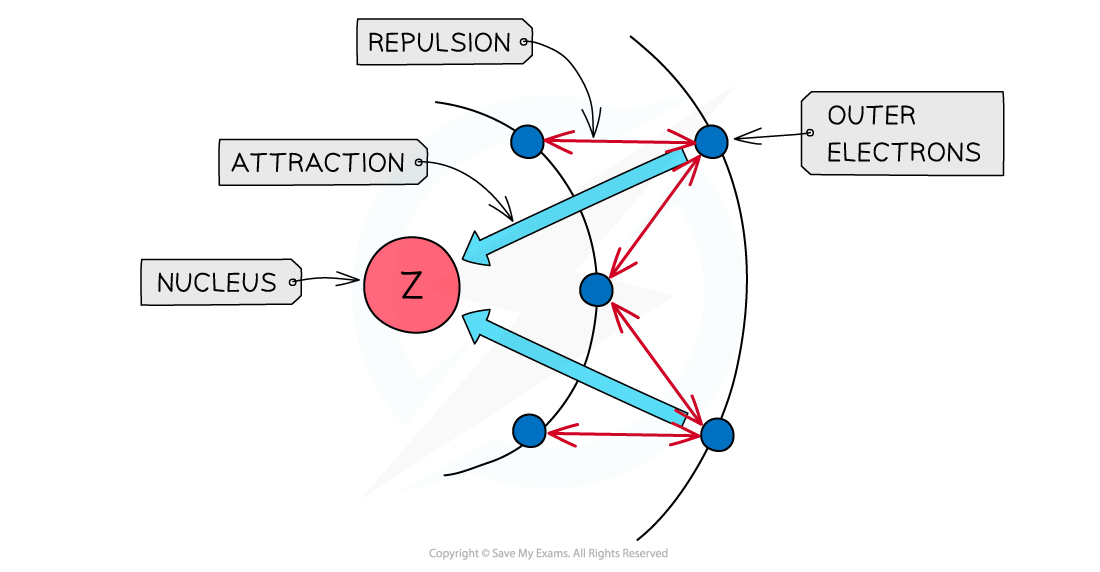
Shielding makes it easier to remove the outermost electrons
- Atomic/ionic radius
- The larger the radius, the greater the distance between the nucleus and the outer shell electron(s)
- Increasing distance?weakens?the strength of the attractive forces
- Larger atoms/ions also result in greater?shielding?due to the presence of more inner electrons
- Less energy is required to remove the outer shell electron(s) so ionisation energy?decreases?with increasing atomic/ionic radius
- Spin-pair repulsion
- Spin pair repulsion occurs when the electron being removed is spin paired with another electron in the same orbital
- The proximity of the like charges of electrons in the orbital results in repulsion
- Less energy is required to remove one of the electrons so ionisation energy?decreases?when there is spin-pair repulsion
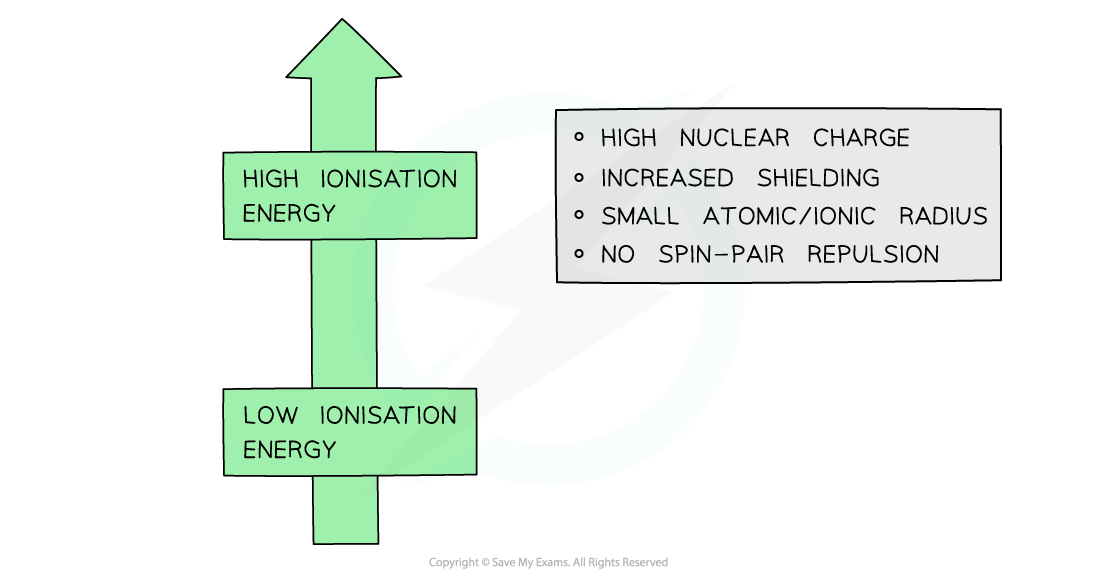
Summary of factors affecting ionisation energies of atoms
Ionisation Energies: Electronic Configuration
- Successive?ionisation?data?can be used to:
- Predict or confirm the simple electronic configuration of elements
- Confirm the number of electrons in the outer shell of an element
- Deduce the Group an element belongs to in the Periodic Table
- By analyzing where the large jumps appear and the number of electrons removed when these large jumps occur, the?electron configuration?of an atom can be determined
- Na, Mg and Al will be used as examples to deduce the electronic configuration and positions of elements in the Periodic Table using their successive ionisation energies
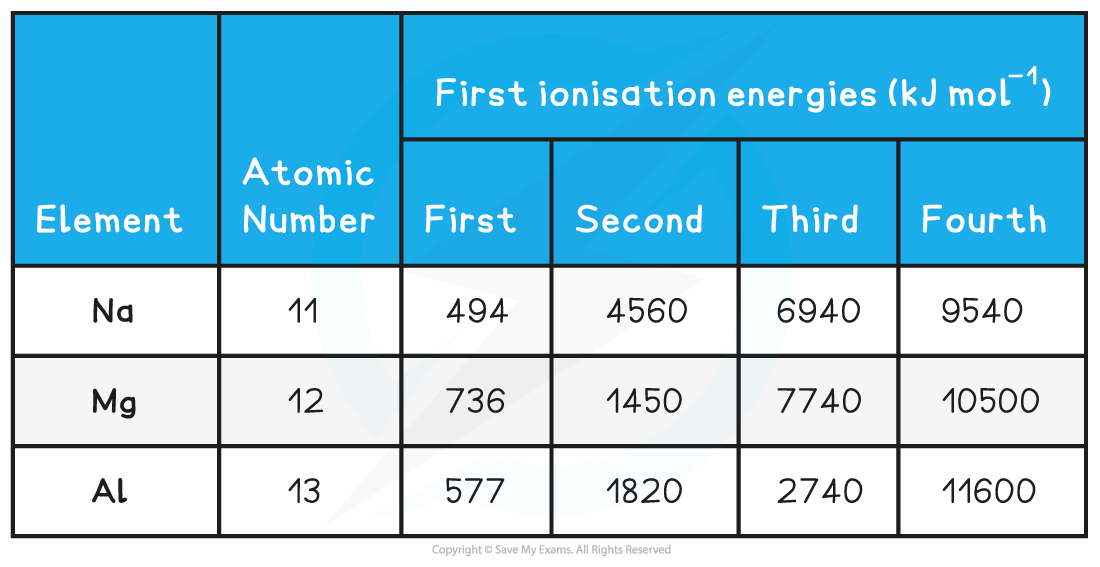
Successive ionisation energies table
Sodium
- For sodium, there is a huge?jump?from the?first?to the?second?ionisation energy, indicating that it is much easier to remove the first electron than the second
- Therefore, the first electron to be removed must be the last electron in the?valence?shell?thus Na belongs to group I
- The large jump corresponds to moving from the 3s to the full 2p subshellNa?????? 1s2?2s2?2p6?3s1
Magnesium
- There is a huge increase from the?second?to the?third?ionisation energy, indicating that it is far easier to remove the first two electrons than the third
- Therefore the?valence?shell?must contain only two electrons indicating that magnesium belongs to group II
- The large jump corresponds to moving from the 3s to the full 2p subshellMg?????? 1s2?2s2?2p6?3s2
Aluminium
- There is a huge increase from the?third?to the?fourth?ionisation energy, indicating that it is far easier to remove the first three electrons than the fourth
- The 3p electron and 3s electrons are relatively easy to remove compared with the 2p electrons which are located closer to the nucleus and experience greater?nuclear?charge
- This is due to?weakened?shielding?effects?through the loss of three electrons
- The large jump corresponds to moving from the?third shell?to the?second shell
- Al???????? 1s2?2s2?2p6?3s2?3p1
Exam Tip
Find the large jumps by subtracting the successive ionisation energies from each other to identify when an electron has been removed from a different subshell.
轉載自savemyexams
以上就是關于【CIE A Level Chemistry復習筆記1.1.12 Ionisation Energies & Electronic Configurations】的解答,如需了解學校/賽事/課程動態,可至翰林教育官網獲取更多信息。
往期文章閱讀推薦:
MIT官方發布【2026年夏季推薦閱讀書單】!橫跨科學/人文/經濟...


翰林AMC8視頻課重磅上線!

國際競賽真題資源免費領取






