CIE A Level Biology復習筆記11.1.3 Primary Immune Response

Primary Immune Response (Advanced)
- Lymphocytes?are another type of white blood cell
- They play an important part in the?specific?immune response
- They are?smaller?than phagocytes
- They have a?large nucleus?that fills most of the cell
- They are produced in the?bone marrow before birth
- There are?two types?of lymphocytes (with?different modes of action). The two types of lymphocytes are:
- B-lymphocytes (B cells)
- T-lymphocytes (T cells)
B-lymphocytes
- B-lymphocytes?(B cells) remain in the?bone marrow?until they are?mature?and then spread through the body, concentrating in lymph nodes and the spleen
- Millions of types of B-lymphocyte cells are produced within us because as they?mature the genes?coding for antibodies are changed to code for?different antibodies
- Once mature,?each type of B-lymphocyte cell?can make?one type of antibody molecule
- At this stage, the antibody molecules do not leave the B-lymphocyte cell but?remain in the cell surface membrane
- Part of each antibody molecule forms a?glycoprotein receptor?that can combine specifically with?one type of antigen
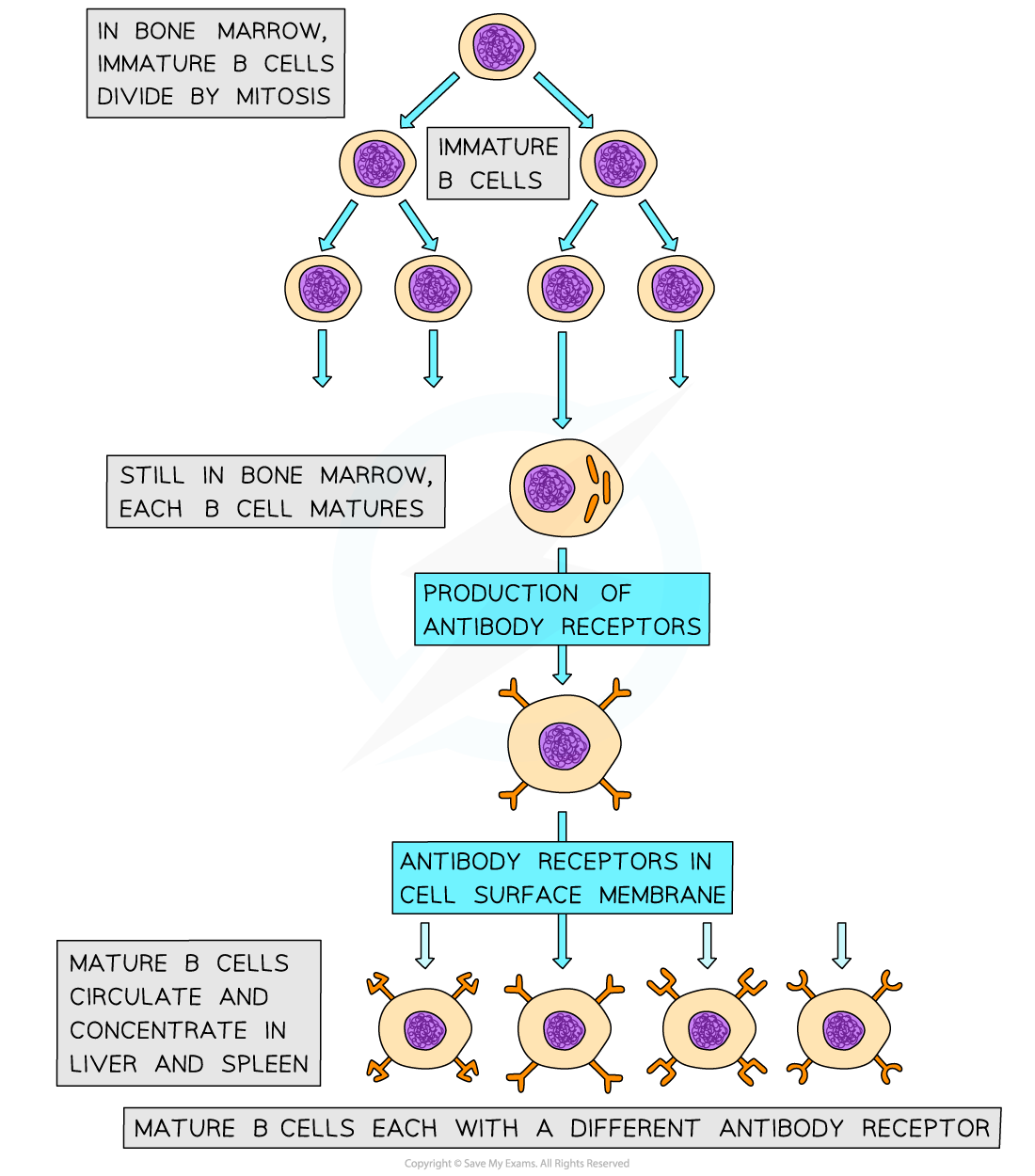
The maturation of B-lymphocytes – by the time a child is born, it will have millions of different types of B-lymphocytes, each with a specific antibody receptor
- When an?antigen?enters the body for the?first time, the small numbers of B-lymphocytes with receptors complementary to that antigen are stimulated to?divide?by?mitosis
- This is known as?clonal selection
- As these clones divide repeatedly by mitosis (the?clonal expansion?stage) the result is large numbers of identical B-lymphocytes being produced over a few weeks
- During an immune response, these B-lymphocytes then form?two types?of cell:
- Some of these B-lymphocytes become?plasma cells?that?secrete lots of antibody molecules?(specific to the antigen) into the blood, lymph or linings of the lungs and the gut
- These plasma cells are?short-lived?(their numbers drop off after several weeks) but the antibodies they have secreted stay in the blood for a longer time
- The other B-lymphocytes become?memory cells?that remain circulating in the blood for a?long time
- This response to a?newly encountered antigen?is relatively?slow?and is known as a?primary immune response
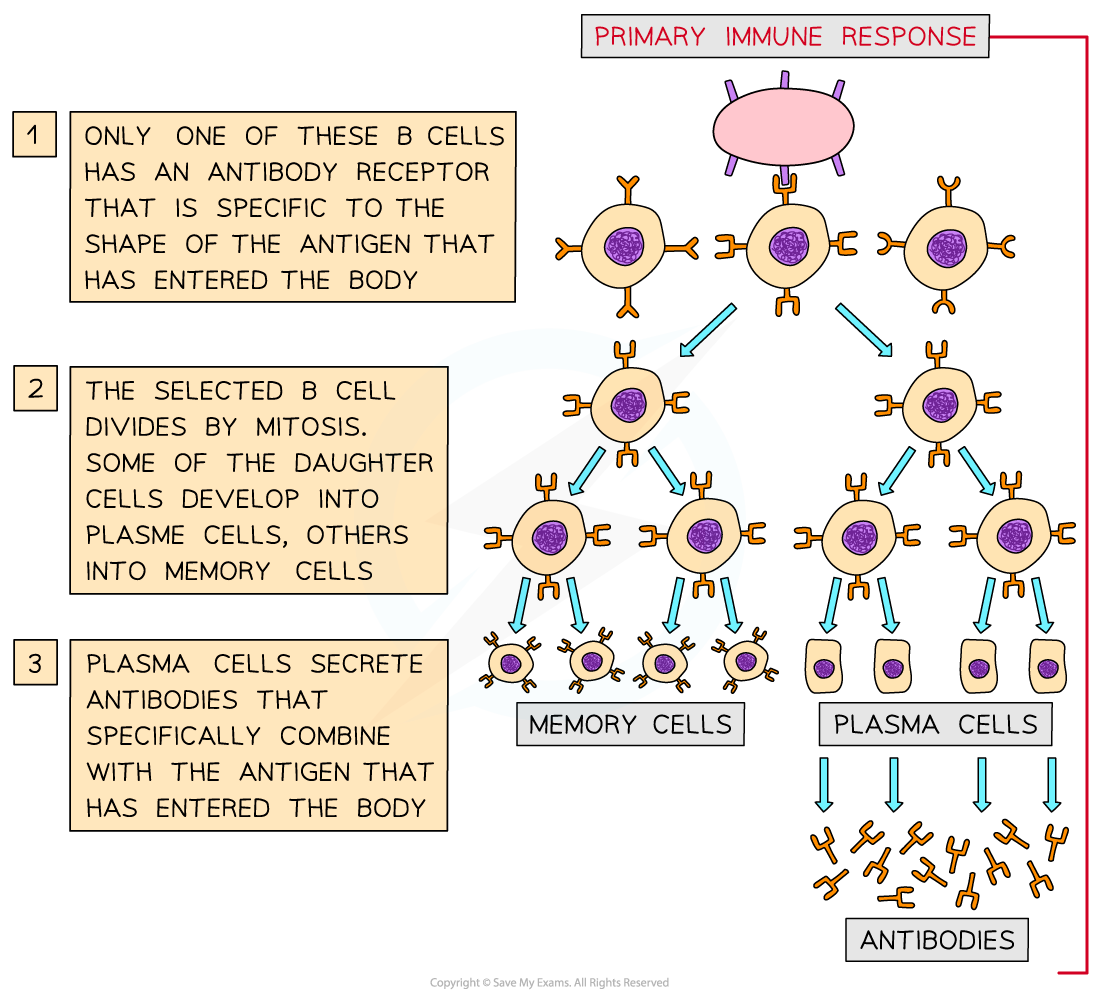
During a primary immune response, B-lymphocytes form two types of cell
T-lymphocytes
- Immature?T-lymphocytes?leave the bone marrow to?mature?in the?thymus
- Mature?T-lymphocytes?have specific cell surface receptors called?T cell receptors
- These receptors have a?similar structure to antibodies?and are each?specific to one antigen
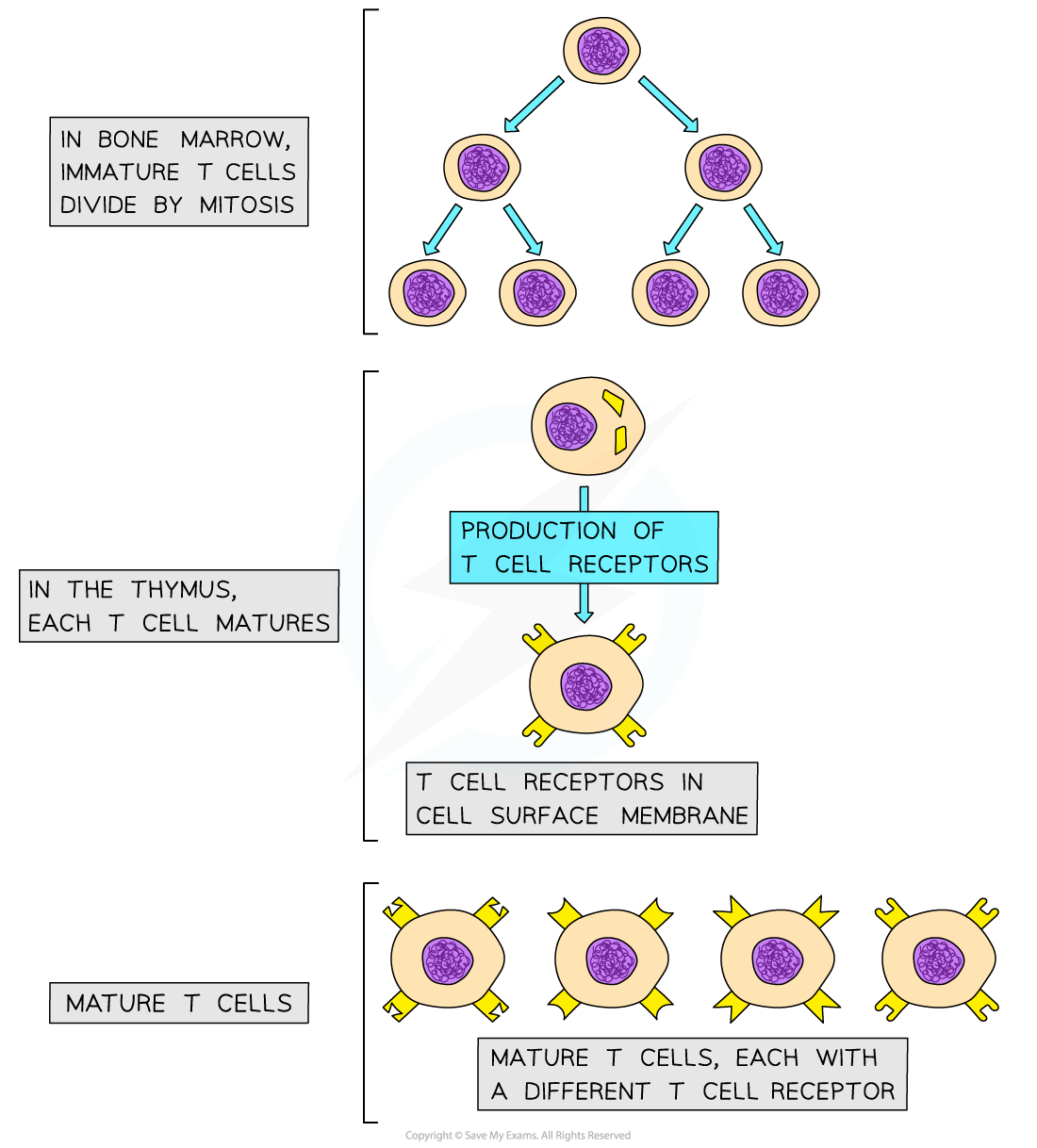
The maturation of T-lymphocytes – some become helper T cells and others become killer T cells
- T-lymphocytes are?activated?when they encounter (and bind to) their specific antigen that is being presented by one of the host’s cells (host cells being the human’s own cells)
- This?antigen-presenting?host cell might be a?macrophage?or a body cell that has been invaded by a pathogen and is?displaying the antigen on its cell surface membrane
- These activated T-lymphocytes (those that have receptors specific to the antigen)?divide?by?mitosis?to increase in number (similar to the?clonal selection and clonal expansion?of B-lymphocytes)
- These T-lymphocytes differentiate into?two main types of T cell:
- helper T cells
- killer T cells
- Helper T cells?release cytokines?(hormone-like signals) that?stimulate B-lymphocytes to divide?and develop into?antibody-secreting plasma cells. Some helper T cells secrete cytokines that?stimulate macrophages?to?increase their rates of phagocytosis
- Killer T cells?attach to the antigens?on the cell surface membranes of infected cells and?secrete toxic substances?that?kill?the body cells, along with the pathogen inside
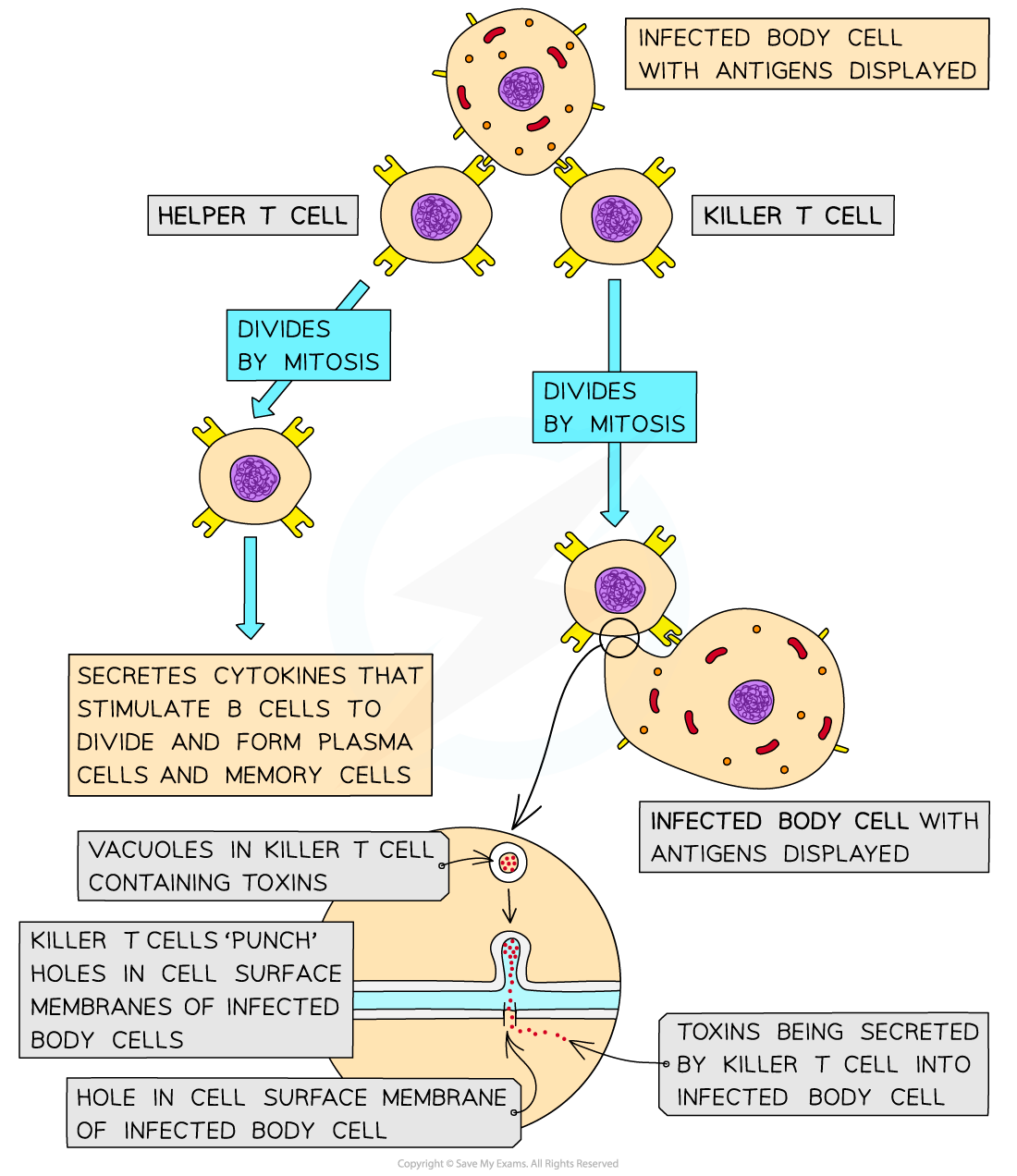
Helper T cells and killer T cells carry out different functions during an immune response
轉載自savemyexams
以上就是關于【CIE A Level Biology復習筆記11.1.3 Primary Immune Response】的解答,如需了解學校/賽事/課程動態,可至翰林教育官網獲取更多信息。
往期文章閱讀推薦:
MIT官方發布【2026年夏季推薦閱讀書單】!橫跨科學/人文/經濟...


翰林AMC8視頻課重磅上線!

國際競賽真題資源免費領取






