CIE A Level Biology復習筆記7.2.2 Transpiration in Plants

Transpiration Explained
- The movement of water through a plants xylem is largely due to the?evaporation of water vapour?from the?leaves?and the?cohesive?and?adhesive?properties exhibited by water molecules
- It is the gradient in water potential that is the driving force permitting the movement of water from the soil (high water potential), to the atmosphere (low water potential), via the plant's cells
- Plants are constantly taking water in at their roots and losing water via the?stomata?(in the leaves)
- Around 99% of the water absorbed is lost through evaporation from the plant's stem and its leaves in a process called?transpiration
- Transpiration refers to the loss of?water vapour?from a plant to its environment by?diffusion?and the?transpiration stream?refers to the movement of water from the roots to the leaves
- The advantage of transpiration is that:
- It provides a means of?cooling?the plant via evaporative cooling
- The transpiration stream is helpful in the?uptake of mineral ions
- The turgor pressure of the cells (due to the presence of water as it moves up the plant) provides?support?to leaves (enabling an increased surface area of the leaf blade) and the stem of non-woody plants
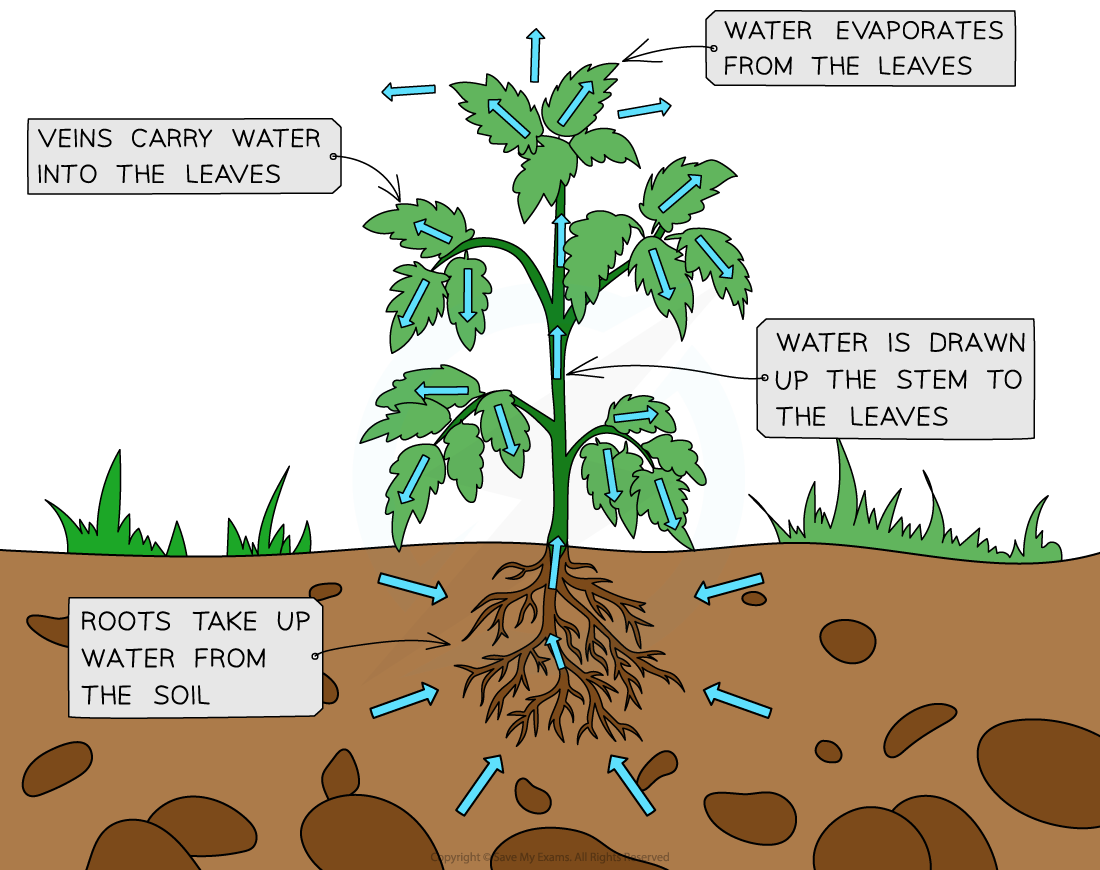
The loss of water vapour from the leaves of plants (transpiration) results in a lower water potential creating a concentration gradient between the roots and leaves causing water to move upwards
Movement of water through leaves
- Certain environmental conditions (eg. low humidity, high temperatures) can cause a water potential gradient between the air inside the leaves (higher?water potential)?and the air outside (lower?water potential) which results in water vapour?diffusing?out of the leaves through the stomata (transpiration)
- The water vapour lost by transpiration lowers the water potential in the air spaces surrounding the mesophyll cells
- The water within the mesophyll cell walls?evaporates?into these air spaces resulting in a transpiration pull
- This transpiration pull results in water moving through the mesophyll cell wall (apoplastic pathway) or out of the mesophyll cytoplasm (symplastic pathway) into the cell wall
- The pull from the water moving through the mesophyll cells results in water leaving the xylem vessels through?pits?(non-lignified areas), which then causes water to move?up?the xylem vessels (due to the cohesive and adhesive properties of the water). This movement is called?transpiration stream
- When rates of transpiration are high the walls of the xylem are pulled inwards by the faster flow of water
The role of the stomata
- Transpiration is mainly controlled by the pairs of guard cells that surround stomata (plural, stoma is singular)
- Guard cells open the stomata when they are turgid and close the stomata when they lose water
- When the stomata are open there is a greater rate of transpiration and of gaseous exchange
- When the stomata close transpiration and gaseous exchange decrease
- As stomata allow gaseous exchange (CO2?in and O2?out) they are generally open during the day
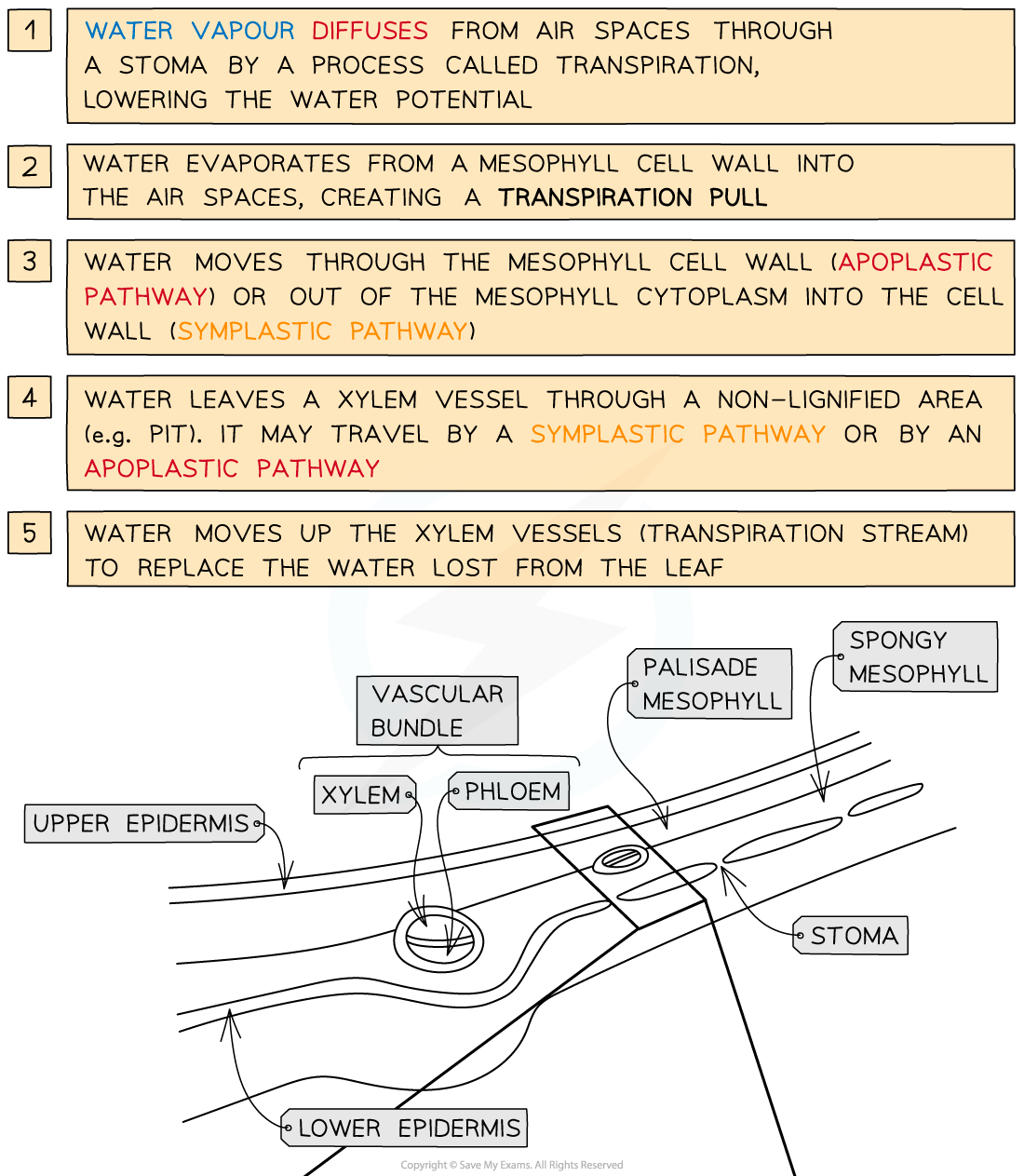
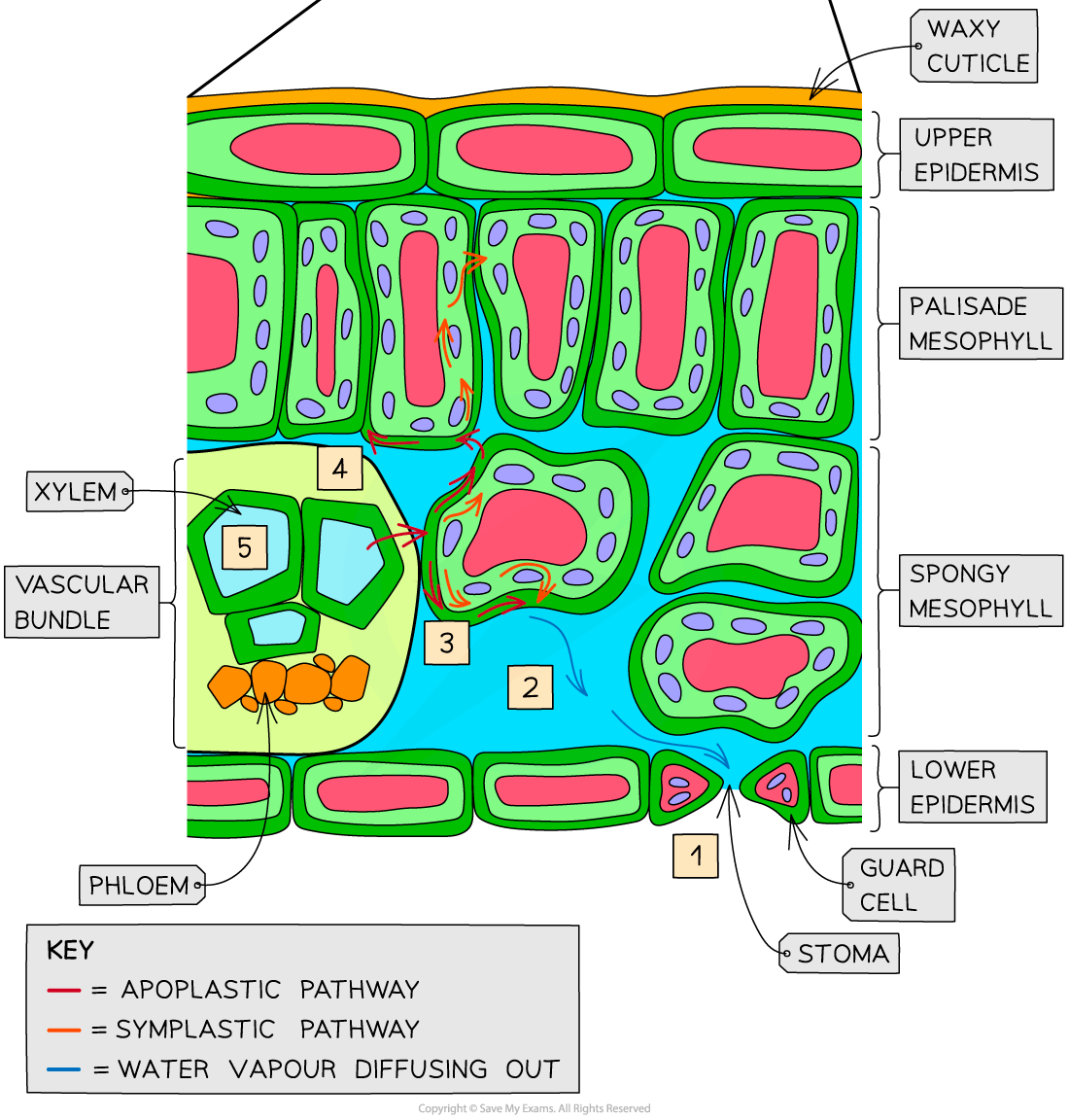
Water movement through a leaf. Water enters the leaf as a liquid and diffuses out as water vapour through the stomata. This loss of water by evaporation and transpiration results in a water potential gradient between the leaves (low) and roots (high) causing water to move up the plant in a transpiration stream
Exam Tip
Remember that?water vapour diffuses?through the stomata and?water evaporates?from the mesophyll cells into the air spaces in the leaf. Transpiration and transpiration pull/stream are different –?transpiration?is the?loss of water vapour?from the leaves or stem, whereas transpiration pull/stream is the movement of water through the xylem tissue and mesophyll cells.
轉載自savemyexams
以上就是關于【CIE A Level Biology復習筆記7.2.2 Transpiration in Plants】的解答,如需了解學校/賽事/課程動態,可至翰林教育官網獲取更多信息。
往期文章閱讀推薦:
2026 ALEVEL 夏考A率出爐!愛德思vs牛津AQA,哪些科目真的“好出分”?
2026 AMC10/12美國數學競賽新賽季!【翰林教育 × 清華大學出版社】獨家教材全面發售!


翰林AMC8視頻課重磅上線!

國際競賽真題資源免費領取






