CIE A Level Biology復(fù)習(xí)筆記4.2.9 Estimating Water Potential in Plants

Estimating Water Potential in Plant Tissue
- It is possible to investigate the effects of immersing plant tissue in?solutions of different water potentials?and then?use the results to estimate the water potential of the plant tissue?itself
- The most common osmosis practical of this kind involves cutting?cylinders of potato?and placing them into solutions with a?range of different water potentials (usually sucrose solutions of increasing concentration?– at least 5 different concentrations are usually required)
Method
- The required number of potato cylinders are cut (one for each of the solutions you are testing – or more than one per solution if you require repeats)
- They are all cut to the?same length?and, once blotted dry to remove any excess moisture, their?initial mass is measured and recorded?before placing into the solutions
- They are left in the solutions for a set amount of time (eg. 30 minutes), usually in a water bath (set at around 30o)
- They are then removed and?dried to remove excess liquid
- The?final length and mass?of each potato cylinder is then measured and recorded
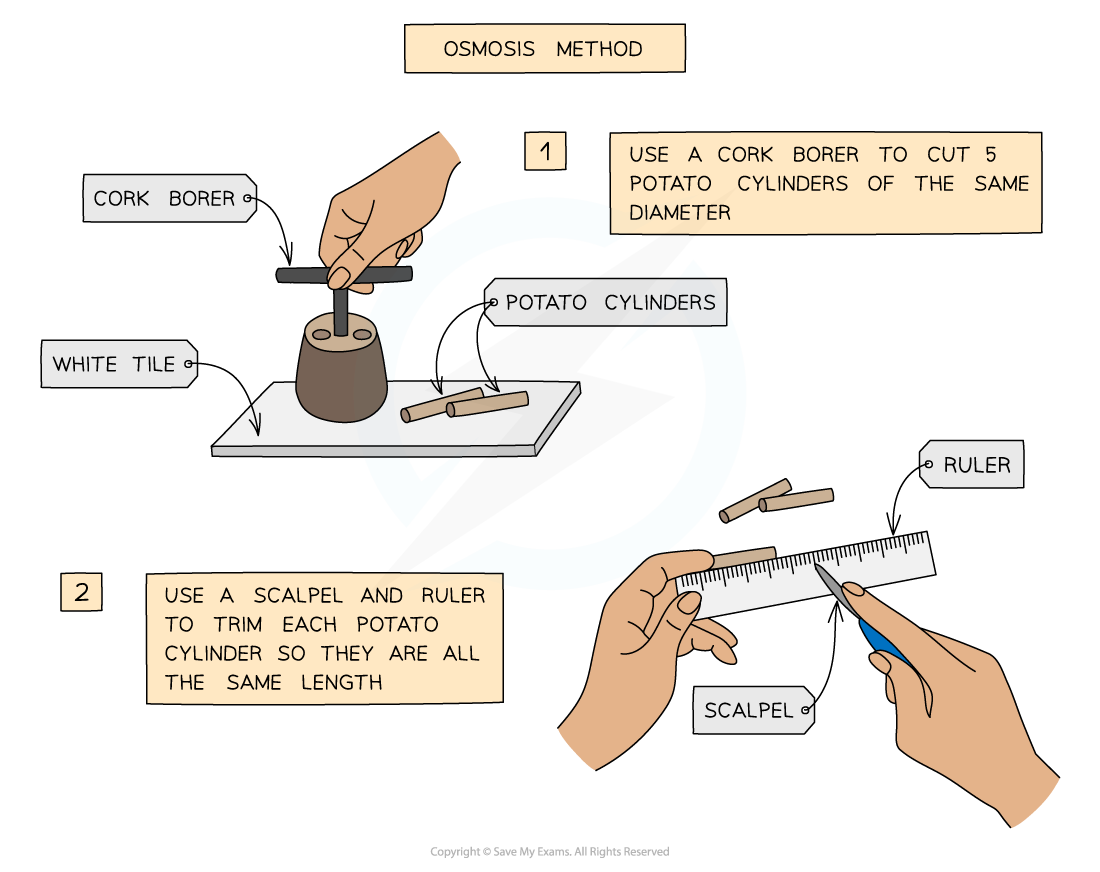
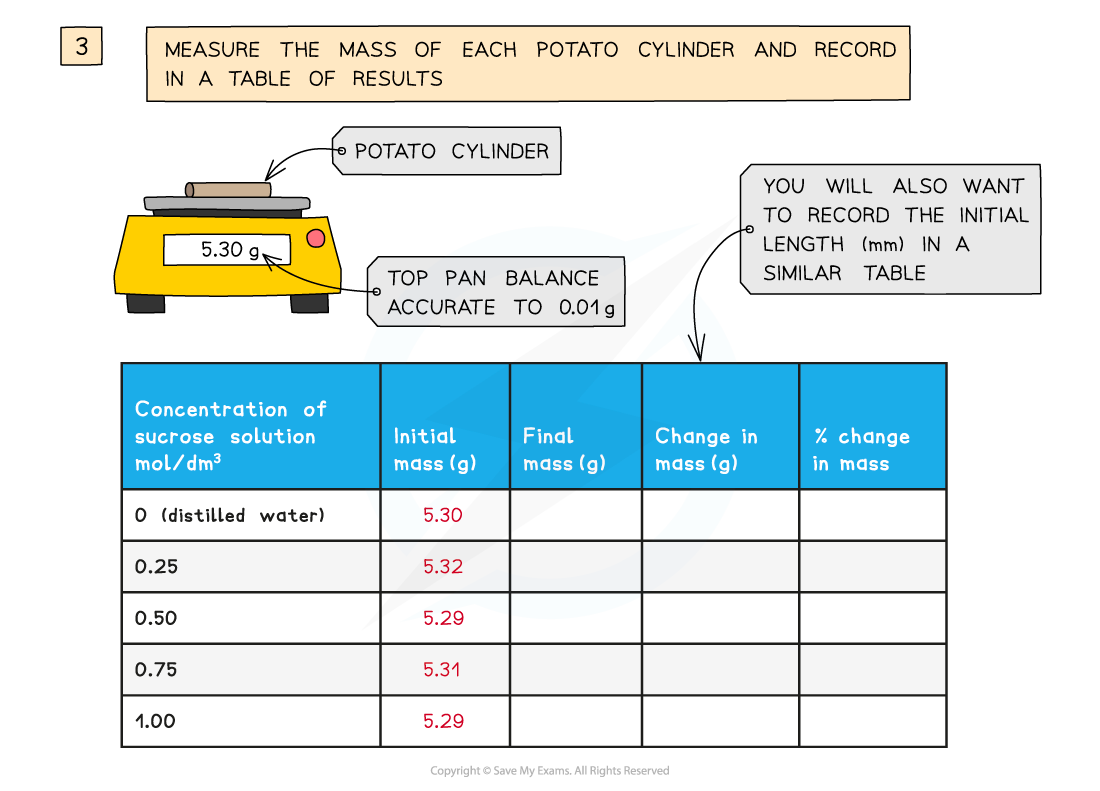
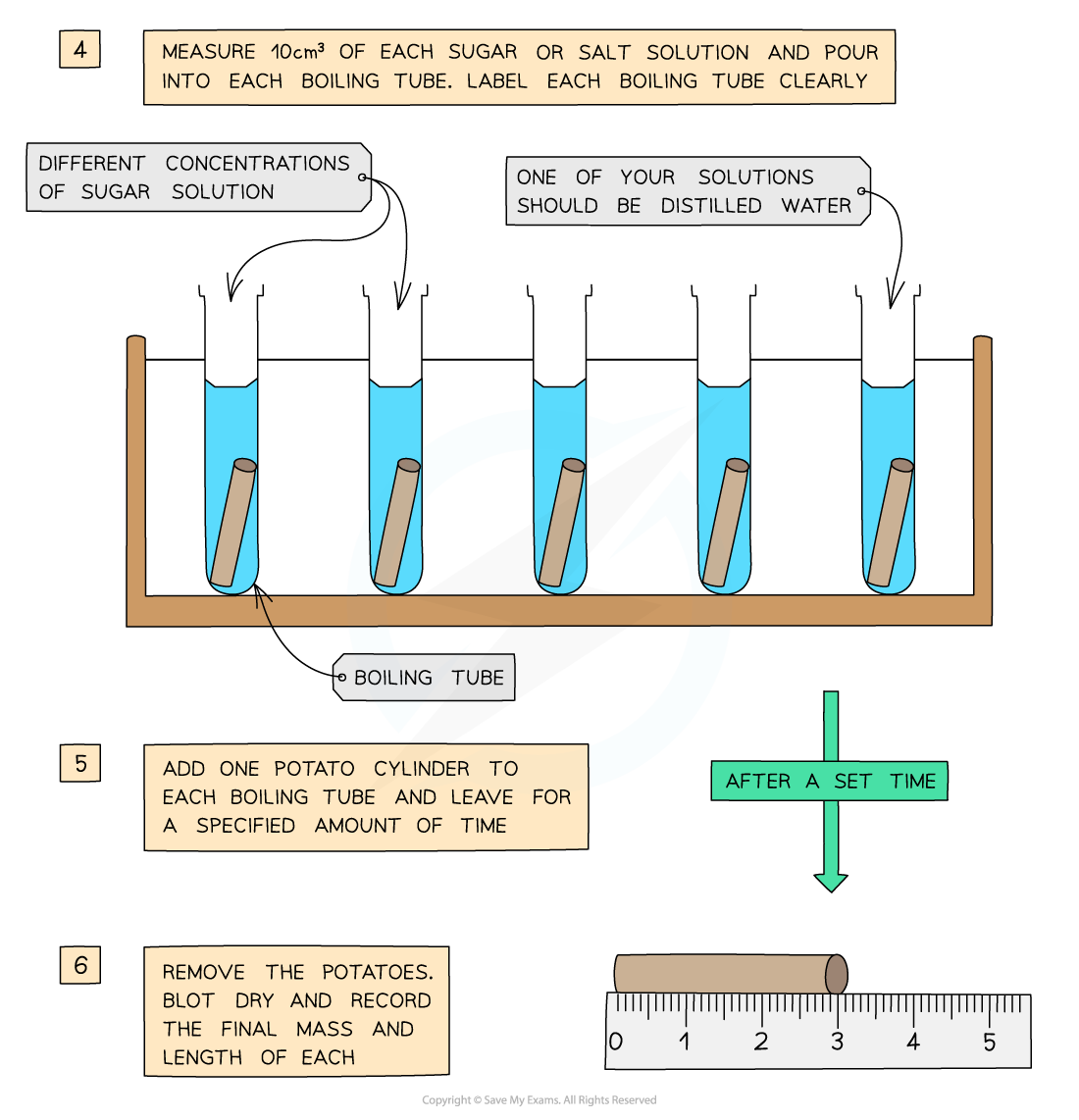
You will need to use apparatus appropriately to measure out the volumes of your solutions and record your measurements
Analysis
- The?percentage change?in mass for each potato cylinder is calculated
- If there is a potato cylinder that has neither increased nor decreased in mass, it means there was?no overall net movement of water?into or out of the potato cells
- This is because the solution that this particular potato cylinder was in had the?same water potential?as the solution found in the cytoplasm of the potato cells, so there was?no concentration gradient?and therefore no net movement of water into or out of the potato cells
- The concentration of sucrose inside the potato cylinders can be found if a graph is drawn showing how the percentage change in mass changes with the concentration of sucrose solution –?the point at which the line of best fit crosses the x-axis is the concentration of sucrose inside the potato cylinders
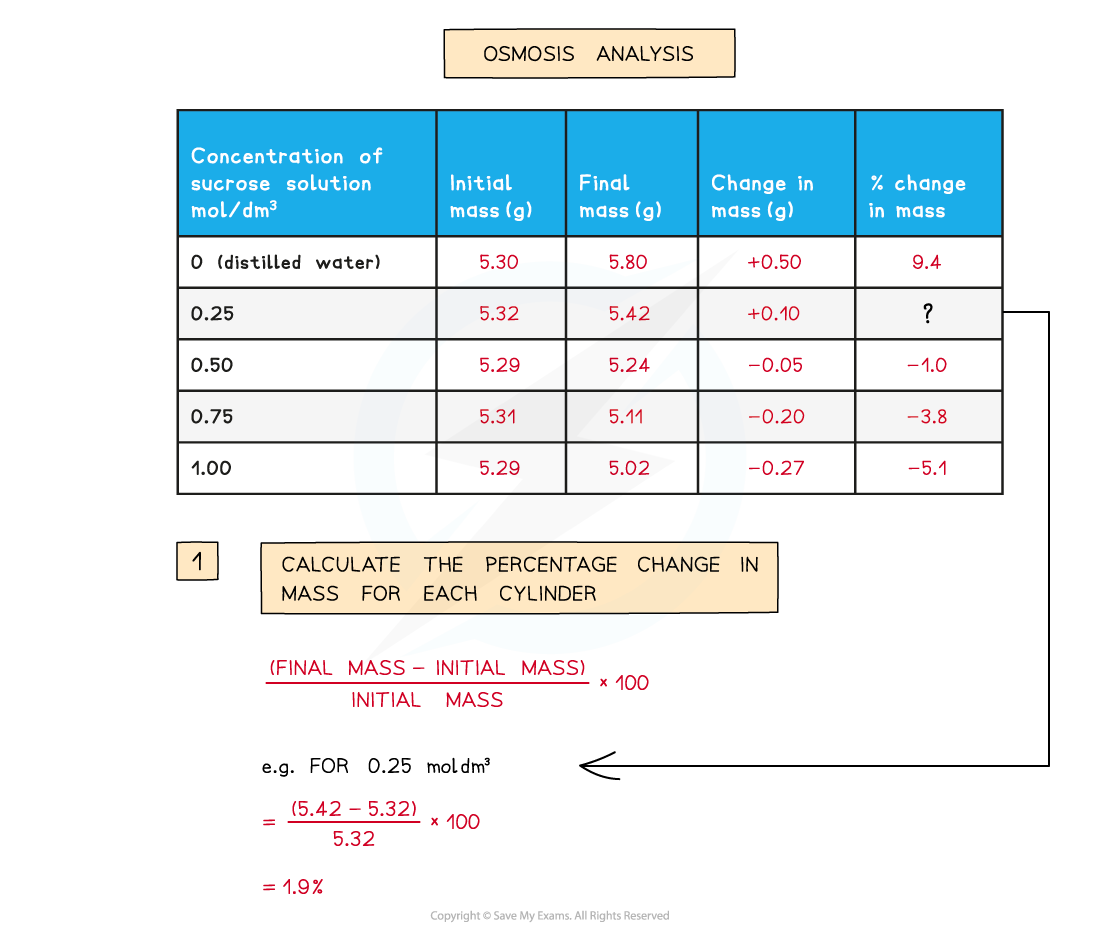
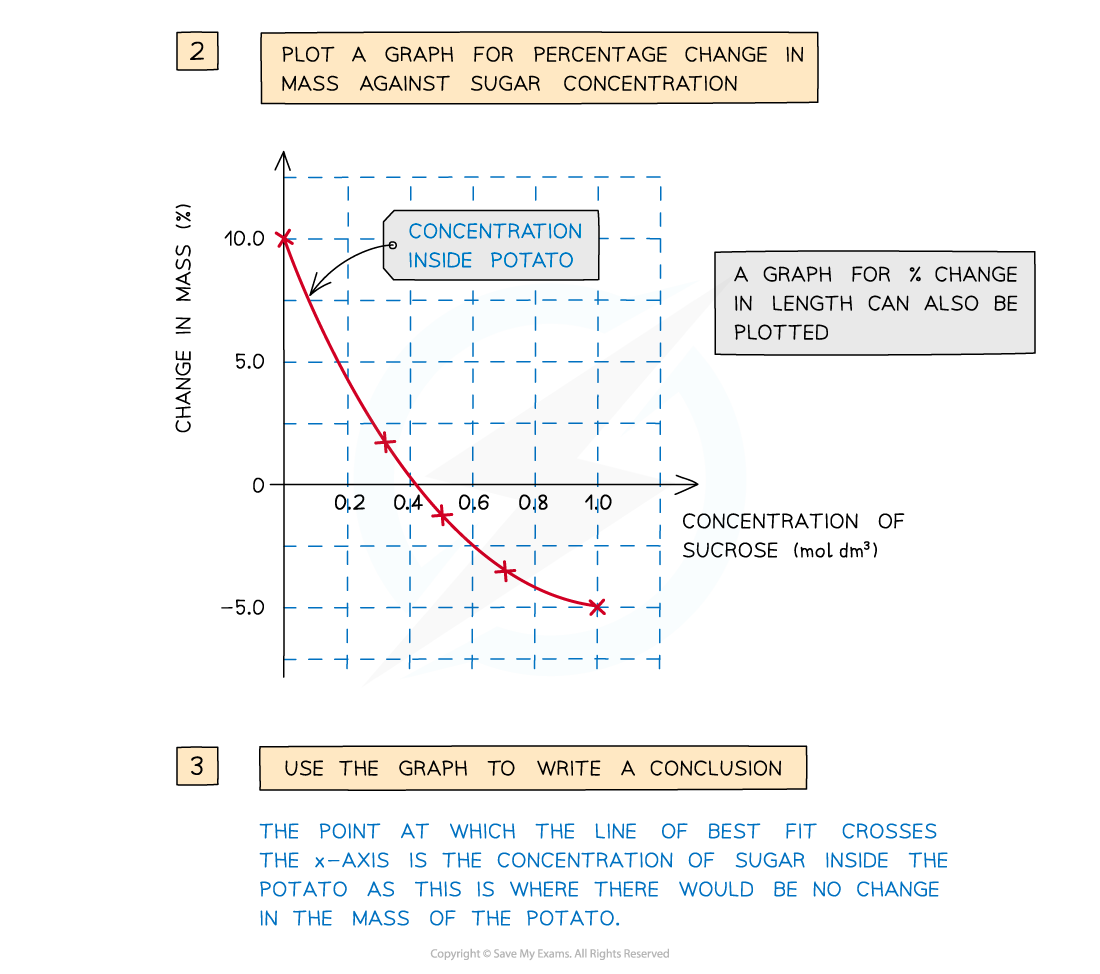
A positive percentage change in mass indicates that the potato has gained water by osmosis (net movement of water from the solution into the potato) meaning the solution had a higher water potential than the potato. A negative percentage change suggests the opposite
- A?positive?percentage change in mass indicates that the potato has gained water by osmosis (net movement of water from the solution into the potato) meaning the?solution?had a?higher water potential?than the potato
- This would make the potato cells?turgid,?as the water exerts turgor pressure (or hydrostatic pressure) on the cell walls – the potatoes will feel hard
- A?negative?percentage change suggests the opposite, that is, the solution had a?lower?water potential than the potato
- The potato cylinder in the?strongest sucrose concentration?will have?decreased in mass?the most as there is the?greatest concentration gradient?in this tube between the potato cells (higher water potential) and the sucrose solution (lower water potential)
- This means more water molecules will move out of the potato cells by?osmosis, making them?flaccid?and decreasing the mass of the potato cylinder – the potato cylinders will feel floppy
- If looked at underneath the microscope, cells from this potato cylinder might be?plasmolysed, meaning the cell membrane has pulled away from the cell wall
Exam Tip
Questions involving osmosis experiments are common and you should be able to use your knowledge of osmosis to explain the results obtained. If describing or analysing an experiment remember to include mention of variables that need to be controlled and mention repeats, as this helps determine the reliability of the results obtained.Don’t worry if it is an experiment you haven’t done – simply figure out where the higher concentration of water molecules is – this is the solution with the higher water potential – and explain which way the molecules move due to the differences in water potential.
轉(zhuǎn)載自savemyexams
以上就是關(guān)于【CIE A Level Biology復(fù)習(xí)筆記4.2.9 Estimating Water Potential in Plants】的解答,如需了解學(xué)校/賽事/課程動態(tài),可至翰林教育官網(wǎng)獲取更多信息。
往期文章閱讀推薦:
2026 ALEVEL 夏考A率出爐!愛德思vs牛津AQA,哪些科目真的“好出分”?
2026 AMC10/12美國數(shù)學(xué)競賽新賽季!【翰林教育 × 清華大學(xué)出版社】獨家教材全面發(fā)售!


翰林AMC8視頻課重磅上線!

國際競賽真題資源免費領(lǐng)取






