CIE A Level Biology復習筆記2.3.4 Globular & Fibrous Proteins

Proteins: Globular & Fibrous
Globular
- Globular proteins?are?compact, roughly?spherical?(circular) in shape and?soluble?in water
- Globular proteins form a spherical shape when folding into their tertiary structure because:
- their?non-polar hydrophobic R groups?are orientated towards the?centre?of the protein away from the aqueous surroundings and
- their?polar hydrophilic R groups?orientate themselves on the?outside?of the protein
- This orientation enables globular proteins to be (generally)?soluble?in water as the water molecules can surround the?polar hydrophilic R groups
- The?solubility?of globular proteins in water means they play important?physiological?roles as they can be easily?transported?around organisms and be involved in?metabolic reactions
- The folding of the protein due to the interactions between the R groups results in globular proteins having?specific shapes. This also enables globular proteins to play physiological roles, for example,?enzymes?can catalyse specific reactions and?immunoglobulins?can respond to specific antigens
- Some globular proteins are?conjugated?proteins that contain a?prosthetic?group eg. haemoglobin which contains the prosthetic group called haem
Fibrous
- Fibrous proteins?are long strands of polypeptide chains that have cross-linkages due to hydrogen bonds
- They have little or no tertiary structure
- Due to the large number of?hydrophobic R groups?fibrous proteins are?insoluble?in water
- Fibrous proteins have a limited number of amino acids with the sequence usually being highly repetitive
- The highly repetitive sequence creates very organised structures that are strong and this along with their insolubility property, makes fibrous proteins very suitable for structural roles, for example, keratin that makes up hair, nails, horns and feathers and collagen which is a connective tissue found in skin, tendons and ligaments
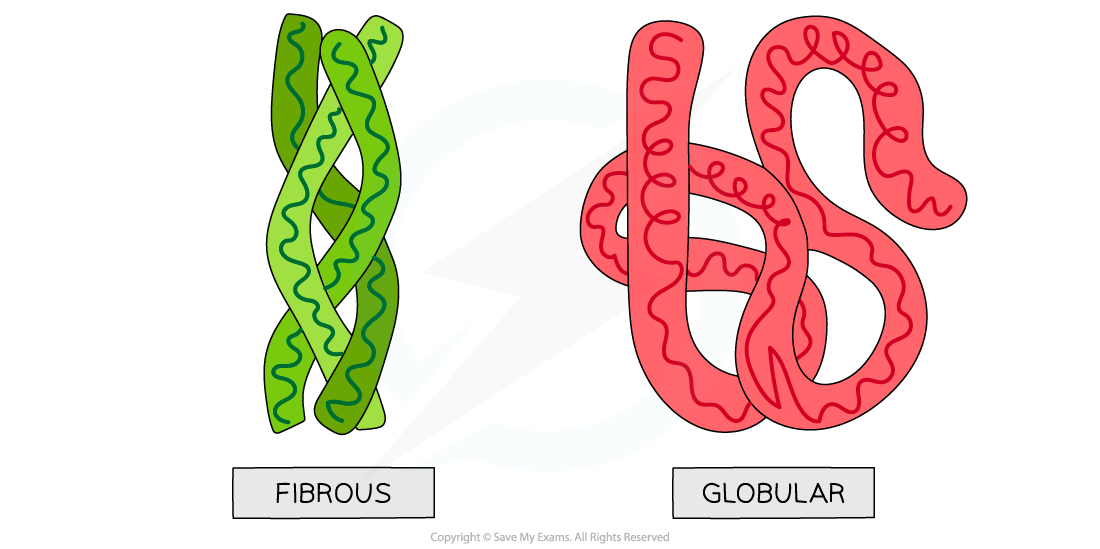
Globular and fibrous protein models illustrating the roughly spherical shape of globular proteins and the long, stranded shape of fibrous proteins
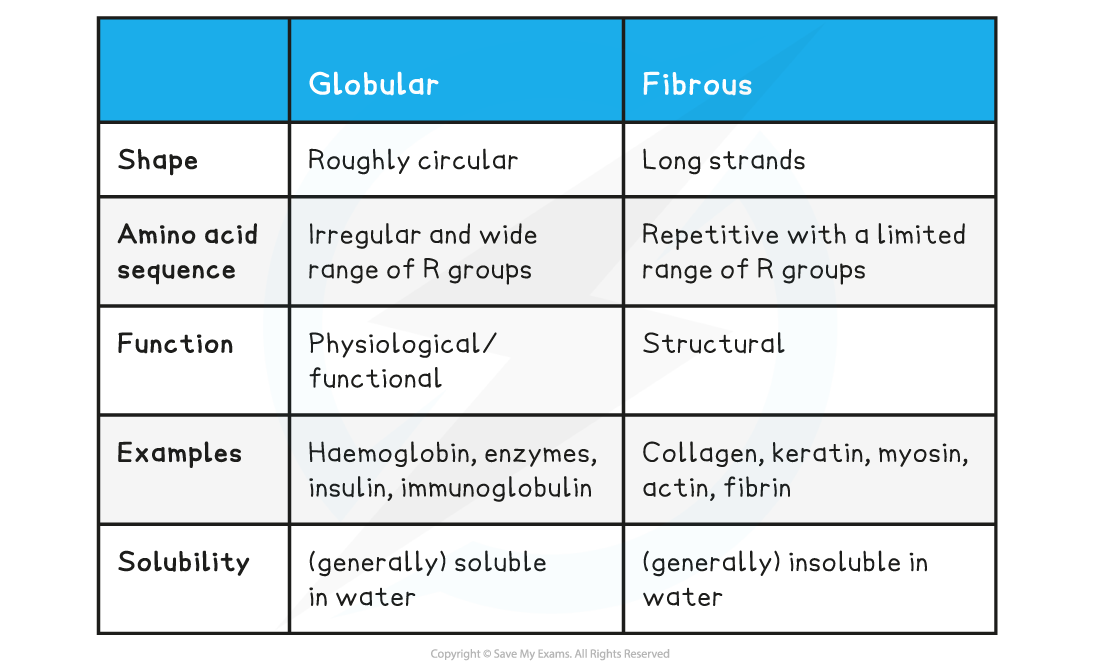
Comparison of Globular & Fibrous Tertiary Proteins Table
Exam Tip
To distinguish between the two proteins, learn?SAFES?(Shape,?Amino acid sequence,?Function,?Examples and?Solubility).
轉載自savemyexams
以上就是關于【CIE A Level Biology復習筆記2.3.4 Globular & Fibrous Proteins】的解答,如需了解學校/賽事/課程動態,可至翰林教育官網獲取更多信息。
往期文章閱讀推薦:
2026 ALEVEL 夏考A率出爐!愛德思vs牛津AQA,哪些科目真的“好出分”?
2026 AMC10/12美國數學競賽新賽季!【翰林教育 × 清華大學出版社】獨家教材全面發售!


翰林AMC8視頻課重磅上線!

國際競賽真題資源免費領取






