IB DP Physics: SL復(fù)習(xí)筆記4.3.2 Amplitude & Intensity

Amplitude & Intensity
Intensity
- The?intensity?of a wave is defined as follows:
Power per unit area
- Intensity is measured in?W m–2
- Power is defined as:
The rate of energy transfer
- Therefore, intensity can also be defined as:
The rate of energy transfer per unit area
- For spherical waves being emitted by a point source equally in all directions, the intensity follows an?inverse square law with distance from the point source
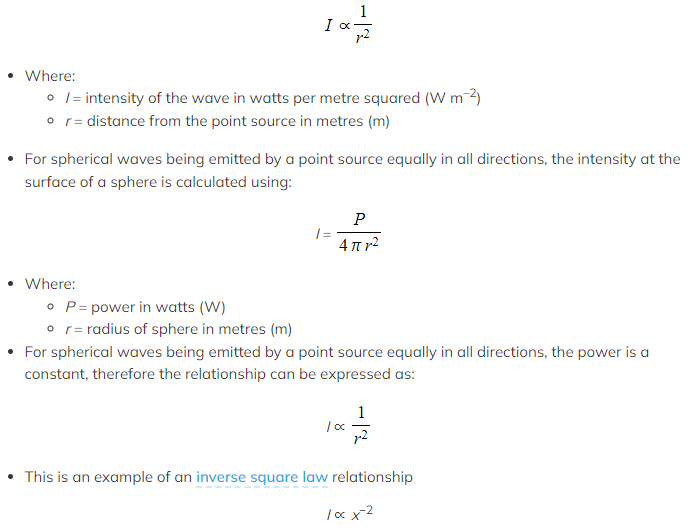
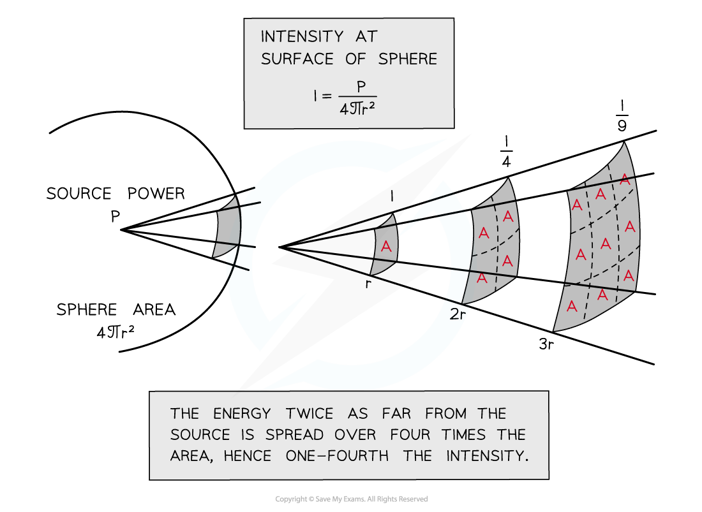
Intensity decreases by the inverse square law
Intensity Variation with Amplitude
- By definition, the intensity of a wave (its power per unit area) is proportional to the?energy?transferred?by the wave
- The intensity of a wave at a particular point is related to the amplitude of the wave at that point
- The energy transferred by a wave is proportional to the square of the?amplitude
- Therefore, the?intensity?of a wave is proportional?to?the?square?of the amplitude
 Where:
- I?= intensity of the wave in?W m–2
- A?= amplitude of the wave in metres (m)
Worked Example
A person stands 10 m away from a loudspeaker. The sound produced by the loudspeaker is very loud, so the person moves 20 m away from it.
State the effect of this change on the intensity and the amplitude of the sound waves heard by the person.
Step 1: Write down the known quantities
-
- Original distance,?r1?= 10 m
- New distance,?r2?= 20 m
Step 2: Write down the relationship between the intensity of a wave and the distance from the point source producing the wave

Step 2: State the new intensity
-
- Since the distance doubles (r2?= 2r1), the intensity is reduced by a factor four

Step 3: Write down the relationship between the intensity of a wave and its amplitude

Step 4: State the new amplitude
-
- Since the intensity is reduced by a factor four, the amplitude decreases by half

轉(zhuǎn)載自savemyexams
以上就是關(guān)于【IB DP Physics: SL復(fù)習(xí)筆記4.3.2 Amplitude & Intensity】的解答,如需了解學(xué)校/賽事/課程動態(tài),可至翰林教育官網(wǎng)獲取更多信息。
往期文章閱讀推薦:
斯坦福大學(xué)官方推薦書單!名校學(xué)霸們暑假都在讀什么?
MIT官方發(fā)布【2026年夏季推薦閱讀書單】!橫跨科學(xué)/人文/經(jīng)濟...


翰林AMC8視頻課重磅上線!

國際競賽真題資源免費領(lǐng)取






