IB DP Physics: SL復習筆記2.4.4 Collisions & Explosions

Collisions & Explosions
- In both collisions and explosions,?momentum is always conserved
- However,?kinetic energy?might not always be
- A collision (or explosion) is either:
- Elastic?– if the kinetic energy?is?conserved
- Inelastic?– if the kinetic energy is?not?conserved
- Collisions are when objects strike against each other
- Elastic?collisions are commonly those where objects colliding do not stick together and then?move in opposite directions
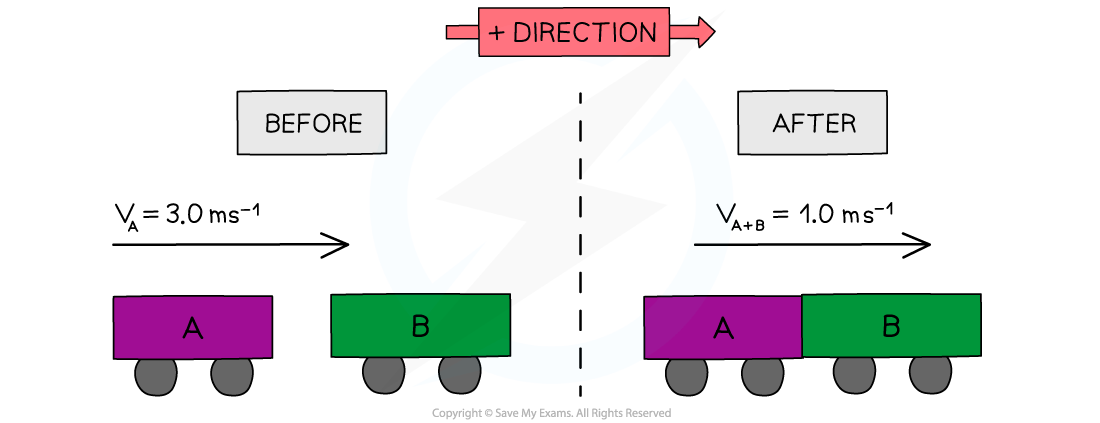
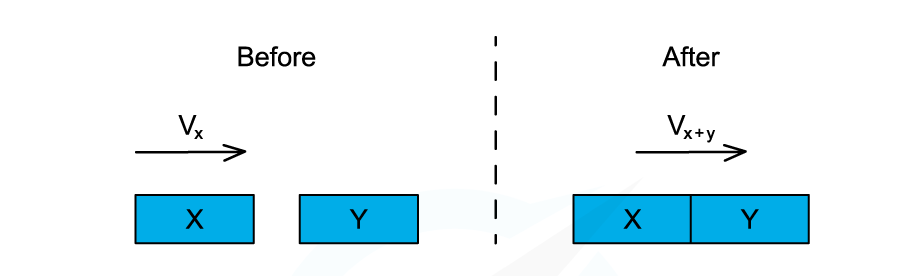
- Inelastic?collisions are commonly those where objects collide and?stick together?after the collision
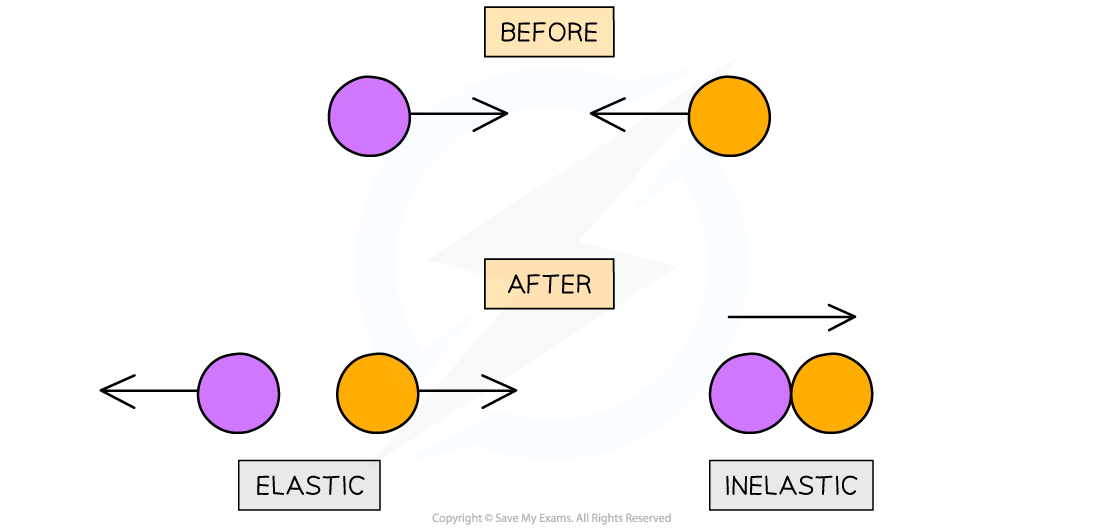
Elastic collisions are where two objects move in opposite directions. Inelastic collisions are where two objects stick together
- An explosion is commonly to do with?recoil
- For example, a gun recoiling after shooting a bullet or an unstable nucleus emitting an alpha particle and a daughter nucleus
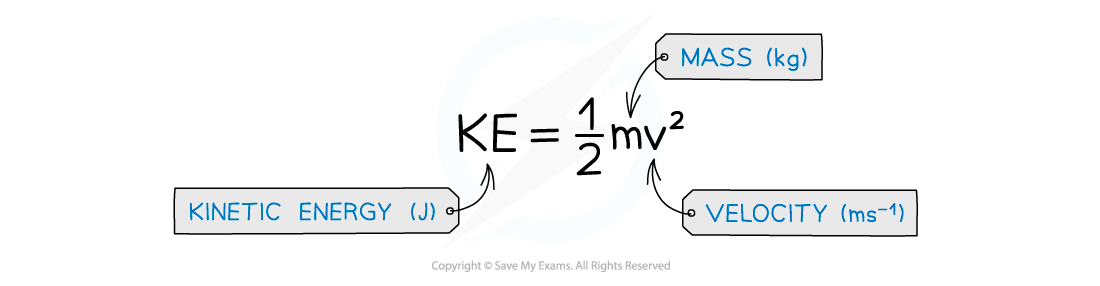
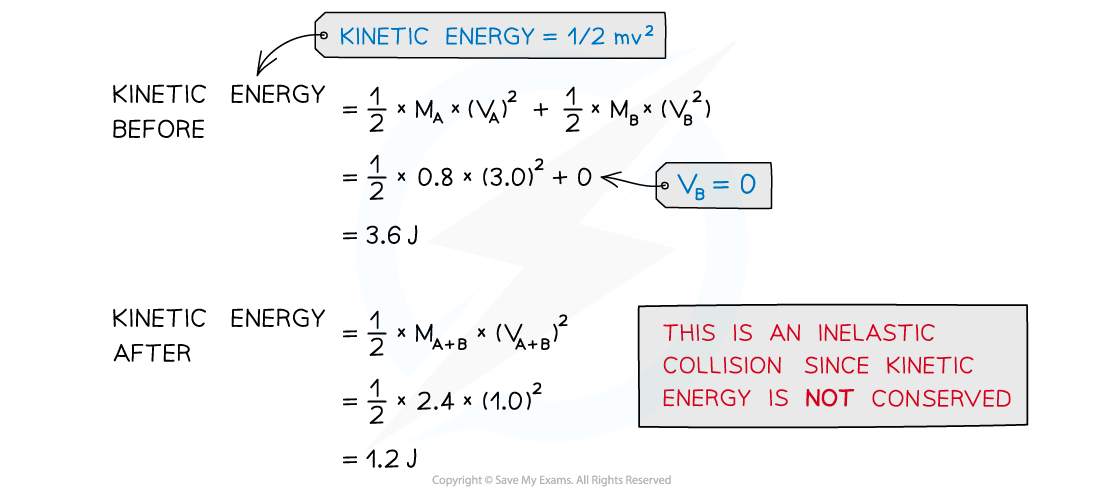
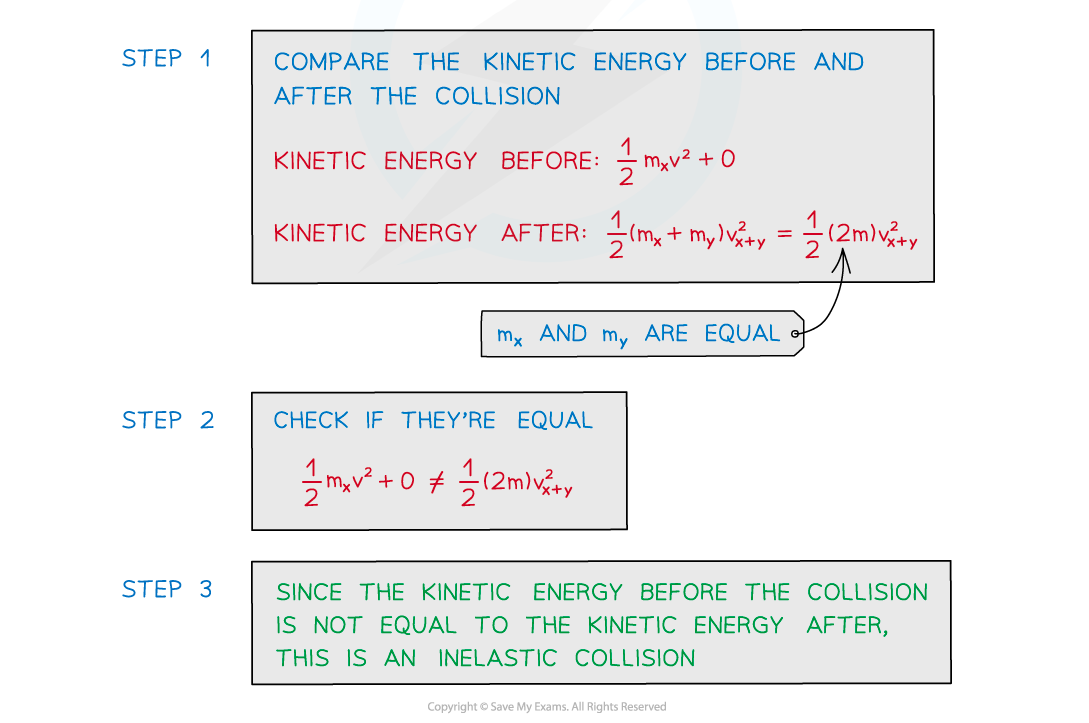
- To find out whether a collision is elastic or inelastic,?compare the kinetic energy before and after the collision
- The equation for kinetic energy is:
Worked Example
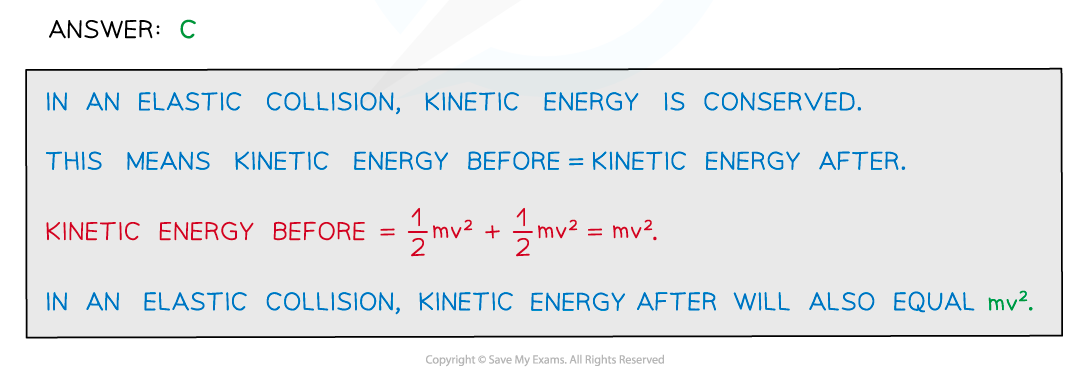
Two similar spheres, each of mass?m?and velocity?v?are travelling towards each other. The spheres have a head-on elastic collision.What is the total kinetic energy after the impact?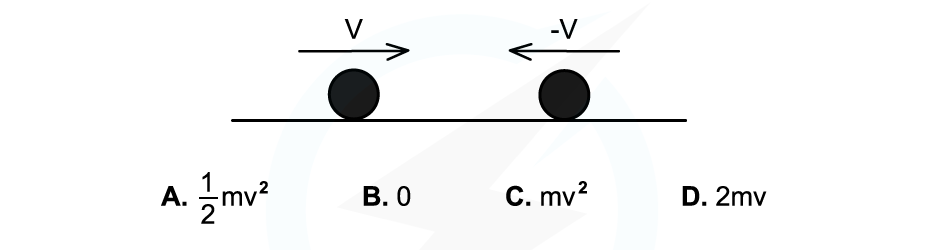
Worked Example
Trolley?A?of mass 0.80 kg collides head-on with stationary trolley?B?at speed 3.0 m s–1. Trolley?B?has twice the mass of trolley?A.The trolleys stick together and travel at a velocity of 1.0 m s–1.Determine whether this is an elastic or inelastic collision.
Exam Tip
If an object is stationary or at rest, its velocity equals?0, therefore, the momentum and kinetic energy are also equal to 0When a collision occurs in which two objects are stuck together, treat the final object as a single object with a mass equal to the?sum?of the two individual objectsDespite velocity being a vector, kinetic energy is a scalar quantity and therefore will?never?include a minus sign - this is because in the kinetic energy formula, mass is scalar and the?v2?will always give a positive value whether its a negative or positive velocity
Applying Conservation of Momentum
- The principle of conservation of momentum can be used to solve various types of problems for isolated systems such as problems involving:
- Collisions
- Fluid jets
- Conveyor belts
- Explosions & many more
- Kinetic energy can also be used to check if a collision is elastic or inelastic
- In elastic collisions, momentum and kinetic energy are conserved
- In inelastic collisions, momentum is conserved, but kinetic energy is not
- Inelastic includes explosions
Worked Example
Two trolleys?X?and?Y?are of equal mass. Trolley?X?moves towards trolley?Y?which is initially stationary. After the collision, the trolleys join and move off together.Show that this collision is inelastic.
Worked Example
A 2 kg crossbow is fired and a 100 g arrow is fired horizontally. The arrow is released from the crossbow at 40 m s?1.Determine the magnitude of the recoil velocity of the crossbow.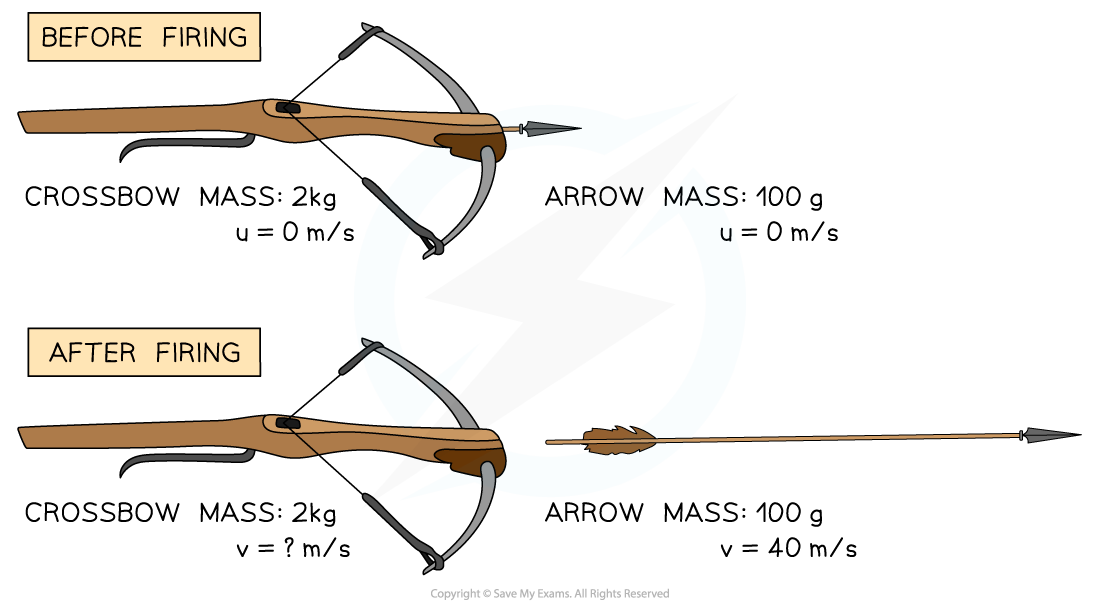
Step 1: List the known quantities
-
- Mass of the crossbow: 2 kg
- Mass of the arrow: 100 g = 0.1 kg
- Speed of arrow during release: 40 m s?1
Step 2: Determine the momentum before release
-
- Since before release neither the arrow nor the crossbow was moving, their momentum together is?0 kg m s?1
Step 3: Determine the momentum of the arrow
-
- The momentum of the arrow can be found from the equation:
p = m × v
parrow?=?0.1?×?40 = 4 kg m s?1
Step 4: Determine the recoil velocity of the crossbow
-
- The arrow has a momentum of 4 kg m s?1?and the system had a total momentum of 0 kg m s?1?before the collision
- Therefore, the crossbow must have a momentum of 4 kg m s?1?in the opposite direction to the arrow
- Therefore:
pcrossbow?= m × v
pcrossbow?÷ m = v
v?= 4?÷?2?=?2 m/s in opposite direction to arrow
Step 5: State the final answer
-
- The magnitude of the recoil velocity of the crossbow is?2 m s?1.
轉載自savemyexams
以上就是關于【IB DP Physics: SL復習筆記2.4.4 Collisions & Explosions】的解答,如需了解學校/賽事/課程動態,可至翰林教育官網獲取更多信息。
往期文章閱讀推薦:
MIT官方發布【2026年夏季推薦閱讀書單】!橫跨科學/人文/經濟...


翰林AMC8視頻課重磅上線!

國際競賽真題資源免費領取






