IB DP Chemistry: SL復(fù)習(xí)筆記8.2.2 pH & [H?]

pH & [H?]
- The acidity of an aqueous solution depends on the number of?H+?(H3O+) ions in solution
- The?pH?is defined as:

-
- where [H+] is the concentration of H+?in mol dm–3
- The pH scale is a logarithmic scale with base 10
- This means that each value is 10 times the value below it. For example, pH 5 is 10 times more acidic than pH 6.
- pH values are usually given to 2 decimal places
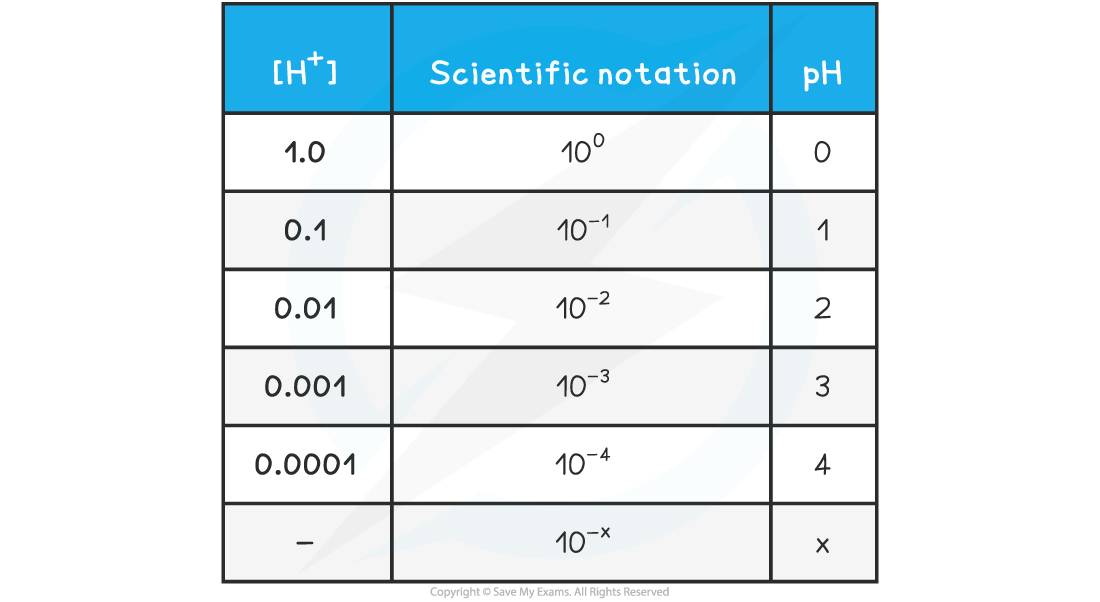
- The relationship between concentration is easily seen on the following table:
pH & [H+] Table
Worked Example
10.0 cm3?of an aqueous solution of nitric acid of pH = 1.0 is mixed with 990.0 cm3?of distilled water. What is the pH of the final solution?
A.??1
B.??2
C.??3
D.??10
Answer:
The correct option is?C.
-
- The total volume after dilution is 1000.0 cm3?so the concentration of H+?has been?reduced?by a factor of 100 or 10-2, which means an increase of 2 pH units
- The final solution is therefore?pH 3
Exam Tip
Make sure you know how to use the antilog (base 10) feature on your calculator. On most calculators it is the 10x?button, but on other models it could be LOG-1, ALOG or even a two-button sequence such as INV + LOG
轉(zhuǎn)載自savemyexams
以上就是關(guān)于【IB DP Chemistry: SL復(fù)習(xí)筆記8.2.2 pH & [H?]】的解答,如需了解學(xué)校/賽事/課程動態(tài),可至翰林教育官網(wǎng)獲取更多信息。
往期文章閱讀推薦:
斯坦福大學(xué)官方推薦書單!名校學(xué)霸們暑假都在讀什么?
MIT官方發(fā)布【2026年夏季推薦閱讀書單】!橫跨科學(xué)/人文/經(jīng)濟(jì)...


翰林AMC8視頻課重磅上線!

國際競賽真題資源免費領(lǐng)取






