IB DP Chemistry: SL復(fù)習(xí)筆記1.2.7 Standard Solutions

Concentrations of Solutions
Standard solutions
- Chemists routinely prepare solutions needed for analysis, whose concentrations are known precisely
- These solutions are termed?standard solutions
- They are made as accurately and precisely as possible using three decimal place balances and volumetric flasks to reduce the impact of measurement uncertainties
- The steps are:
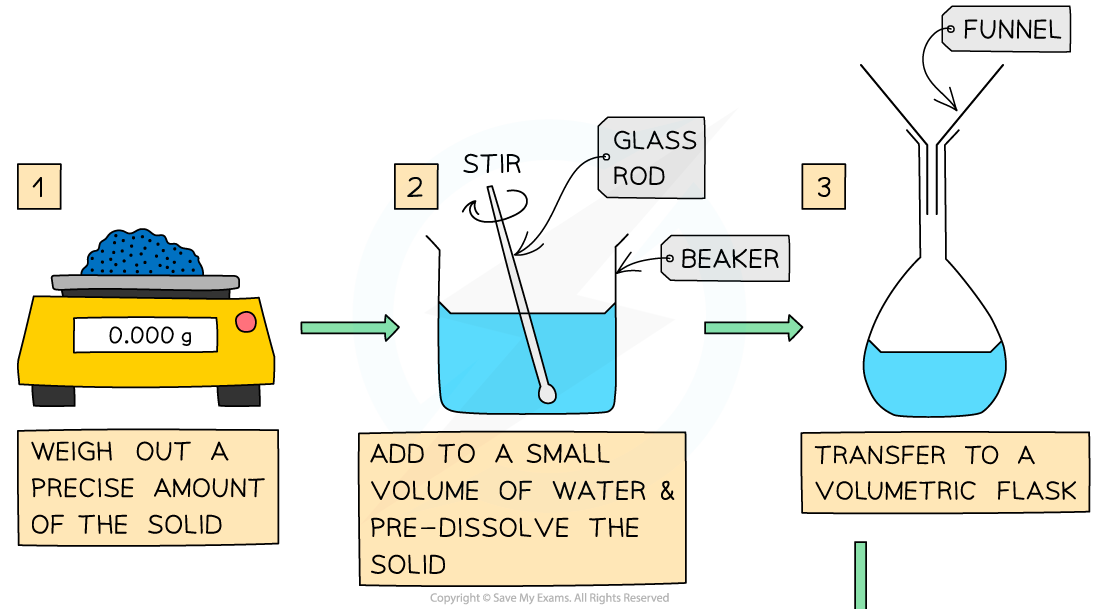
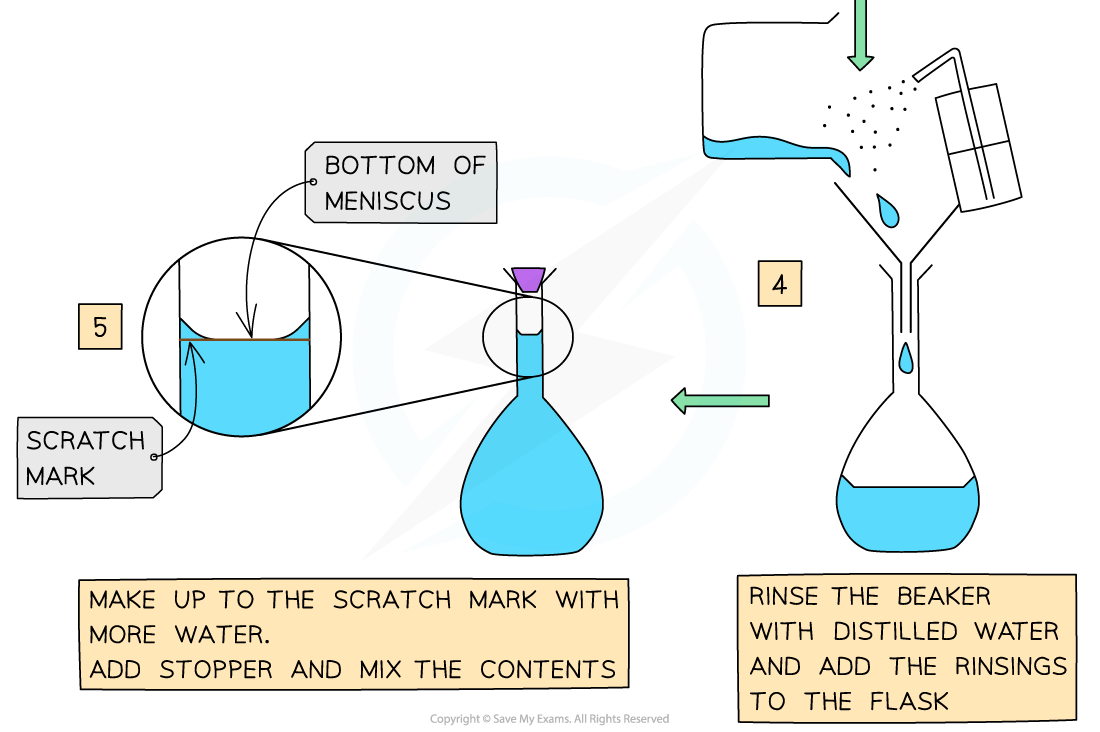
Volumes & concentrations of solutions
- The?concentration?of a solution is the amount of?solute?dissolved in a?solvent?to make 1 dm3?of??solution
- The solute is the substance that dissolves in a solvent to form a solution
- The solvent is often water
- A?concentrated?solution is a solution that has a?high?concentration of solute
- A?dilute?solution is a solution with a?low?concentration of solute
- Concentration is usually expressed in one of three ways:
- moles per unit volume
- mass per unit volume
- parts per million
Moles per unit volume
- The formula for expressing concentration using moles is:

- You must make sure you change cm3?to dm3??(by dividing by 1000)
- The relationships can be expressed using this formula triangle:
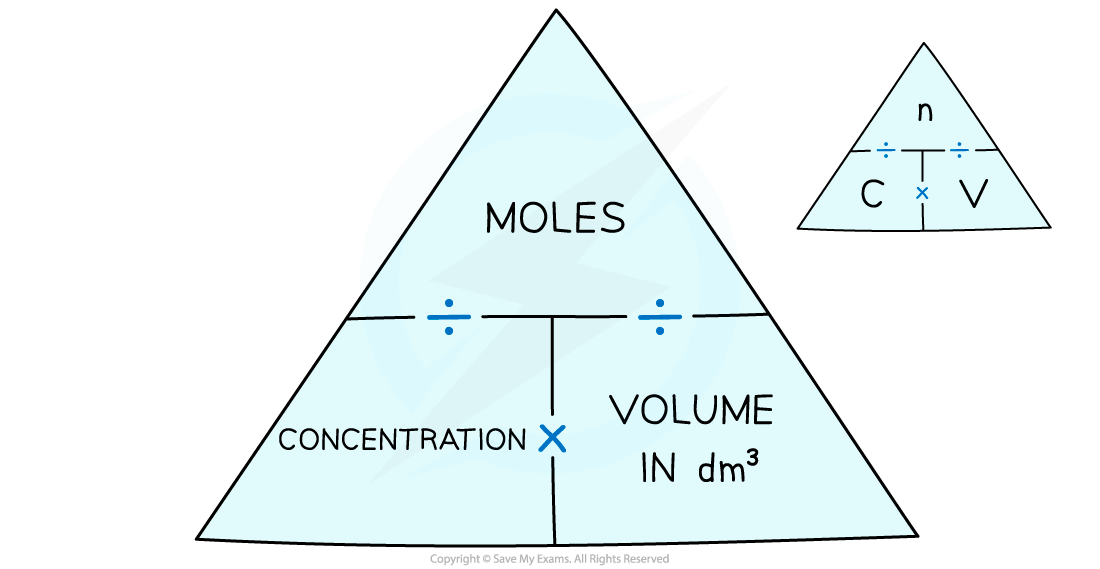
To use the concentration formula triangle cover the one you want to find out about with your finger and follow the instructions
Worked Example
Calculate the mass of sodium hydroxide, NaOH, required to prepare 250 cm3?of a 0.200 mol dm-3 solution
Answer:
Step 1: Use the formula triangle to find the number of moles of NaOH needed
number of moles? =?concentration (mol dm-3)?x?volume (dm3)??
n = 0.200?mol dm-3?x 0.250?dm3
n =?0.0500 mol
Step 2:?Find the molar mass of NaOH
M?= 22.99 + 16.00 + 1.01 = 40.00 g mol-1
Step 3: Calculate the mass required
mass = moles x molar mass
mass =? 0.0500 mol x 40.00 g mol-1?? =?2.00 g
Mass per unit volume
- Sometimes it is more convenient to express concentration in terms of mass per unit volume
- The formula is:

- To change a concentration from mol dm-3?to g dm-3
- Multiply the moles of solute by its molar mass
mass of solute (g) = number of moles (mol) x molar mass (g mol-1)
Parts per million
- When expressing extremely low concentrations a unit that can be used is?parts per million?or?ppm
- This is useful when giving the concentration of a pollutant in water or the air when the absolute amount is tiny compared the the volume of water or air
- 1 ppm?is defined as
- A mass of?1 mg?dissolved in?1 dm3?of water
- Since 1 dm3?weighs 1 kg we can also say it is
- A mass of?1 mg?dissolved in?1 kg?of water, or 10-3?g in 103?g which is the same as saying the concentration is?1 in?106?or?1 in a million
Worked Example
The concentration of chlorine in a swimming pool should between between 1 and 3 ppm. Calculate the maximum mass, in kg, of chlorine that should be present in an olympic swimming pool of size 2.5 million litres.
Answer:
Step 1: calculate the total mass in mg assuming 3ppm(1 litre is the same as 1 dm3)
3 x 2.5 x 106?= 7.5 x 10⁶?mg
Step 2: convert the mass into kilograms (1 mg = 10-6?kg)
7.5 x 10⁶??x 10-6??kg =?7.5 kg
轉(zhuǎn)載自savemyexams
以上就是關(guān)于【IB DP Chemistry: SL復(fù)習(xí)筆記1.2.7 Standard Solutions】的解答,如需了解學(xué)校/賽事/課程動態(tài),可至翰林教育官網(wǎng)獲取更多信息。
往期文章閱讀推薦:
斯坦福大學(xué)官方推薦書單!名校學(xué)霸們暑假都在讀什么?
MIT官方發(fā)布【2026年夏季推薦閱讀書單】!橫跨科學(xué)/人文/經(jīng)濟(jì)...


翰林AMC8視頻課重磅上線!

國際競賽真題資源免費(fèi)領(lǐng)取






