IB DP Biology: SL復習筆記6.1.3 Absorption

Methods of Absorption
- Digestion breaks down food into?smaller, soluble molecules
- These products of digestion then pass from the?lumen?of the intestine into the?blood
- They pass through the microvilli of the cell surface membrane and into the?epithelium cells
- Then they move through the cell surface membrane that separates the epithelium cells from the blood; into the?blood capillaries?and?lacteal?(lymph vessels within the villus)
- Different mechanisms are required in the process of absorption including?diffusion, active transport, exocytosis, and?facilitated diffusion
- Amino acids?and?monosaccharides?both use facilitated diffusion, active transport and?co-transport proteins?in order to move across the epithelial membrane
- Lipids?are absorbed in a different way using simple diffusion, facilitated diffusion and exocytosis
Absorption of amino acids
- Specific?amino acid co-transport proteins?(a type of carrier protein) are found within the cell-surface membrane of the?epithelial cells?lining?the ileum
- They transport amino acids only when there are?sodium ions?present
- For every sodium ion that is transported into the cell, an?amino acid is also transported in
- This occurs via?facilitated diffusion, which requires the movement of molecules?down their?concentration gradient
- Amino acids diffuse across the epithelial cell and then pass into the capillaries via?facilitated diffusion
- The concentration gradient of sodium ions from the lumen of the ileum into the epithelial cell is maintained by the?active transport of sodium ions?out of the cell and into the blood via a?sodium-potassium pump?at the capillary end of the cell
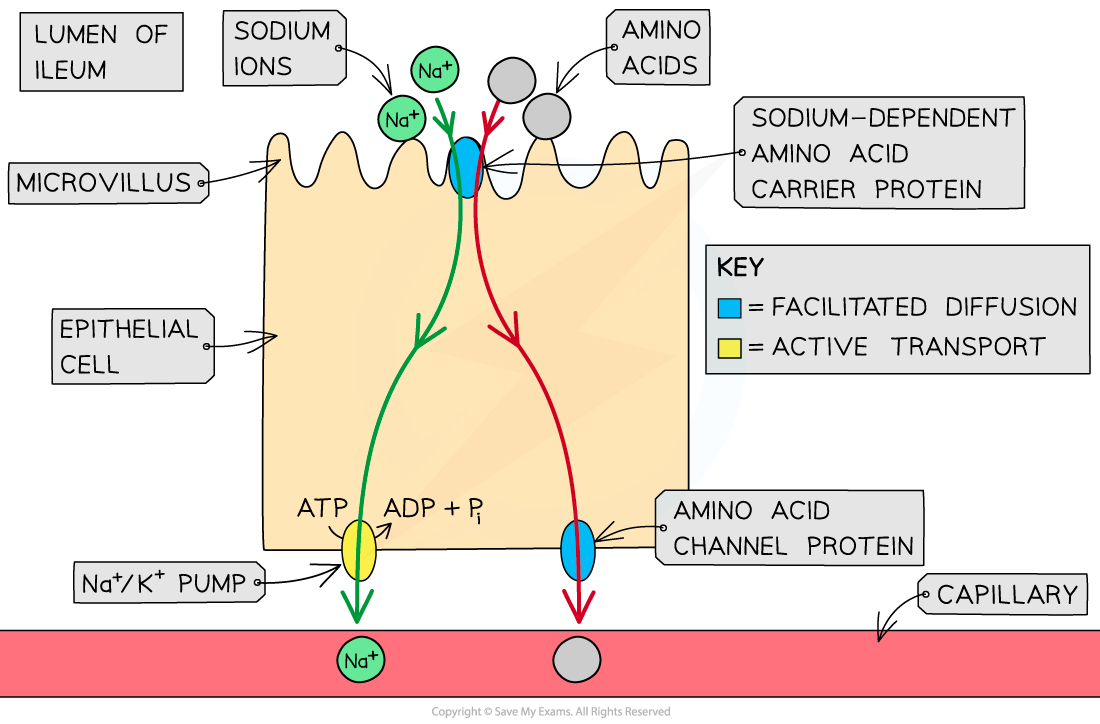
The co-transport of sodium ions and amino acids in the ileum. Both facilitated diffusion and active transport are involved in the process.
Absorption of monosaccharides
- Glucose is?polar?so cannot pass into the blood by diffusion
- The?glucose carrier proteins?in the cell-surface membrane of the small intestine work in a similar way to the amino acid carrier proteins
- Sodium ions and glucose molecules are co-transported?into the epithelial cells via?facilitated diffusion
- This is a?passive process?but depends on the?concentration gradient?of sodium ions from the lumen of the ileum into the epithelial cell
- The gradient is maintained by the?active transport of sodium ions?out of the cell and into the blood via a?sodium-potassium pump?at the capillary end of the cell
- The glucose molecules diffuse across the epithelial cell and enter the capillary by?facilitated diffusion?through a glucose channel protein
- Sodium ions and glucose molecules are co-transported?into the epithelial cells via?facilitated diffusion
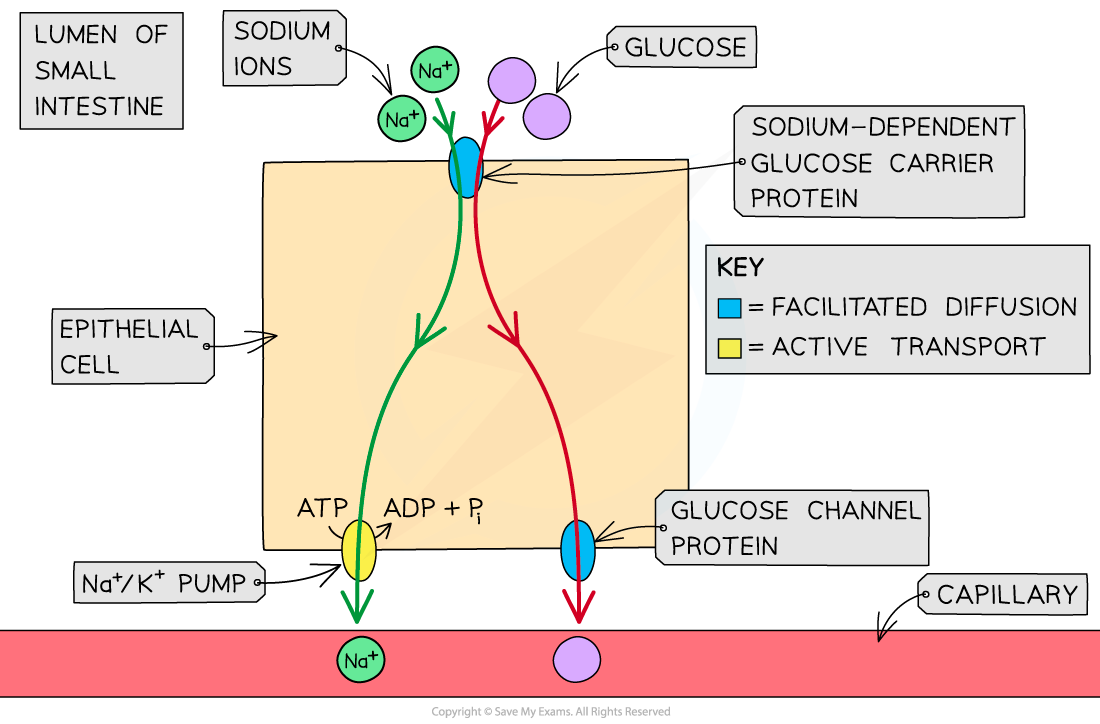
The co-transport of sodium ions and glucose in the small intestine. Both facilitated diffusion and active transport are involved in the process.
Absorption of lipids
- The products of lipid digestion are?fatty acids, monoglycerides,?and?glycerol
- Absorption of these products is?different?from the absorption of monosaccharides and amino acids
- Fatty acids?and?monoglycerides?can enter the epithelial cell by?simple?diffusion
- They are?non-polar?molecules so they can diffuse through the phospholipid bilayer of the cell surface membrane
- Fatty acids also move by?facilitated diffusion?through fatty acid transport proteins
- Inside the epithelial cell,?fatty acid chains?recombine with?monoglycerides?or?glycerol?to form?triglycerides,?which are unable to diffuse back into the lumen
- The?triglycerides?are packaged up with?cholesterol?and encased in phospholipids and proteins to form?lipoproteins
- These droplets then enter the?lacteal?or?capillaries?via?exocytosis
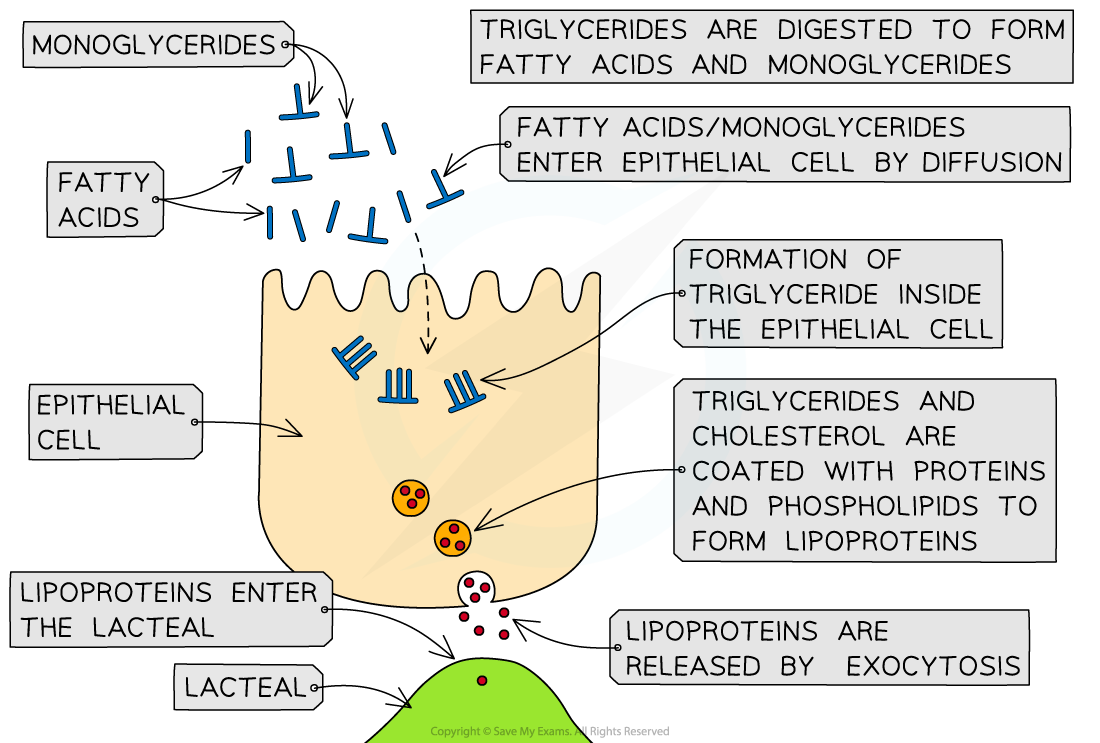
Lipids are absorbed in the small intestine through a combination of simple diffusion, facilitated diffusion and exocytosis
轉載自savemyexams
以上就是關于【IB DP Biology: SL復習筆記6.1.3 Absorption】的解答,如需了解學校/賽事/課程動態,可至翰林教育官網獲取更多信息。
往期文章閱讀推薦:
MIT官方發布【2026年夏季推薦閱讀書單】!橫跨科學/人文/經濟...


翰林AMC8視頻課重磅上線!

國際競賽真題資源免費領取






