IB DP Biology: SL復習筆記1.3.1 Phospholipid Bilayer Properties

Amphipathic Properties
Phospholipids
- Phospholipids form the basic structure of the membrane (the phospholipid bilayer)
- They are formed by a?hydrophilic?phosphate head?bonding with two?hydrophobic?hydrocarbon (fatty acid) tails
- As phospholipids have a?hydrophobic?and?hydrophilic?part they are known as?amphipathic
- The?phosphate head?of a phospholipid is?polar?(hydrophilic)?and therefore?soluble?in water
- The?fatty acid tail?of a phospholipid is?nonpolar?(hydrophobic) and therefore?insoluble?in water
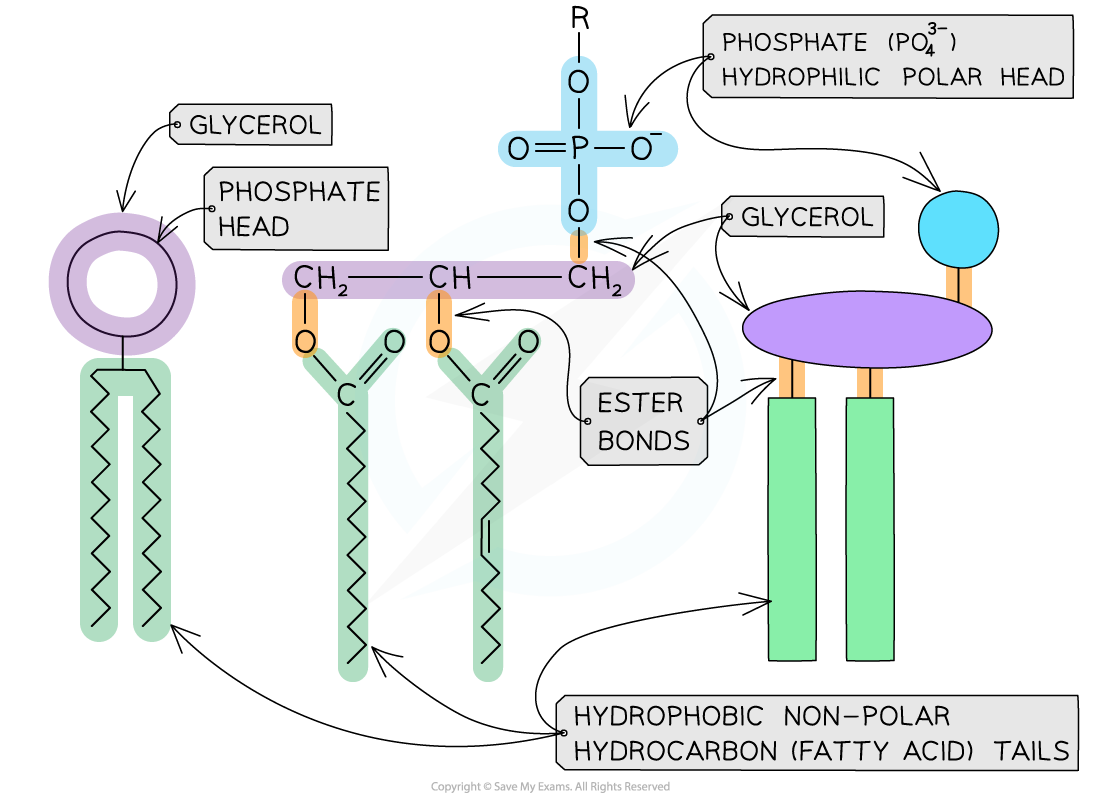
The generalised molecular structure of a phospholipid
- Due to their?amphipathic?properties, phospholipids display an?emergent property?when placed into water
- The?hydrophilic?phosphate heads orientate towards the water and the?hydrophobic?hydrocarbon tails orientate inwards (away from the water)
- They form a?phospholipid monolayer

A phospholipid monolayer
- If phospholipids are?mixed/shaken?with water they form spheres with the hydrophilic phosphate heads facing out towards the water and the hydrophobic fatty acid tails facing inwards
- This is called a?micelle
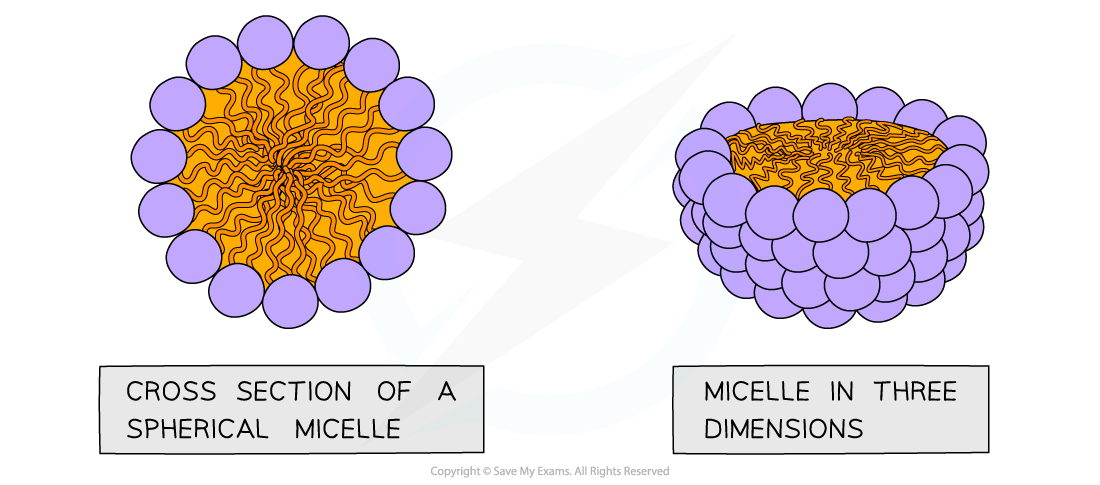
A micelle
- Alternatively, when there is a sufficient concentration of phospholipids present then two-layered structures may form
- These sheets are called?phospholipid bilayers?– this is the basic structure of the cell membrane
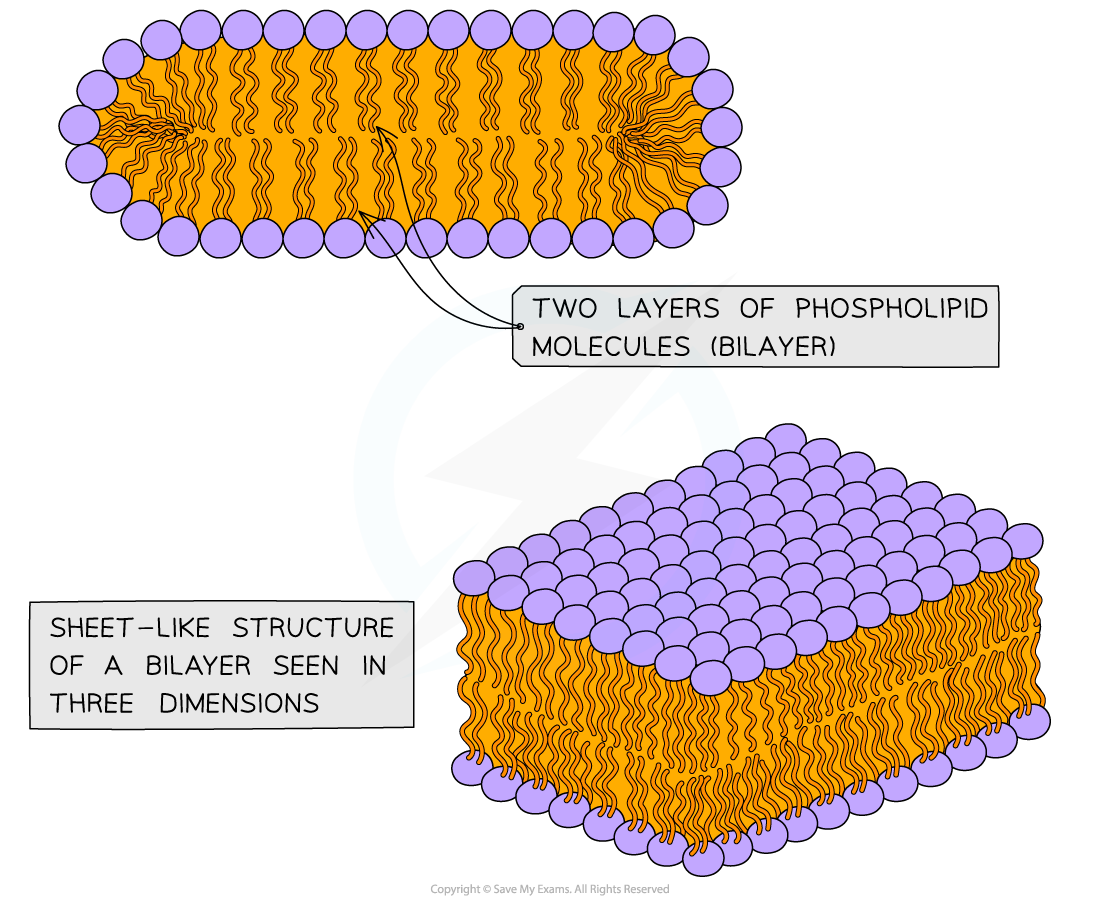
A phospholipid bilayer is composed of two layers of phospholipids; their hydrophobic tails facing inwards and hydrophilic heads outwards
- The two layers of phospholipids are loosely held together by?weak hydrophobic interactions?between the hydrocarbon tails allowing some membrane fluidity
- The amphipathic properties result in the phospholipid bilayer acting as a?barrier to most water-soluble substances?(the non-polar fatty acid tails prevent polar molecules or ions from passing across the membrane)
- This?ensures water-soluble molecules such as sugars, amino acids and proteins cannot leak out of the cell?and unwanted water-soluble molecules cannot get in
Animal Cell Membranes: Cholesterol
- Phospholipids?and?cholesterol?are the two main components of?animal?cell?plasma membranes (cholesterol is absent in plant membranes)
Cholesterol
- Cholesterol is a?lipid?that belongs to the?steroid?group
- It is?amphipathic, with the majority of the cholesterol molecule being?hydrophobic?and therefore?attracted?to the hydrophobic?hydrocarbon tails?of the phospholipid
- The?hydroxyl?group of the cholesterol molecule is?hydrophilic. It is attracted to the?phosphate heads?of the phospholipid
- Therefore in the plasma membrane cholesterol is positioned between phospholipids
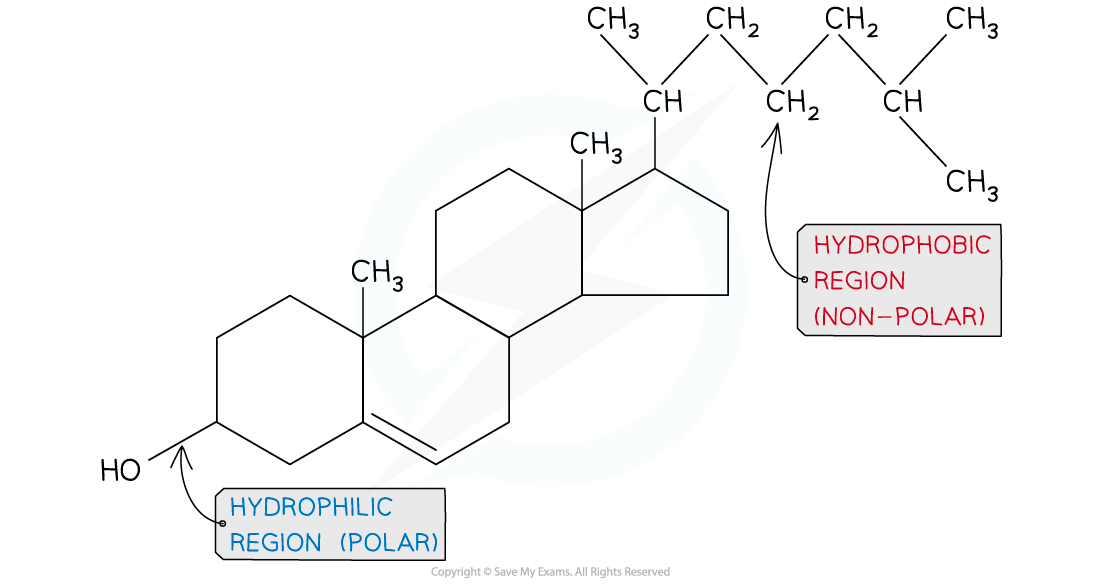
The molecular structure of cholesterol
Mammalian Membranes: Role of Cholesterol
- The?plasma membrane?is?fluid, meaning the components are free to move
- The fluidity of the membrane needs to be controlled:
- If it was too fluid the cell could not regulate what moved in and out
- If it was not fluid enough then the cell would not be able to move and substances would be unable to move into or out of the cell
- Cholesterol?helps with the?regulation?of the?membrane fluidity?and?permeability
- Interaction between cholesterol and phospholipid tails?stabilises the plasma membrane at higher temperatures?by stopping the membrane from becoming too fluid
- Cholesterol molecules bind to the hydrophobic tails of phospholipids, stabilising them and causing phospholipids to pack more closely together
- At?colder temperatures?cholesterol?increases?the fluidity of the membrane, stopping it crystallizing and becoming too rigid
- This occurs because cholesterol?stops the phospholipid tails packing too closely together
- The impermeability of the membrane to hydrophilic ions (e.g. sodium and hydrogen) is also reduced by cholesterol
- Interaction between cholesterol and phospholipid tails?stabilises the plasma membrane at higher temperatures?by stopping the membrane from becoming too fluid
- Cholesterol?increases the mechanical strength and stability of membranes?(without it membranes would break down causing cells to burst)
Exam Tip
It is important to remember that cholesterol affects membrane fluidity and the permeability of hydrophilic ions (e.g. sodium and hydrogen) in mammal membranes.
轉載自savemyexams
以上就是關于【IB DP Biology: SL復習筆記1.3.1 Phospholipid Bilayer Properties】的解答,如需了解學校/賽事/課程動態,可至翰林教育官網獲取更多信息。
往期文章閱讀推薦:
MIT官方發布【2026年夏季推薦閱讀書單】!橫跨科學/人文/經濟...


翰林AMC8視頻課重磅上線!

國際競賽真題資源免費領取






