IB DP Physics: HL復習筆記11.2.4 Transformer Calculations

Transformer Calculations
- The transformer equation is:
 Where:
- Ns?= number of turns in the secondary coil
- Np?= number of turns in the primary coil
- εs?= output voltage from the secondary coil (V)
- εp?= input voltage in the primary coil (V)
There are two types of transformers:
- Step-up?transformer (increases the voltage of the power source) where?Ns > Np
- Step-down?transformer (decreases the voltage of the power source) where?Np > Ns
- For an ideal transformer, there is no electrical energy lost and it is 100% efficient
- This means the power in the primary coil equals the power in the second coil;
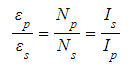
- Where:
- Ip?= current in the primary coil (A)
- Is?= output current from the secondary coil (A)
Worked Example
A step-down transformer turns a primary voltage of 0.5 kV into a secondary voltage of 100 V. Calculate the number of turns needed in the secondary coil if the primary coil contains 3000 turns of wire.
Step 1: List the known quantities
-
- Primary voltage,?εp?= 0.5 kV = 0.5 × 10³?V
- Secondary voltage,?εs?= 100?V
- Number of turns in the primary coil,?Np?= 3000 turns
Step 2: Write down the transformer equation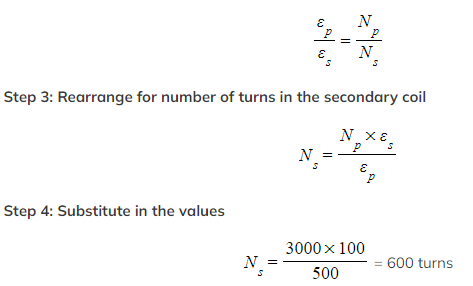
轉載自savemyexams
以上就是關于【IB DP Physics: HL復習筆記11.2.4 Transformer Calculations】的解答,如需了解學校/賽事/課程動態,可至翰林教育官網獲取更多信息。
往期文章閱讀推薦:
MIT官方發布【2026年夏季推薦閱讀書單】!橫跨科學/人文/經濟...


翰林AMC8視頻課重磅上線!

國際競賽真題資源免費領取






