IB DP Physics: HL復習筆記9.5.3 The Doppler Equation

The Doppler Equation
Calculating Doppler Shift
- When a source of sound waves moves relative to a stationary observer, the observed frequency can be calculated using the equation below:
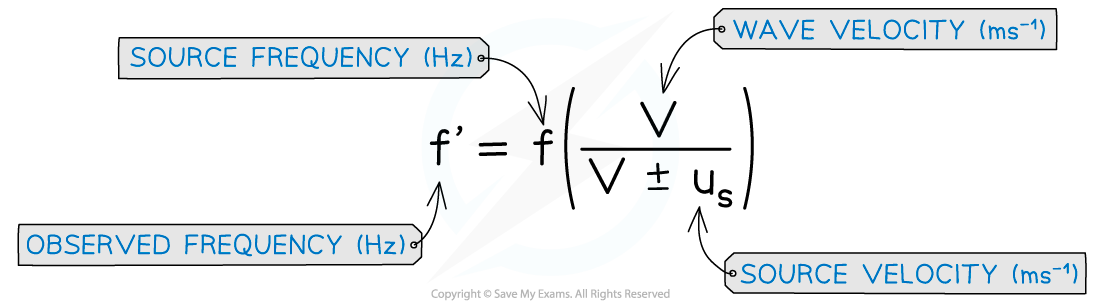
Doppler shift equation?for a moving source
- The wave velocity for sound waves is 340 ms-1
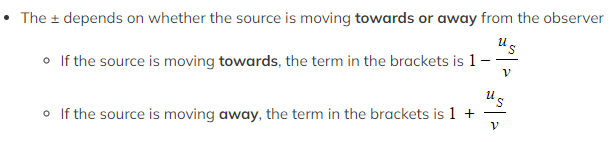
- The ± depends on whether the source is moving towards or away from the observer
- If the source is moving?towards?the observer, the denominator is v - us
- If the source is moving?away?from the observer, the denominator is v + us
- When a source of sound waves remains stationary, but the observer is moving relative to the source, the observed frequency can be calculated using the equation below:
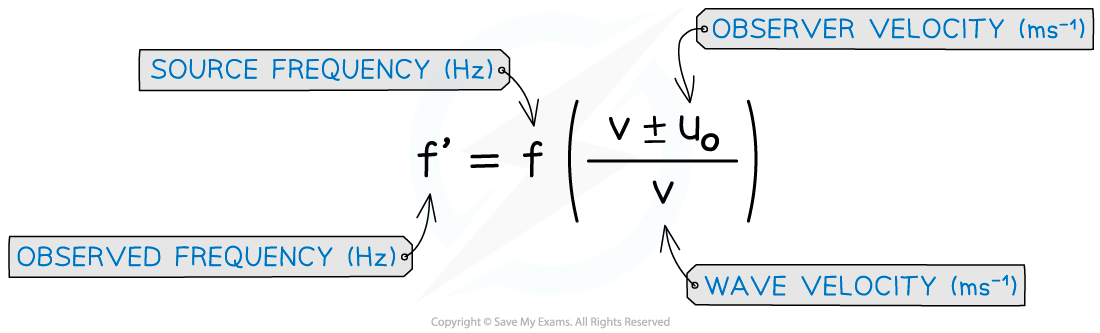
Doppler shift equation for a moving observer
- The ± depends on whether the source is moving towards or away from the observer
- If the observer is moving?towards?the source, the numerator is?v?+?uo
- If the observer is moving?away?from the source,?the numerator is?v???uo
- These equations can also be written in terms of wavelength
- For example, the equation for a moving source is shown below:
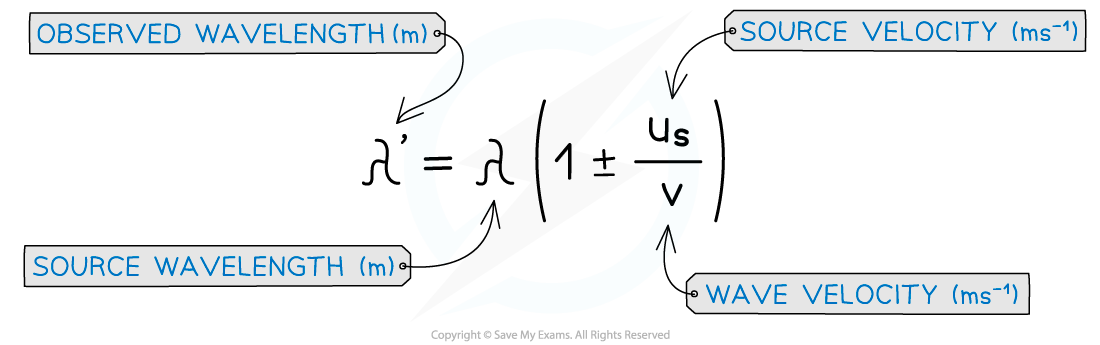
Doppler shift equation for a moving source in terms of wavelength
 Worked Example
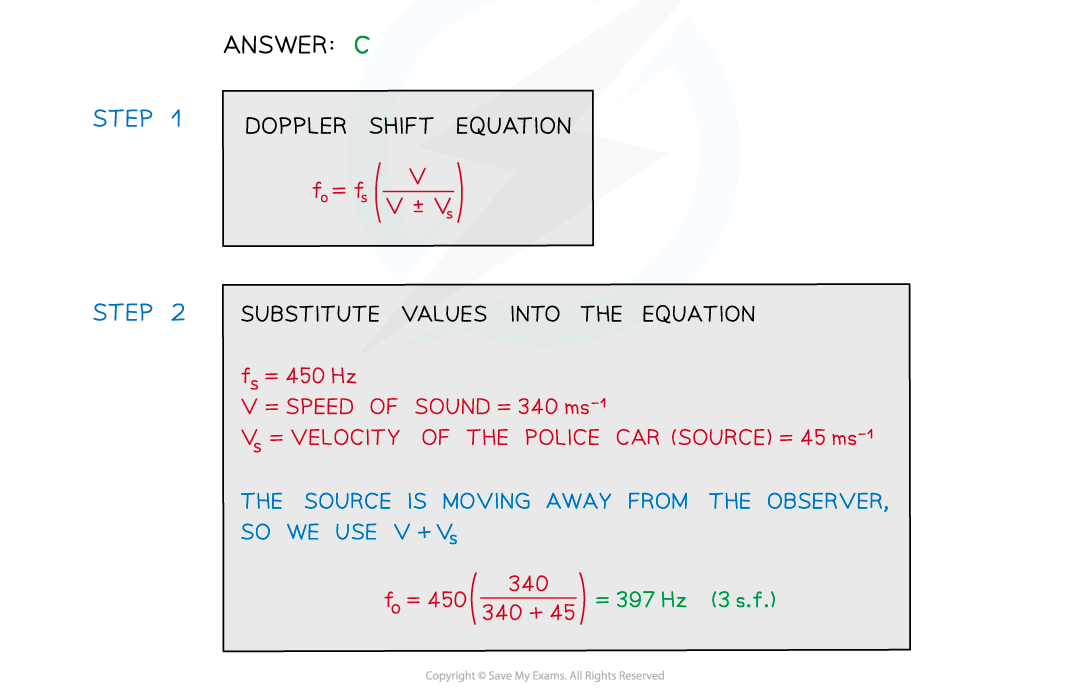
A police car siren emits a sound wave with a frequency of 450 Hz. The car is traveling away from an observer at speed of 45 m s-1. The speed of sound is 340 m s-1. Which of the following is the frequency the observer hears?
???A.?519 Hz? ? ? ? ? ? ? ?B.?483 Hz? ? ? ? ? ? ? ?C.?397 Hz? ? ? ? ? ? ? ?D.?358 Hz
Worked Example
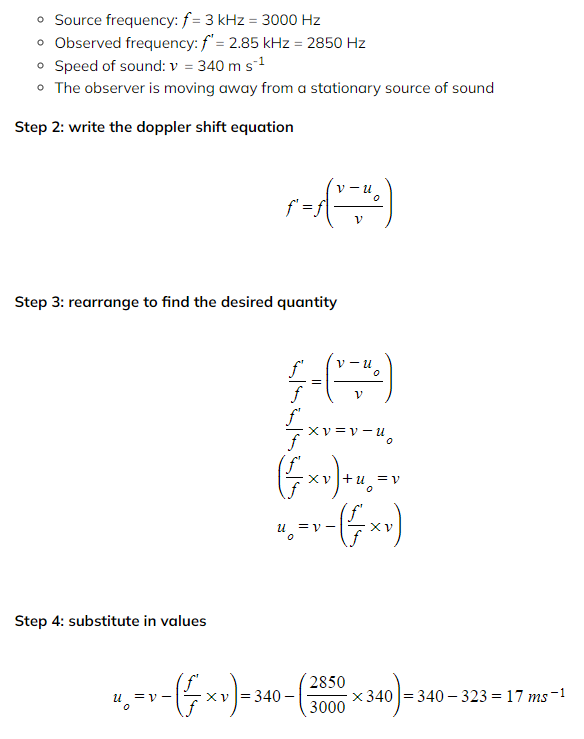
A?bank robbery has occurred and the alarm is sounding at a frequency of 3 kHz. The thief jumps into a car which accelerates and reaches a constant speed. As he drives away at a constant speed, the frequency decreases to 2.85 kHz.?The speed of sound is 340 m s-1. Determine at what speed must he be driving away from the bank.
Step 1: List the known quantities
 Step 5: State final answer
-
- The bank robber must be driving away at a constant speed of?17 ms-1?based on the change in frequency heard
Calculating Doppler Shift of Light
- Doppler shift can be calculated with relation to a light emitting source
- For example, a galaxy moving towards or away from Earth
- Doppler shift for light is?complicated, however if the?speed?of the observer or source is?small (non-relativistic)?compared to the speed of light, then this equation becomes?simpler
- The Doppler shift for a light-emitting non-relativistic source is described using the equation:

Doppler shift equation relating wavelength change for a moving source
- Where:
- Δf = change in frequency in Hertz (Hz)
- f0?= reference frequency in Hertz (Hz)
- λ = observed wavelength of the source in metres (m)
- λ0?= reference wavelength in metres (m)
- Δλ = change in wavelength in metres (m)
- v?= velocity of a galaxy in metres per seconds (m/s)
- c?= the speed of light in?metres per second (m/s)
- This means that the change in wavelength,?Δλ:
Δλ = λ – λ0
- This equation can be used to calculate the velocity of a galaxy if its wavelength can be measured and compared to a reference wavelength
- Since the fractions have the same units on the numerator (top number) and denominator (bottom number), the Doppler shift has?no units
Worked Example
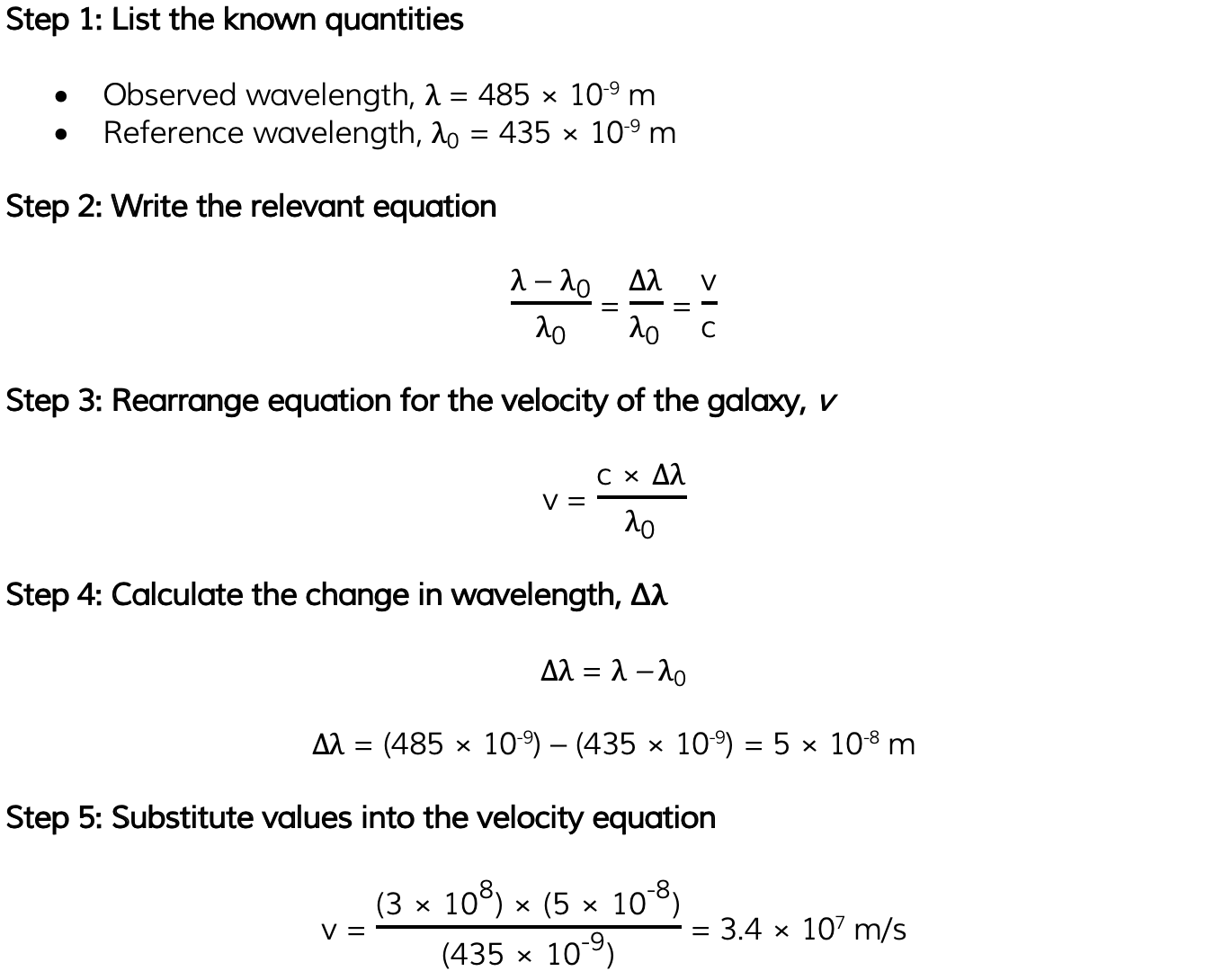
Light emitted from a star has a wavelength of 435 × 10-9?m. A distance galaxy emits the same light but has a wavelength of 485 × 10-9?m. Calculate the speed at which the galaxy is moving relative to Earth. The speed of light = 3 × 10⁸?m/s.
轉載自savemyexams
以上就是關于【IB DP Physics: HL復習筆記9.5.3 The Doppler Equation】的解答,如需了解學校/賽事/課程動態,可至翰林教育官網獲取更多信息。
往期文章閱讀推薦:
MIT官方發布【2026年夏季推薦閱讀書單】!橫跨科學/人文/經濟...


翰林AMC8視頻課重磅上線!

國際競賽真題資源免費領取






